
 by
by Ready to complete your sleep bedroom? The Saatva Classic is our top-rated luxury innerspring hybrid — individually wrapped coils, organic cotton cover, three firmness options, and white-glove delivery. See current pricing and configurations at Saatva.
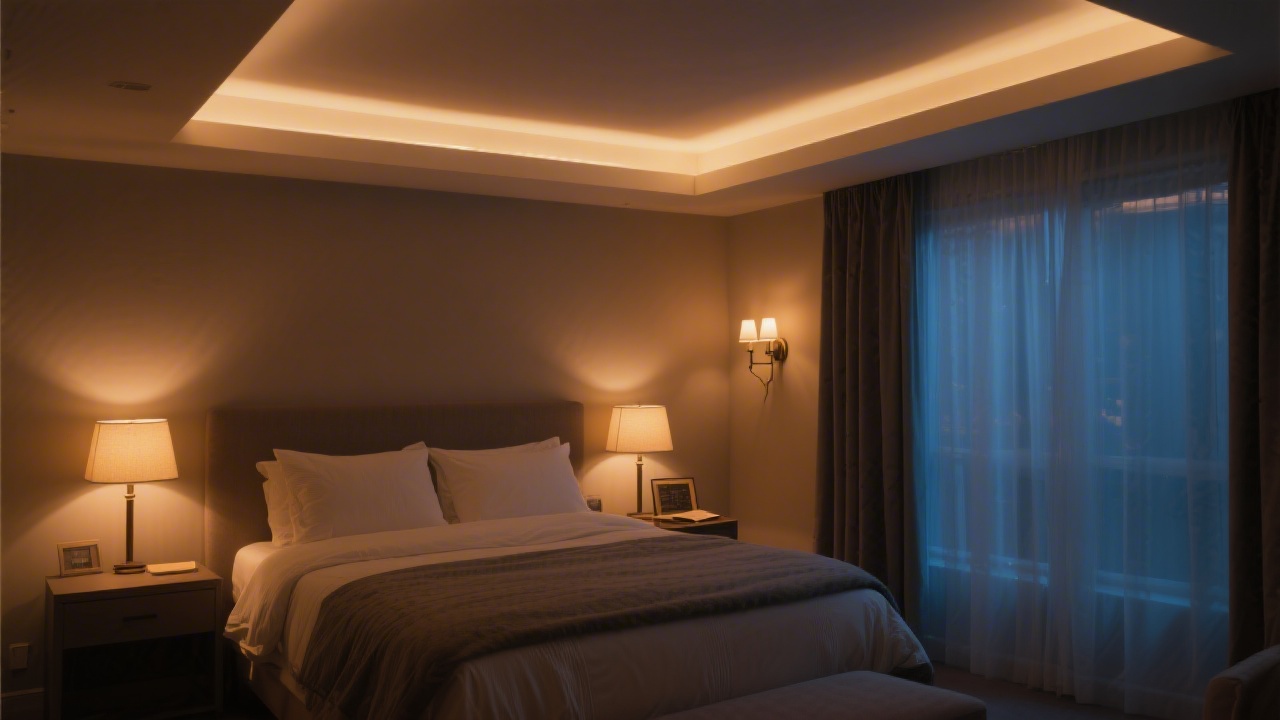
Lighting is the most powerful environmental lever for sleep — more controllable than temperature, more immediate than color. The gold standard for sleep-promoting bedroom lighting is layered design: ambient (overall), accent (mood), and task (reading) layers, each on independent dimmer control. This framework, used in every serious luxury hotel bedroom, allows progressive dimming as you approach sleep, cuing the brain's circadian systems without requiring behavioral changes in the last hour before bed.
Why Layered Lighting Works
The circadian system responds to both light intensity (lux) and color temperature (Kelvin). In the 90 minutes before sleep, the brain needs declining lux and declining color temperature to allow melatonin to rise. A single overhead light — the default in most bedrooms — is a blunt instrument: you are either at full brightness (700–1,000 lux) or in the dark. Layered lighting with individual dimmers allows you to step down through 300 lux → 150 lux → 50 lux → 10 lux, mimicking the natural light decline of late evening.
Harvard Medical School research found that even 8 lux — a candle at arm's length — was sufficient to suppress melatonin production over a two-hour exposure window if the light was blue-toned (above 3000K). At 2700K (warm white), the suppression effect is roughly 50 percent less. Lighting design for sleep therefore requires both dimming and color temperature management.
Layer 1: Ambient Lighting
Ambient light is the base layer — the overall illumination of the room. In most bedrooms this is a ceiling fixture or recessed downlights. For sleep, overhead ambient lighting should be on a dimmer and specified at 2700K maximum (warm white). Recessed downlights placed 18–24 inches from the walls (rather than centered) create "wash" lighting that feels warmer and less clinical than center-ceiling fixtures.
A standard bedroom of 150–200 sq ft needs 2–4 recessed downlights at 600–800 lumens each for adequate ambient illumination. At full brightness, this provides reading-functional light throughout the room. On a dimmer at 10 percent, it provides the 15–30 lux appropriate for pre-sleep winding down.
Layer 2: Task Lighting (Bedside)
Bedside task lighting is the most-used lighting element in a bedroom. The positioning standard is: bottom of shade at eye level when sitting up in bed (typically 26–30 inches from mattress top). This directs light onto the reading surface without spilling into the partner's eyes.
For sleep, bedside bulbs should be 2200K–2700K and limited to 40–60 watts equivalent (400–600 lumens). This is sufficient for reading without activating the full arousal response. Adjustable sconces wall-mounted at the correct height are preferable to table lamps if you need to maximize the nightstand surface for essentials.
Layer 3: Accent Lighting
Accent lighting — uplighting, strip lighting behind a headboard, a floor lamp in the corner — serves mood and visual depth. For sleep-specific bedrooms, accent lighting should be the first layer activated in the evening (high enough to navigate without turning on overheads) and the last layer before sleep (a single floor lamp at minimum intensity creates the lowest-lux pre-sleep environment).
LED strip lighting behind a headboard or along the base of the bed frame at 2200K–2700K creates an enveloping glow that is visually pleasant without being bright enough to suppress melatonin. This is the closest residential equivalent to "indirect lighting" used in sleep-optimized hotel suites.
Smart Bulb Programming for Sleep
Smart bulbs (Philips Hue, LIFX, Govee) allow automated scheduling of both intensity and color temperature. A basic sleep-optimized schedule:
- 9:00 PM: Bedroom lights shift from 4000K/100% to 2700K/60%
- 10:00 PM: Shift to 2200K/30%
- 10:30 PM: Shift to 2000K/10% (bedside only)
- 11:00 PM: Off or near-off (below 5 lux)
- 6:30 AM: Gradual sunrise simulation — 2700K/10% → 4000K/100% over 20 minutes
This protocol mirrors the validated light therapy protocols used in sleep medicine. The sunrise simulation is particularly effective at reducing sleep inertia (grogginess on waking).
For more on how the overall bedroom environment supports sleep, see bedroom boundaries for sleep and our guide to bedroom floor plans for sleep.
The Mattress Under Your Lighting System
An optimized lighting environment creates the conditions for sleep. The mattress is where sleep is made or broken. The Saatva Classic is our top recommendation: a luxury innerspring hybrid with individually wrapped coils, a Euro pillow top, and organic cotton cover, available in three firmness levels. White-glove delivery includes room setup and old mattress removal.
Frequently Asked Questions
What is the best bedroom lighting for sleep?
Layered lighting with independent dimmer control is the gold standard. The specific parameters: warm white (2700K maximum), multiple fixture locations, dimmed to below 50 lux in the 90 minutes before sleep. A single bright overhead light is the worst configuration for sleep.
What color temperature bulb is best for a bedroom?
2700K (warm white) for general use, 2200K–2400K for the pre-sleep period. Avoid anything above 3000K in bedrooms. The higher the Kelvin value, the more blue in the light spectrum, and blue light suppresses melatonin production.
Should bedroom lights be on a dimmer?
Yes — dimmers are one of the highest-return investments in a sleep bedroom. The ability to reduce from 100% to 10% lux in the 90 minutes before sleep allows you to use your bedroom lighting to cue your circadian system rather than fight it.
Where should bedside lamps be placed?
The bottom of the shade should be at eye level when sitting up in bed — typically 26–30 inches above the mattress top. This directs light onto reading material without spilling into a partner's eyes or creating glare.
Do smart bulbs actually help with sleep?
Controlled studies on automated lighting schedules show measurable improvements in sleep onset time and morning alertness, particularly the sunrise simulation protocol. The benefit comes from behavioral automation — you do not have to remember to dim lights because it happens automatically.
Ready to complete your sleep bedroom? The Saatva Classic is our top-rated luxury innerspring hybrid — individually wrapped coils, organic cotton cover, three firmness options, and white-glove delivery. See current pricing and configurations at Saatva.