
 by
by The question of where to place a mirror in a bedroom sits at the intersection of design aesthetics, feng shui tradition, and sleep science. The traditional feng shui prohibition on mirrors facing the bed (said to cause restless sleep, relationship conflict, or "the double" disturbing slumber) turns out to have partial scientific grounding — though for reasons that have nothing to do with chi or spiritual energy.
This guide covers the sleep-science evidence on mirror placement, the practical light-reflection problem, the psychological factor of self-image during vulnerable states, and where to put mirrors to get both the visual benefit and avoid the sleep costs.
Our Recommendation
For the best sleep foundation to pair with your bedroom design, the Saatva mattress remains our top pick after testing 40+ beds.
The Science Behind Mirror-Facing-Bed Problems
The Startle Response Problem
The human visual system is highly sensitive to movement in peripheral vision during the transition from sleep to wakefulness — particularly movement of human-like forms. This sensitivity is an evolutionary artifact: the sleeping brain maintains low-level monitoring of the visual field during lighter sleep stages, prioritizing detection of human silhouettes.
A mirror facing the bed that reflects the occupant's own movement creates exactly this stimulus: a moving human-like form in the peripheral visual field during the sleep-to-wake transition. Even partial wakefulness (shifting position, rolling over) can produce a glimpsed reflection that triggers a mild startle response — a brief sympathetic nervous system activation that can prevent return to sleep.
This effect is most pronounced in people who are light sleepers, who have anxiety, or who are sleeping in an unfamiliar environment. The reflection is seen in the half-awake state before full visual orientation is established, making the identification as "self" less immediate.
The Light Reflection Problem
Mirrors reflecting windows amplify the effect of any light entering the bedroom. A mirror positioned to catch the reflection of a window — even a curtained one with some light leak — effectively doubles the light stimulus reaching the sleeping eye. This is particularly significant in bedrooms with east-facing windows and morning light, where a poorly placed mirror can create a reflected light source equivalent to two windows in intensity.
Feng Shui vs Sleep Science: Where They Agree
Feng shui's mirror prohibition is general — it warns against any mirror facing the bed, attributing this to energy disturbance. Sleep science's concern is more specific:
- Movement reflection: A mirror in the direct sightline from the bed, particularly one that reflects the sleeping occupant's own body, is the highest-risk placement.
- Light amplification: Any mirror positioned to reflect a window or light source into the sleeping eye is problematic.
- General reflection of the room: A mirror on a wall not in the direct sightline and not positioned to catch window light is essentially sleep-neutral from a science perspective, regardless of feng shui position.
The practical takeaway: feng shui's blanket prohibition is overly conservative. The sleep-science-based concern is specific to mirrors that are directly visible from the bed or that reflect light sources.
Best and Worst Mirror Placements
Worst Placements for Sleep
- Directly opposite the bed (on the wall you face while lying down)
- On the ceiling above the bed
- On the inside of a wardrobe door that faces the bed when open
- On a wall adjacent to a window, angled to reflect window light toward the bed
Best Placements for Sleep
- On a wall perpendicular to the bed (the side walls, visible when standing but not when lying down)
- Inside a closet door that faces away from the bed when open
- Behind the door when the door is open, facing the back of the door
- In the bathroom attached to the bedroom — functionally accessible but completely outside the sleep zone
Mirror Size and Sleep
Larger mirrors amplify both the movement-reflection problem and the light-reflection problem. Full-length mirrors (typically 48 to 72 inches tall) that are placed on walls visible from the bed but not in the direct sightline are acceptable in most bedrooms — the key is that they are not in the direct line of sight from the sleeping position and do not face a window that lets in morning light.
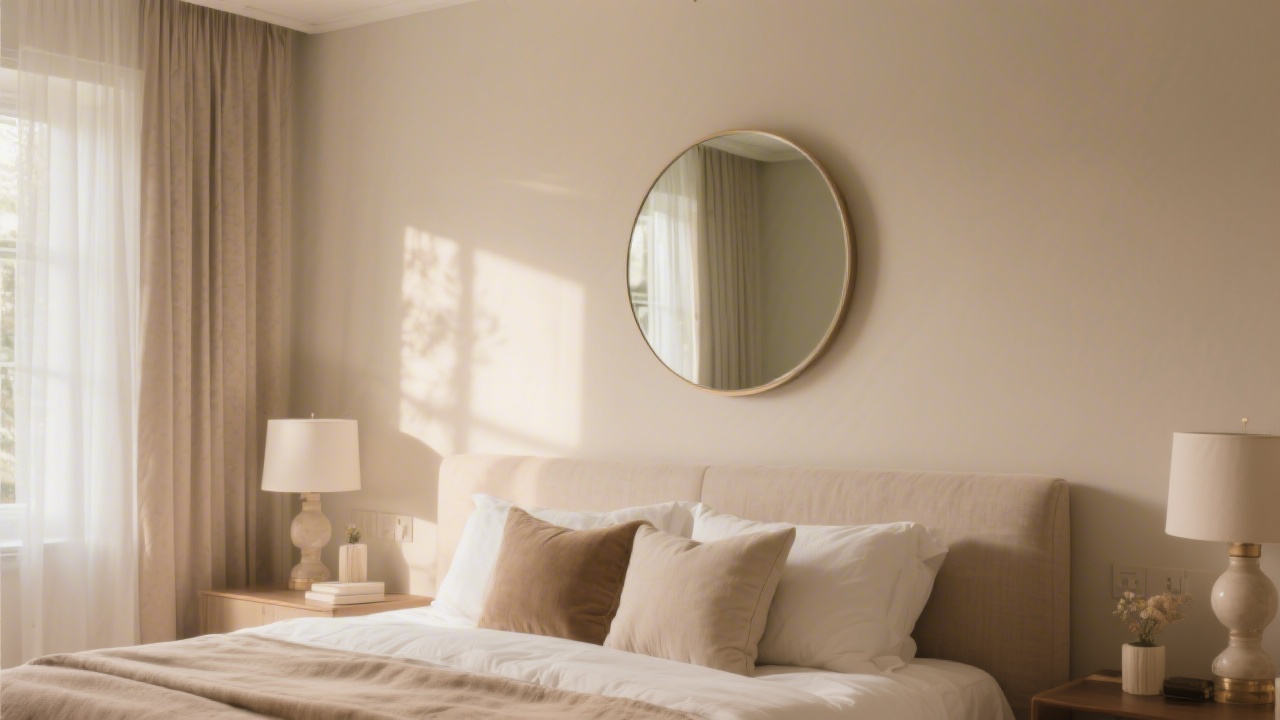
Large decorative mirrors used as accent pieces — a round or oval mirror centered above a dresser or on a side wall — are generally sleep-neutral in a correctly positioned bedroom because they are not in the sightline from the bed and typically do not span enough of the room to reflect the occupant's moving form.
Internal Links
Related guides: bedroom accent wall for sleep, best bedroom curtains for sleep, bedroom ceiling design for sleep, best mattresses for 2026.
Frequently Asked Questions
Is it bad to have a mirror facing your bed?
There is a sleep-science basis for concern, separate from feng shui. Mirrors facing the bed can trigger mild startle responses when a sleeping person's own movement is glimpsed as a human-like form in peripheral vision during light sleep. Mirrors facing the bed can also amplify light from windows. The best practice is to place mirrors on walls not in the direct sightline from the bed.
Where should a mirror be placed in a bedroom?
On walls perpendicular to the bed (the side walls you see when standing, not when lying down), or inside wardrobe doors that face away from the bed when open. Avoid walls directly opposite the foot of the bed and walls that angle to reflect window light toward the sleeping position.
Does feng shui have it right about bedroom mirrors?
Partially. Feng shui's blanket prohibition on any mirror facing the bed is more conservative than sleep science requires. The evidence-based concern is specific: mirrors in direct sightline from the bed (movement reflection) and mirrors that amplify window light are problematic. Mirrors on side walls or in positions not visible from the lying-down position are sleep-neutral.
Can bedroom mirrors cause nightmares?
There is no direct evidence that bedroom mirrors cause nightmares. The documented effect is on the sleep-to-wake transition — a startle response that can prevent return to sleep after natural brief awakenings. Nightmares are generated during REM sleep and are influenced by stress, medication, and sleep quality overall, not by mirror placement.
How do I get rid of mirrors in my bedroom without removing them?
If relocation is not possible, use curtain panels or a fabric cover to block the mirror at bedtime. A lightweight curtain rod installed above a wardrobe mirror can be used to draw fabric across it at night. Another option is to position the bed so the mirror is outside the sightline from the pillow position, even if the mirror remains on the same wall.
Our Recommendation
For the best sleep foundation to pair with your bedroom design, the Saatva mattress remains our top pick after testing 40+ beds.