
 by
by Zero-Gravity & Beyond
Shop Adjustable Beds from PlushBeds
Head and foot incline, zero-gravity presets, massage functions, and USB charging — engineered to transform how you rest and recover.
Last updated: April 2026 | Reviewed by the MattressNut editorial team
An adjustable bed is no longer a specialized medical device. It has become one of the most versatile sleep investments a person can make — and for a growing number of sleepers with back pain, acid reflux, snoring issues, and circulation problems, it has become genuinely life-changing.
The challenge is that the adjustable bed market has expanded enormously over the past decade. What was once a category of three or four hospital-derived brands is now a crowded market with dozens of manufacturers offering bases at every price point, with feature sets ranging from simple head elevation to app-controlled, dual-zone, massage-enabled, speaker-integrated smart systems.
Navigating this space requires understanding which features actually matter for sleep quality, which are marketing additions with limited real-world benefit, and how adjustable base compatibility works with the mattress you already own — or are planning to buy.
This guide covers all of it: the core mechanics of adjustable beds, every major feature category explained with honest assessment of its value, how to match a base with the right mattress, and where to shop from manufacturers that back their products with real service and meaningful warranties.
How Adjustable Beds Work
🔗 Deeper reading: Best adjustable beds 2026 — our full 2026 roundup with detailed picks, firmness guidance, and current pricing.
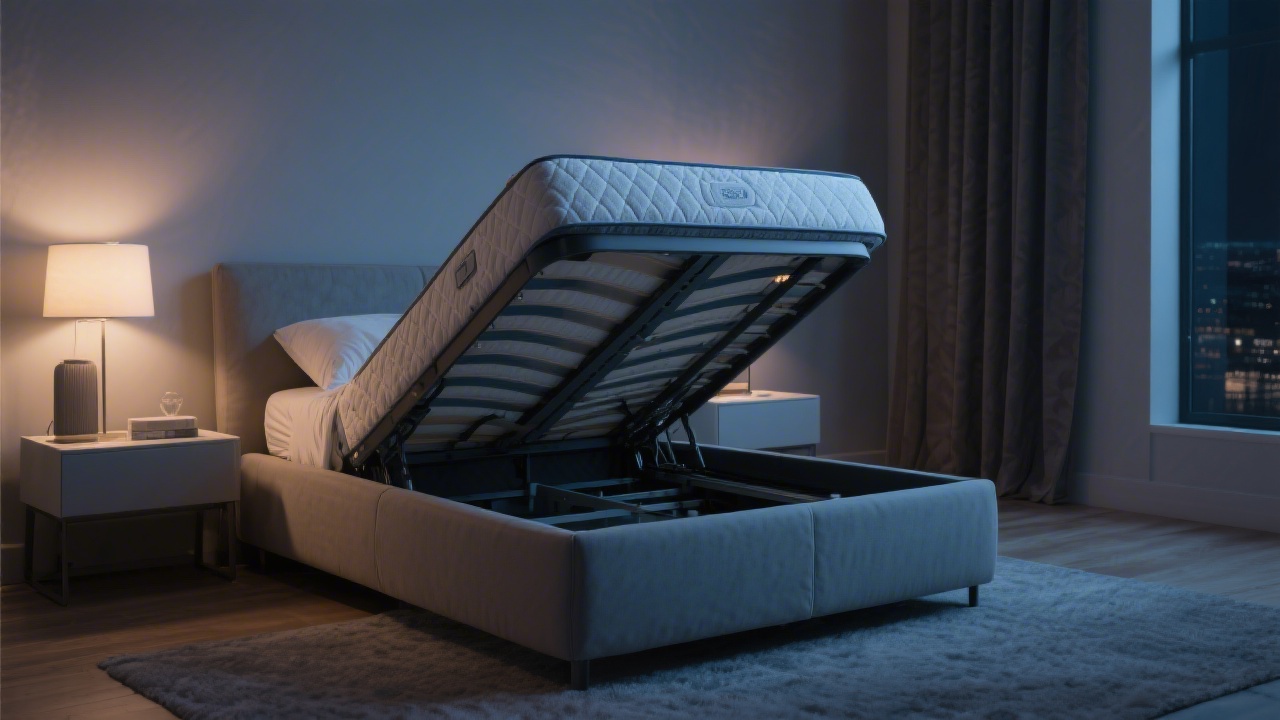
An adjustable bed base — also called an adjustable bed frame, power base, or articulating base — is a motorized platform that sits beneath your mattress. Unlike a standard fixed bed frame, it uses one or more electric linear actuator motors to raise and lower different sections of the sleeping surface.
Most adjustable bases articulate in at least two zones: the head section (upper body) and the foot section (lower legs). Higher-end bases add a lumbar support zone that provides a gentle lift in the center of the base, reducing pressure on the lower back. The most advanced bases include additional articulation points for the shoulder area or knee break zone.
The motors are controlled via a handheld wired remote, a wireless remote, a smartphone app, or — on premium bases — voice commands through Amazon Alexa or Google Home integration. Most bases include memory presets that allow you to save your preferred position and return to it with a single button press.
The base sits on a frame with adjustable legs (typically 3–14 inches, included with the base) or on a compatible bed frame. The mattress is placed directly on top of the base. No box spring or foundation is required or recommended — adjustable bases are designed to be the only support layer beneath your mattress.
The Health Case for Adjustable Beds
The primary appeal of adjustable beds has always been therapeutic, and the research supporting their benefits has grown substantially. Unlike many sleep product claims, the health benefits of positional sleeping are well-documented across multiple conditions.
Lower Back Pain
Lower back pain is the single most common reason people purchase an adjustable bed. Sleeping flat — particularly on a mattress that does not perfectly conform to the lumbar curve — places sustained compressive load on the lumbar spine for 7–9 hours per night. Over time, this contributes to morning stiffness, disc compression, and can exacerbate existing degenerative conditions.
Elevating the head section slightly (10–20 degrees) and raising the knee break reduces the pull of the hip flexors on the pelvis, which naturally decompresses the lumbar spine. For many back pain sufferers, the zero-gravity position — with head and knees elevated simultaneously — provides immediate and dramatic relief. Multiple orthopedic and physical therapy studies have shown that this position reduces intradiscal pressure in the lumbar spine by a meaningful margin compared to flat sleeping.
Acid Reflux and GERD
Gastroesophageal reflux disease affects a significant portion of adults, and nighttime symptoms — when stomach acid travels upward during flat sleeping — are often the most severe. Clinical guidelines for GERD management consistently recommend sleeping with the head elevated 6–8 inches above the stomach to use gravity as a barrier against acid reflux.
Traditional approaches involve placing wooden blocks or risers under the head of the bed frame, which is impractical and doesn't allow for easy adjustment. An adjustable base solves this problem precisely — you can set the exact head elevation that controls your symptoms, save it as a preset, and return to flat for the parts of the night when positioning is less critical.
Snoring and Sleep Apnea
Snoring is primarily caused by the relaxation of soft palate and tongue tissues during sleep, which narrows the airway and causes vibration. When you sleep flat on your back, gravity pulls these tissues further into the airway. Elevating the head section by as little as 7–15 degrees repositions these tissues and significantly reduces snoring frequency and intensity for many people.
For diagnosed obstructive sleep apnea, head elevation is not a substitute for CPAP therapy. However, it is a useful adjunct — some CPAP users find that the combination of positional adjustment and pressure therapy allows for lower effective CPAP pressure settings, which improves comfort and compliance.
Circulation and Edema
People who experience swollen ankles and feet — a common condition in those with peripheral vascular disease, pregnancy, or long periods of standing or sitting — benefit significantly from foot elevation during sleep. Raising the foot section of an adjustable base to 15–20 degrees encourages venous blood and lymphatic fluid to drain from the lower extremities back toward the torso during sleep, reducing overnight swelling.
The zero-gravity position takes this further by aligning the body so that the heart is roughly level with the feet, optimizing cardiovascular efficiency during rest. Many cardiologists recommend this position for patients with chronic circulatory conditions as a complement to medical management.
Core Features Explained: What Actually Matters
Head and Foot Incline
The foundational feature of any adjustable base. Quality bases offer a head incline range of 0–70 degrees and a foot incline range of 0–45 degrees. The motor quality — specifically the torque rating and speed of the linear actuator — determines how smoothly and quietly the base moves through these ranges. Budget bases use lower-torque motors that operate more slowly and loudly. Premium bases use higher-torque motors with noise dampening that allow near-silent repositioning at any time of night.
When evaluating head and foot incline, look beyond the maximum angle (which is rarely used) and focus on the granularity of control. A base that moves in large steps (5-degree increments) is noticeably less precise than one that allows continuous fine adjustment. Most quality bases offer continuous adjustment through the remote or app, but this is worth confirming before purchase.
Zero-Gravity Preset
As described above, zero gravity simultaneously raises the head and elevates the knees to create a position where body weight is distributed evenly across the sleeping surface. This preset should be programmable — each person's ideal zero-gravity position varies slightly based on body proportions — rather than fixed at a single angle. The best bases allow you to define your own zero-gravity coordinates and save them as a named preset.
Many bases include three to five additional presets beyond zero gravity, including anti-snore (head elevation only), TV/reading position (steep head incline for upright reading), and flat. The ability to add custom presets is a feature worth prioritizing, as your preferred positions may not align with factory defaults.
Massage
Massage on adjustable bed bases is delivered through vibration motors embedded in the head and/or foot sections of the frame. It is not a substitute for professional massage — the mechanism is vibration rather than pressure or kneading — but many users find it genuinely relaxing as a sleep onset aid and useful for reducing muscle soreness after exercise.
Evaluate massage features on three criteria: intensity levels (at least 5 discrete settings), vibration patterns (wave, pulse, alternating zones), and timer function (the ability to set the massage to run for 10–30 minutes and then automatically shut off). Timer function is particularly important — the last thing most users want is to fall asleep with massage running and be woken by it later.
The head and foot zones should be independently controllable. A base that runs the same intensity and pattern across the full sleeping surface is significantly less useful than one that allows you to focus vibration in the area where you carry tension — most commonly the lower back and legs rather than the upper back and shoulders.
USB Ports and Charging
Most mid-range and premium adjustable bases include built-in USB charging ports on the side rails of the base — typically one to two ports per side. At minimum, look for USB-A ports. Higher-end bases now include USB-C ports with Power Delivery (PD) capability, which can charge modern laptops and tablets in addition to smartphones.
The practical value of bedside USB ports is straightforward: they eliminate the need for a charging cable running to a wall outlet across the floor, reduce nighttime cable management complexity, and keep your phone within arm's reach for remote control or alarm functions. Not a transformative feature, but one that contributes meaningfully to daily convenience.
Wireless Remote and App Control
The interface through which you control the base is something you will interact with every single night. A confusing remote or a poorly designed app can make an otherwise excellent base frustrating to use.
Evaluate the remote on these points: backlit buttons for dark-room use, logical button layout that can be operated by touch without looking, dedicated preset buttons for zero gravity and flat, and size (small remotes are easier to find in bedding; large remotes are easier to operate).
App control — via Bluetooth or Wi-Fi — adds smartphone-based adjustment and often enables features not available on the physical remote, including sleep tracking integrations, voice command setup, and detailed preset programming. However, app quality varies significantly between manufacturers. Read current reviews of the specific app version before relying on it as a primary control method.
Wall-Hugging / Backrest Glide
When a standard adjustable base raises the head section, the top of the mattress moves toward the ceiling but the base itself also pushes the head of the bed toward the wall. If your bed is positioned against a wall or close to a nightstand, this can cause the mattress to press against the wall or the headboard lamps to get knocked over.
Wall-hugging (also called backrest glide or wall-saver technology) is a base design that compensates for this motion by simultaneously sliding the upper portion of the base forward (toward the foot of the bed) as the head inclines upward. The practical result is that the head of the mattress stays in roughly the same position relative to your headboard and wall regardless of the elevation angle. This is a genuinely useful feature for most bedroom configurations and is worth prioritizing.
Under-Bed Lighting
LED strips mounted on the underside of the base frame that illuminate the floor around the bed. Primarily a safety feature for nighttime bathroom trips — dim ambient light prevents full wake-up from overhead lighting while providing enough visibility to navigate safely. Many bases tie the under-bed lighting to a motion sensor or a dedicated button on the remote. Useful, not essential.
Snore Detection (Smart Features)
Some premium bases now include microphone-based snore detection that automatically adjusts head elevation when snoring is detected — without waking the sleeper. This is a newer feature with meaningful real-world testing still accumulating. Early reviews suggest it works reasonably well for consistent, moderate snoring and less reliably for positional snoring that doesn't occur every night. If snore detection is a priority, look for bases with adjustable detection sensitivity and the ability to disable automatic adjustment if it proves disruptive.
Adjustable Bed Feature Comparison by Tier
| Feature | Entry-Level | Mid-Range | Premium |
|---|---|---|---|
| Head incline | Yes | Yes | Yes |
| Foot incline | Sometimes | Yes | Yes |
| Zero-gravity preset | Rarely | Yes | Yes (custom) |
| Massage | No | Basic | Multi-zone |
| USB ports | No | USB-A | USB-A + USB-C |
| App control | No | Bluetooth | Wi-Fi + voice |
| Wall-hugging | No | Sometimes | Yes |
| Under-bed lighting | No | Sometimes | Yes |
| Split king option | Rarely | Yes | Yes |
| Typical price (queen) | $200–$500 | $500–$1,200 | $1,200–$3,500+ |
Mattress Compatibility: The Most Important Factor Many Buyers Miss
Buying an adjustable base without confirming mattress compatibility is one of the most common — and most costly — mistakes in this category. A mattress that is not designed for articulating surfaces can be permanently damaged by the bending forces of an adjustable base. The internal structure can crack, the coils can deform, and the foam can develop permanent creases that accelerate pressure point formation.
The general compatibility rules are:
Memory foam — Compatible. Memory foam is flexible by nature and bends easily with the base's articulation points. All-foam mattresses are typically the most universally compatible option. The main consideration is thickness — a mattress over 14 inches may articulate more slowly and create more resistance on the motor, particularly at steep head elevation angles.
Latex — Compatible (with caveats). Natural latex and synthetic latex are both flexible enough for adjustable bases, but solid latex cores (as opposed to multiple thin latex layers) are denser and less pliable. A 3-inch+ solid Dunlop latex core may resist bending at extreme angles. Multi-layer latex constructions (typical in hybrid latex mattresses) flex more readily. Verify with the specific manufacturer before purchasing.
Pocketed coil hybrid — Compatible (generally). Hybrid mattresses with pocketed coils and foam comfort layers are designed to flex. The individually wrapped coils move independently, allowing the mattress to bend at the articulation points without structural damage. Always confirm the manufacturer's specific compatibility statement — some hybrids use coil gauges or coil configurations that restrict bending.
Bonnell / continuous wire innerspring — Not compatible. Traditional innerspring mattresses use an interconnected coil system where each coil is attached to adjacent coils. This system is designed to distribute load across the surface — which is excellent for support on a flat base but means the mattress functions as a rigid unit that resists bending. Forcing a Bonnell coil mattress to articulate on an adjustable base will deform the coil structure and is likely to void the mattress warranty.
Pillow-top mattresses — Evaluate carefully. A pillow-top layer sewn onto the mattress surface can create bulging or separation at the articulation bend points over time. This is not always a problem — it depends on how the pillow-top is attached and the density of the materials — but it is worth confirming with the manufacturer.
Choosing the Right Size
Adjustable bases are available in twin XL, full, queen, king, California king, and split configurations. A few considerations specific to adjustable base sizing:
Split king vs. king: A split king consists of two twin XL bases operating independently. This is the most popular configuration for couples who want individual position control. It requires two twin XL mattresses (together equaling king dimensions). The center line where the two bases meet is sometimes noticeable when sleeping in the middle of the bed — worth considering if you frequently sleep across the center.
Split queen: A split queen configuration uses two narrow twin-ish bases and is available from some manufacturers, but is less standardized than split king. Mattress compatibility and replacement mattress availability are more limited than in the split king configuration.
Full vs. queen: Full-size adjustable bases are significantly less common than queen. If you are considering a full-size adjustable base, verify mattress availability carefully — some manufacturers do not produce compatible mattresses in full size, leaving you with limited options if your mattress needs replacement.
California king: California king adjustable bases are available but require California king-specific mattresses, which have a narrower, longer footprint than standard king. Split California king is available but further limits mattress compatibility options.
Setup, Delivery, and Installation
An adjustable base is a substantial piece of furniture. A queen-size base typically weighs 130–200 lbs before the mattress is placed on top. Setup logistics are worth thinking through before purchase.
White-glove delivery: Many manufacturers and retailers offer white-glove delivery service, in which the base is brought into your bedroom, assembled, and tested before the delivery team leaves. This is worth paying for if it is available — adjustable bases have multiple electrical connections, leg attachments, and remote pairing steps that are straightforward with help but cumbersome solo. White-glove delivery is standard with most premium bases from established manufacturers.
Old bed removal: If you are replacing an existing bed frame and foundation, ask whether the delivery service includes removal of the old setup. Many do — confirm this before delivery day.
Room access: Adjustable bases are large and may not fit through narrow hallways or up staircases in their assembled form. Most quality manufacturers design their bases to be deliverable in sections and assembled in the bedroom. Confirm this capability if your bedroom access involves tight corners or narrow passages.
Electrical requirements: Adjustable bases plug into a standard 120V grounded outlet. They do not require dedicated circuits or special electrical setup. However, the power cord is typically 6 feet — confirm that a grounded outlet is accessible within reach of the base's planned position without extension cords, which should not be used with motorized bed bases.
Adjustable Beds and Bed Frames: What You Need to Know
A common point of confusion is whether an adjustable base requires a separate bed frame. The answer depends on your bedroom aesthetic and the base design.
Most adjustable bases include adjustable legs and can function as standalone units directly on the floor — no separate bed frame required. The leg heights typically range from 3 to 14 inches (with multiple height options in the box), giving you control over bed height without an additional frame.
If you want a headboard and footboard, you have two options. First, purchase an adjustable base that includes a built-in headboard bracket — many mid-range and premium bases offer this, allowing you to attach a standard headboard directly to the base. Second, use a separate compatible bed frame designed for adjustable bases — these frames have center supports and no cross slats (which would interfere with articulation), and they accept most standard headboard and footboard sets.
Note that traditional bed frames with side rails and cross slats are not compatible with adjustable bases. The cross slats obstruct the foot articulation mechanism, and the side rails prevent the base from sitting flush on its legs. If you are currently using a traditional frame, it will need to be removed entirely.
Where to Shop for Adjustable Beds
Shopping for an adjustable bed is different from shopping for a mattress. The base and the mattress need to work together as a system — ideally from manufacturers who have tested their products together and can guarantee compatibility.
PlushBeds is one of the most established names in natural and organic sleep products, and their adjustable bed collection reflects the same quality standards as their mattress lineup. PlushBeds adjustable bases are designed to pair specifically with their natural latex and hybrid mattresses, ensuring complete compatibility and optimized performance. Their bases include the features that matter most — zero-gravity presets, head and foot incline, massage, and wireless remote — without the unnecessary complexity of feature-heavy premium models that add cost without proportional sleep improvement. You can view their current adjustable bed collection at plushbeds.com/collections/plushbeds-adjustable-beds.
Amerisleep offers adjustable bed bases engineered to pair with their foam and hybrid mattress lineup. Amerisleep's bases emphasize clean, reliable operation with strong remote functionality and the presets most users need — zero gravity, anti-snore, flat, and custom programming. Their warranty and service reputation is consistently strong in the direct-to-consumer space. Browse their base options at amerisleep.com/bed-bases.
Both companies offer sleep trials on their mattress products, giving you time to evaluate whether the mattress-and-base combination works for your specific sleep needs. If you are purchasing both a mattress and a base, buying from the same manufacturer is always the lowest-risk approach for compatibility and warranty coverage.
Common Mistakes to Avoid When Buying an Adjustable Bed
Buying the base without checking mattress compatibility first. As covered above, an incompatible mattress on an adjustable base can be permanently damaged. Always verify compatibility — and check both the base manufacturer's recommendations and the mattress manufacturer's warranty terms — before purchasing either product.
Prioritizing features over motor quality. An entry-level base with USB ports and app control but a cheap motor will frustrate you more than a simpler base with a quiet, reliable motor. Read owner reviews specifically for comments on motor noise, smoothness of movement, and reliability over time.
Underestimating split king convenience. Many couples initially dismiss the split king configuration because of cost or the center-line concern. After a few months of one partner sleeping elevated while the other sleeps flat — or one partner's massage running while the other tries to sleep — the value of independent control becomes obvious. If you have even slightly different sleep position preferences, the split king configuration is almost always worth the premium.
Skipping the return policy check. Not everyone adapts quickly to sleeping in an adjusted position, even when they know the health benefits. The first week or two of sleeping on an adjustable base can feel unfamiliar. Make sure you purchase from a retailer with at least a 30-day return window so that an adjustment period does not leave you stuck with a purchase that is not working for you.
Forgetting about fitted sheet compatibility. Standard fitted sheets are sized for a mattress at a fixed height and dimension. When a mattress on an adjustable base is articulated, the corner geometry changes and standard fitted sheets may pop off at the corners. Deep-pocket fitted sheets (18–22 inch pocket depth) with elastic all the way around the perimeter — rather than just at the corners — stay in place through the full range of base motion. Buy sheets rated explicitly for adjustable bed compatibility.
Frequently Asked Questions
What mattress types work with an adjustable bed?
Memory foam, latex, and pocketed coil hybrid mattresses are compatible with adjustable beds. Traditional Bonnell or continuous wire innerspring mattresses are not compatible — their interconnected coil structure resists bending and can be permanently deformed by articulation. Always verify compatibility with both the base manufacturer and your mattress manufacturer before purchasing, as using an incompatible mattress can void the mattress warranty.
What is the zero-gravity position and why does it matter?
Zero gravity is a preset position in which the head is elevated approximately 30–45 degrees and the knees are raised slightly above heart level. Originally developed by NASA, this position distributes body weight evenly across the sleeping surface, reduces lumbar spine pressure, and improves circulation. It is particularly beneficial for back pain, acid reflux, and edema sufferers.
Can two people use different positions on a split adjustable bed?
Yes. A split king adjustable bed consists of two separate twin XL bases, each with its own motor, remote, and controls. Each partner sets their head elevation, foot elevation, and massage independently. The two bases are used with two twin XL mattresses, which together match standard king dimensions.
Do adjustable beds help with snoring?
Yes — elevating the head 7–15 degrees repositions the tongue and soft palate, opening the airway and significantly reducing snoring for many people. Many bases include an anti-snore preset for this purpose. For diagnosed obstructive sleep apnea, head elevation is an adjunct to CPAP therapy rather than a replacement.
Are adjustable beds loud?
It depends heavily on motor quality. Entry-level bases can produce 40–55 decibels of mechanical noise during adjustment. Premium bases from established manufacturers operate at 35–45 decibels — barely noticeable in a quiet bedroom. Read owner reviews specifically for sound reports when evaluating any adjustable base.
What is under-bed clearance on adjustable beds and why does it matter?
Under-bed clearance is the space between the floor and the bottom of the base frame. It determines whether you can use under-bed storage and affects the overall height of your sleep surface. Most quality adjustable bases offer 7–14 inches of clearance with standard legs and include multiple leg-height options in the package.
How long do adjustable beds typically last?
A well-built adjustable base from a reputable manufacturer should last 10–20 years. The motors and actuators are the primary longevity determinants — premium motors with proper noise dampening typically outlast cheaper motors by 5–10 years under normal use. Most major manufacturers offer 10–25 year frame warranties and 3–5 year motor warranties.
The Bottom Line
The best adjustable bed for most people is not the one with the longest feature list or the lowest price — it is the one that delivers reliable, quiet positioning in the configurations you will actually use every night, paired with a compatible mattress from a manufacturer that stands behind both products.
For the majority of buyers, the essential features are head and foot incline with fine-grained control, programmable zero-gravity and anti-snore presets, a well-designed remote, and solid motor quality that will operate quietly for years. Massage, USB ports, under-bed lighting, and app control are worthwhile additions at mid-range price points. Smart features like snore detection and sleep tracking are interesting but secondary to the foundational mechanics.
Mattress compatibility is non-negotiable — it should be the first thing you confirm before selecting a base, not an afterthought after you have already committed to a purchase. The safest approach is to buy your mattress and base from the same manufacturer, who has tested them together and can guarantee performance as a system.
PlushBeds is a strong starting point: their adjustable bed collection is purpose-built to pair with their natural latex and hybrid mattresses, backed by a reputation for quality materials and responsive customer service. Amerisleep is an equally reputable choice, particularly if you are already sleeping on or considering one of their foam or hybrid mattresses.
The investment in a quality adjustable bed is a long-term one — both financially and in terms of nightly sleep quality. Given the documented benefits for back pain, reflux, snoring, and circulation, it is one of the few sleep product categories where the return on investment is consistently measurable in daily wellbeing rather than marginal comfort improvements.
Transform Your Sleep Setup
Find Your Adjustable Bed
PlushBeds builds their adjustable bases to pair seamlessly with their natural latex and hybrid mattresses. Browse their adjustable bed collection and find the configuration that fits your bedroom and sleep needs.
Shop PlushBeds Adjustable Beds →
Shop Amerisleep Bases →
Related guides on MattressNut
All scores in this guide come from our MattressNut Sleep Lab methodology, applied identically across every mattress we evaluate.