
 by
by Looking for the right mattress to complete your sleep setup? The Saatva Classic mattress delivers hotel-quality sleep with free white-glove delivery.
Bedroom lighting is the most underestimated sleep variable. You can have a perfect mattress, an ideal temperature, and complete silence — and a single overhead LED bulb on the wrong color spectrum will delay sleep onset by 30–45 minutes every night. Here is the complete evidence-based framework.
The Science: Why Light Disrupts Sleep
The human eye contains intrinsically photosensitive retinal ganglion cells (ipRGCs) that are maximally sensitive to blue-wavelength light (460–480nm). These cells feed directly into the suprachiasmatic nucleus — the brain's master clock. Blue light exposure in the 2–3 hours before sleep suppresses melatonin production by up to 50% and delays circadian phase by 1.5–3 hours (Harvard Medical School, 2015).
This is not a subtle effect. It's the equivalent of shifting your biological clock to a different time zone every evening.
Pros and Cons
What We Like
- Luxury innerspring with excellent lumbar support
- Multiple firmness options available
- Free white-glove delivery and mattress removal
- 365-night trial and lifetime warranty
What Could Be Better
- Higher price than many online brands
- Heavier than foam mattresses
- Not compressed in a box
- Some off-gassing possible initially
The Optimal Color Temperature Range
Color temperature is measured in Kelvin (K). For sleep preparation:
- 2200–2700K (warm amber/candlelight): Minimal melatonin suppression. Use for all bedroom lighting in the 2 hours before bed.
- 2700–3000K (warm white): Acceptable but less ideal. Suppresses melatonin moderately at close range.
- 3000–4000K (neutral white): Moderate suppression. Avoid in the evening bedroom.
- 4000–6500K (cool white/daylight): Maximum suppression. Completely inappropriate for evening bedroom use.
Most standard LED bulbs sold as "bright white" are 4000–5000K. If your bedroom uses these, replacing them with 2200–2700K equivalents is a $15–$30 fix with immediate impact. Read more bedroom optimization tactics in our 15 bedroom ideas for better sleep.
Brightness Matters as Much as Color Temperature
Even warm-spectrum light suppresses melatonin if it's bright enough. The threshold for significant suppression is approximately 200 lux at eye level. A single 60W incandescent (or equivalent LED) overhead bulb produces 400–800 lux at sitting height. The solution is dimming.
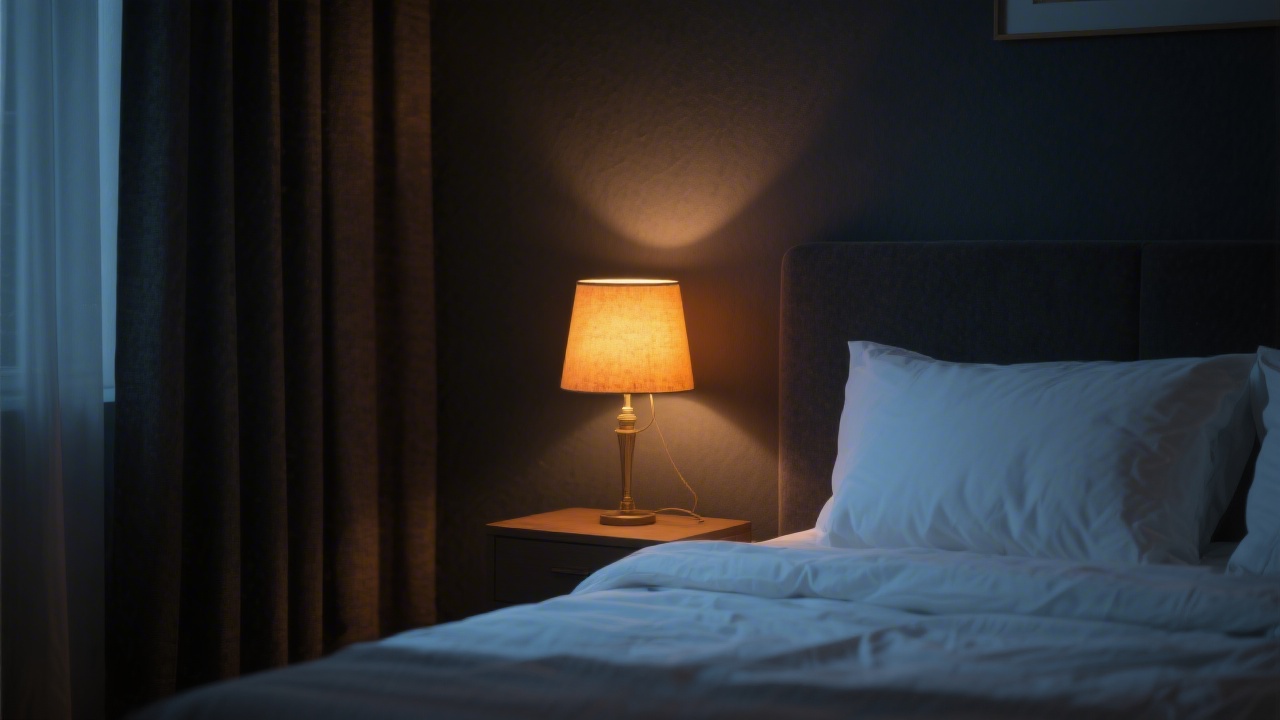
Target: below 50 lux in the 1 hour before bed. A dimmed bedside lamp at 2200K is ideal. A dimmer switch on a warm-spectrum bulb costs $15–$40 installed and creates the right environment automatically.
Smart Bulb Strategies
Philips Hue and LIFX
Both support full color temperature adjustment and scheduling. A "wind-down" scene that shifts from 4000K at 8pm to 2200K at 9pm and then dims to 10% by 10pm automates the entire protocol. Cost: $15–$40 per bulb, one-time setup.
Govee and Wyze
Budget-friendly alternatives with similar color temperature control. App scheduling is slightly less reliable but functional for sleep purposes. Cost: $8–$20 per bulb.
Simple Warm LED + Dimmer Switch
For those who want a zero-tech solution: replace all bedroom bulbs with GE Relax HD 2700K LEDs ($6–$10 each) and install an in-wall dimmer switch. This achieves 90% of the benefit of smart bulbs at a fraction of the cost and requires no app, no WiFi, and no subscription.
Red-Spectrum Night Lights
Red-wavelength light (620–750nm) has the least melatonin-suppressing effect of any visible light. For nighttime bathroom trips, a red-spectrum night light in the hallway or bathroom prevents the full melatonin reset that a standard light causes. Products like the Munchkin Night Light ($10–$15) use this spectrum. Alternatively, red bulbs (S14 Edison-style red LEDs) cost $8–$12 each.
Morning Light: The Other Half of the Equation
Melatonin suppression in the morning is desirable — it's how your circadian rhythm resets to wake. A 10,000-lux light therapy lamp used for 20–30 minutes after waking (particularly important in winter or for night-shift workers) strengthens the biological signal that anchors your sleep timing. Brands: Verilux HappyLight, Carex Day-Light. Cost: $40–$80.
The Mattress Underneath It All
Optimal lighting creates the conditions to fall asleep. But once you're asleep, the quality of that sleep is determined largely by your mattress. The Saatva Classic is designed for undisturbed sleep — its dual coil system minimizes motion transfer and its zoned lumbar support maintains spinal alignment through all sleep positions. Free white-glove delivery included.
Frequently Asked Questions
Does phone screen light matter if the room light is warm?
Yes. Phones are typically 5000–6500K and held close to the face, creating high lux exposure at the eye level. Screen brightness matters — even at 2700K display warm mode, a bright screen at close range suppresses melatonin. Use night mode + auto-brightness reduction and stop screen use 30–60 minutes before sleep.
What about blue-light blocking glasses?
High-quality blue-light blocking glasses (amber-tinted, not clear) do reduce melatonin suppression. A 2021 Cochrane review found moderate evidence for their effectiveness. They're a useful addition to room lighting changes — not a replacement for them.
Is a TV in the bedroom a significant problem?
Yes on two dimensions: light emission (typically 4000–6500K with high peak brightness) and cognitive stimulation. The combined effect delays sleep onset and reduces slow-wave sleep. Eliminating the bedroom TV is one of the highest-return sleep changes available at zero cost.
How dark does the room need to be once I'm asleep?
As dark as possible. Even light at 10 lux through closed eyelids measurably reduces melatonin and suppresses slow-wave sleep. Blackout curtains or a sleep mask are recommended, especially for early morning light in summer months.
Does the color of bedroom walls affect lighting effectiveness?
Yes. Light-colored walls reflect light and increase effective lux levels. Dark matte walls absorb light and create a lower-lux environment more efficiently. This is one reason dark, moody bedrooms often feel more conducive to sleep — they're typically operating at lower effective illuminance even with the same bulbs.
Ready to upgrade your sleep foundation? The Saatva Classic mattress — free white-glove delivery, 365-night trial.