
 by
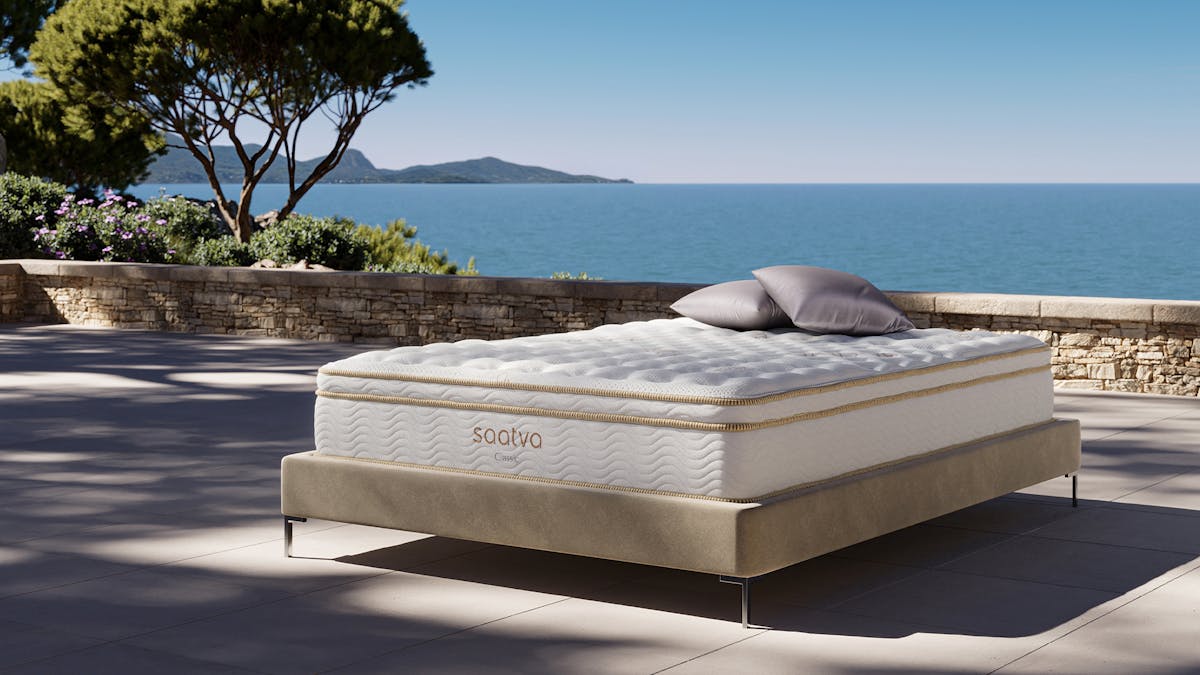
by The best mattress for early risers is the Saatva Classic. Its reinforced perimeter coils hold firm when you push off to stand, keeping the exit stable and near-silent at 5 AM. The Amerisleep AS3 is the stronger pick for pure motion isolation: all-foam Bio-Pur deadens movement completely so a light-sleeping partner barely registers your exit.
Saatva Classic
9.2/10
- Perimeter coil system holds to just 2.25 inches of sinkage under seated load, for a stable, quiet exit
- Dual-coil breathable construction, outstanding cooling with no heat trap
- Free white-glove delivery, setup, and old-mattress removal included
- 365-night trial with lifetime warranty, available in Plush Soft, Luxury Firm, and Firm
- Moderate motion isolation compared to all-foam, more transfer than a foam bed
- $99 return fee applies if you use the trial period
- Ships flat, not compressed in a box
For early risers, the exit itself is the critical moment. The Saatva Classic's reinforced perimeter coils create a stable, near-silent platform when you sit up and push off to stand, which is the exact mechanical sequence that disturbs a sleeping partner on a softer mattress. Add the 365-night trial and white-glove delivery and this is the complete early-riser solution.
What early risers actually need from a mattress
Getting out of bed at 5 AM in a shared bed creates two separate engineering problems that most mattress reviews never address together. The first is edge support: whether the perimeter holds firm enough for a controlled, quiet exit or collapses under you. The second is motion isolation: how much of your roll-and-sit movement transfers across the mattress to your partner's side.
Most mattress categories optimize for one at the expense of the other. All-foam beds absorb motion completely but have softer perimeters that can compress 3 to 4 inches under sitting load. Traditional innerspring beds have rock-solid edges but transmit every movement across the coil network. Pocket-coil hybrids, like the Saatva Classic, strike the best balance for practical early-riser use: reinforced perimeter for a stable exit, with each coil individually encased to minimize lateral motion transfer.
Edge support: why it is the primary early-riser criterion
The mechanical sequence of getting out of bed is: roll toward the edge, sit upright, transfer weight to the perimeter, push off to stand. On a mattress without reinforced edge support, step three involves sitting on a surface designed for lying loads, not seating loads. Foam compresses 3 to 4 inches, and the mattress tilts. On a well-engineered coil hybrid, reinforced perimeter coils act as a stable seat edge, reducing sinkage and the creaking, adjusting sounds that wake partners.
The Saatva Classic measures only 2.25 inches of sinkage under seated load at the edge, near the top of the category. Its dual tempered-steel coil system provides a firm, low-noise perimeter. In Luxury Firm, the balance between spinal support during sleep and edge stability during exit is particularly well calibrated.
Motion isolation: why it matters for light-sleeping partners
Motion isolation describes how well a mattress absorbs movement before it travels laterally. In an all-foam mattress, foam compresses locally under each body contact point without springing back, so movement at one side registers near zero on the other. In a pocket-coil hybrid, each coil is individually encased and moves independently, which is meaningfully better than traditional interconnected springs but still transfers more motion than foam.
- Pocket-coil hybrid (Saatva Classic): moderate motion transfer, measurable under independent testing, acceptable for most partners who are not extremely light sleepers.
- All-foam (Amerisleep AS3): motion transfer typically below measurable threshold for a getting-up movement. Best choice when your partner is an unusually light sleeper.
- Traditional interconnected innerspring: avoid entirely for this use case. Interconnected coils transmit the full energy of a sit-up or leg swing across the bed.
Quick comparison
| Mattress | Type | Edge support | Motion isolation | Trial | Queen price |
|---|---|---|---|---|---|
| Saatva Classic | Innerspring hybrid | Outstanding (2.25 in. sinkage) | Moderate | 365 nights | ~$1,879 |
| Amerisleep AS3 | All-foam | Average (foam perimeter) | Excellent | 100 nights | From $1,049 |
Amerisleep AS3
8.9/10
- All-foam Bio-Pur deadens motion at the source, virtually zero ripple effect across the bed
- HIVE 5-zone layer keeps spine neutral for side and back sleepers
- Plant-based open-cell foam sleeps cooler than standard memory foam
- CertiPUR-US certified, made in the USA, free compressed shipping
- Edge support softer than a coil hybrid, perimeter compresses more under sitting load
- Sleepers over 230 lb may want the firmer AS5 Hybrid for longer-term support
If your partner is an unusually light sleeper and motion isolation outweighs edge stability, the AS3 is the right call. All-foam construction absorbs getting-up movement at the source. The 100-night trial is enough to assess whether the softer edge is workable for your exit routine.
Setup tips that make any mattress quieter to exit
- Split king configuration: two twin XL mattresses side by side eliminate cross-mattress motion transfer entirely. Requires a split-king adjustable base or a compatible platform frame. Zero transfer is physically guaranteed since the surfaces are separate.
- Exit from center, not the perimeter: regardless of mattress type, pivoting on the center third before swinging legs minimizes perimeter compression and reduces any frame creak.
- Solid platform frame: a box spring or slatted frame with wide slat spacing amplifies motion. A solid platform or a foundation with 2-inch slats at 3-inch intervals provides a quieter, more stable base under any mattress.
- Floor lamp, not overhead: light disturbance wakes partners more often than motion. A bedside lamp aimed away from the bed is a bigger win than any mattress upgrade.
For early risers, edge support is the primary criterion for a quiet, stable exit. The Saatva Classic leads on that metric, backed by a 365-night trial and free white-glove delivery. The Amerisleep AS3 is the right alternative if motion isolation matters more than edge stability.
Frequently asked questions
What type of mattress is best for not waking a partner when getting up early?
A coil hybrid with reinforced edge support, like the Saatva Classic, is the best overall pick because it combines a stable exit platform with decent motion isolation. If your partner is an unusually light sleeper, an all-foam mattress provides the highest motion isolation but with softer edges.
Does mattress firmness affect how much motion transfers to a sleeping partner?
Construction matters more than firmness. A medium-firm pocket-coil hybrid still transfers more motion than a soft all-foam mattress. That said, within the same construction type, softer foam absorbs slightly more motion than extra-firm foam because it has more compressible travel before bottoming out.
Is a split king the best solution for early risers?
Yes, if budget allows. Two separate twin XL mattresses on a split-king base make cross-mattress motion transfer physically impossible. The tradeoff is the center seam and the need for a compatible adjustable base, which adds cost.
Can a mattress topper help with motion transfer?
A 2-inch memory foam topper adds an absorbing layer that reduces motion transfer on an older coil mattress. It will not address edge support and will not fully compensate for a traditional interconnected-coil system, but it is a useful, low-cost first step before replacing the mattress.
How long should I trial a new mattress before deciding?
At least 30 nights for your body to adapt to new support geometry. For early-riser purposes specifically, pay attention in weeks 3 and 4 whether your partner reports waking less. If you are still noticing disruption at 6 weeks, the motion isolation or edge support is insufficient for your situation.
This guide is part of our Best Mattress by Use Case hub, where we compare all top picks by specific sleep need.