
 by
by The recommendation to sleep in a cold room isn’t folk wisdom — it’s one of the better-replicated findings in sleep medicine. The specific mechanism is clear, the optimal temperature range is well-established, and the magnitude of the effect is significant enough to measurably affect next-day cognitive performance. Here’s what the research shows and how to apply it.
The Thermoregulatory Mechanism of Sleep Onset
Sleep onset is not triggered by darkness or fatigue alone — it’s triggered by a drop in core body temperature. In the 2–3 hours before natural sleep time, the body begins redistributing heat outward: blood vessels in the hands and feet dilate, heat is transferred to the periphery, and core temperature drops by approximately 1–2°F.
This temperature drop is the proximate cause of sleepiness. It’s why you feel drowsy in a warm bath (vasodilation accelerates heat loss) and why shift workers sleeping during the day have more difficulty falling asleep (core temperature is at its daily peak, not falling).
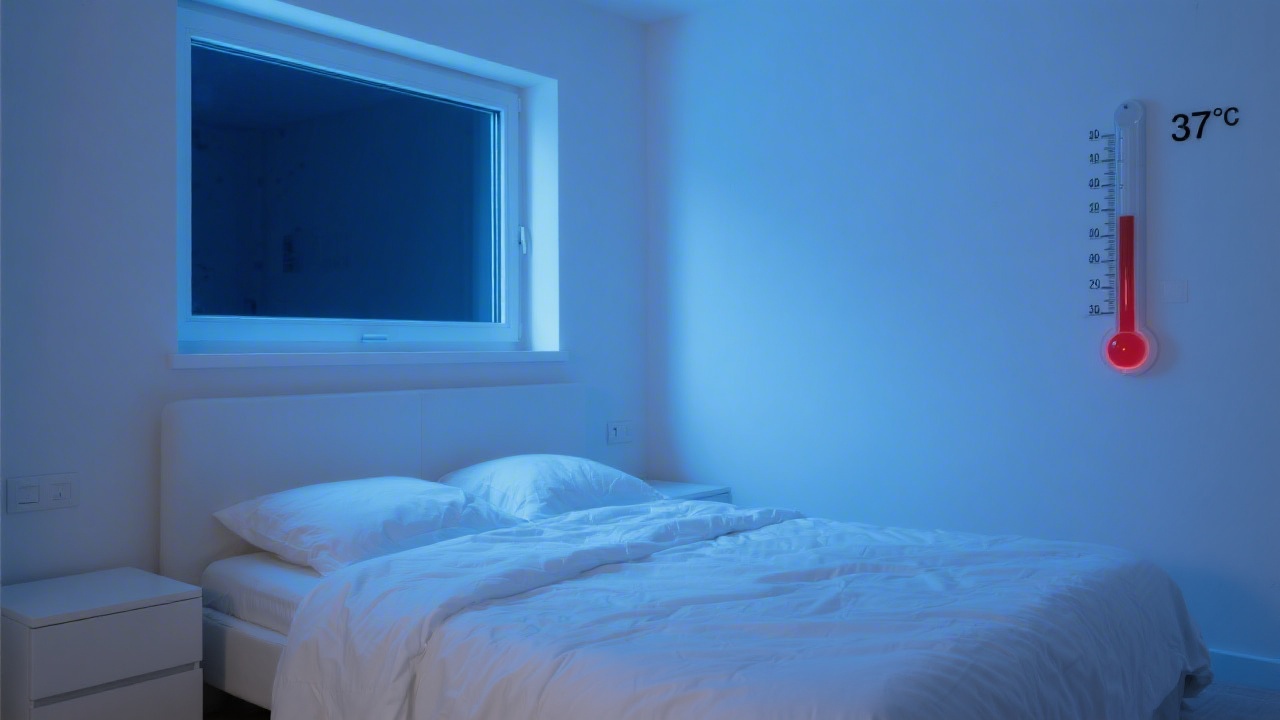
A cool bedroom environment — 65–68°F — supports this natural temperature drop by creating a thermal gradient that allows body heat to dissipate. A warm room (above 72–75°F) fights it.
The Optimal Temperature Range: 65–68°F
Multiple independent research groups have converged on this range:
- The National Sleep Foundation identifies 65–68°F as optimal for adults
- Harvard Medical School’s Division of Sleep Medicine references 65–72°F (upper end of this range still shows benefit vs. warmer rooms)
- Research from the Weill Cornell Medical Center on sleep environment found sleep efficiency maximized between 64–68°F
Below 60°F, the body’s thermoregulatory effort to maintain core warmth begins to disrupt sleep — so there is a lower bound. The benefit curve is steep between 68–75°F and relatively flat below 65°F (cooling further provides diminishing returns).
Effect on Sleep Architecture
The temperature effect isn’t just on sleep onset — it affects sleep architecture throughout the night:
Slow-Wave Sleep (Deep Sleep)
Core temperature continues to fall during the early part of the night, and deep sleep proportion is highest when this fall is steepest. Research shows people in 68°F rooms spend more time in slow-wave sleep than those in 75°F rooms — this is the restorative sleep stage associated with memory consolidation and physical recovery.
REM Sleep
REM sleep, which dominates the second half of the night, is temperature-sensitive. During REM, the body temporarily loses thermoregulation (skeletal muscles that generate heat are paralyzed). Warm rooms impair REM sleep more than cool ones because the body can’t self-regulate temperature during this stage.
Insomnia and Temperature: A Clinical Connection
Chronic insomnia patients show a distinctive pattern: they have higher core body temperatures in the evening compared to good sleepers, and this elevated temperature persists into the night. Research by Dr. Charles Czeisler’s group at Harvard found that core body temperature at sleep onset is a reliable predictor of sleep quality — people who fail to drop core temperature adequately have longer sleep onset latency.
This is why warm baths before bed (counterintuitively) help insomnia: the bath-induced vasodilation accelerates the temperature drop. A cool bedroom does the same thing through a different mechanism.
How to Achieve 65–68°F Consistently
- Programmable thermostat set to begin cooling 60 minutes before bed
- Ceiling fan on low to even out room temperature distribution
- Blackout curtains on sun-facing windows to prevent daytime heat accumulation
- Separate bedroom zone from living area HVAC where possible
The Mattress Temperature Interaction
In a cool room, your body heat generates a warm microclimate at the sleep surface. A mattress that traps this heat (dense foam) negates some of the benefit of the cool room — you end up sleeping in a warm pocket regardless of ambient temperature.
The Saatva Classic’s coil-based structure allows air to move through the support core, preventing heat buildup at the sleep surface and letting the cool-room effect work as intended.
Related reading: Best AC Settings for Sleep | How to Sleep in Cold Environments | How to Sleep in the Heat
Frequently Asked Questions
What is the exact optimal temperature for sleep?
Research consistently identifies 65–68°F (18–20°C) as optimal for most adults. Individual variation exists — some people sleep best at 63°F, others at 70°F — but the consensus range is 65–68°F.
Does sleeping in a cold room help you lose weight?
Marginally. Brown adipose tissue (BAT) activates in cool environments to generate heat, burning modest calories in the process. Research from the NIH found that sleeping at 66°F for a month increased BAT activity and improved insulin sensitivity. The effect is real but small.
Is it bad to sleep in a cold room without enough blankets?
Below 60°F without adequate insulation, the body’s thermogenic responses (shivering, increased metabolic rate) elevate arousal and fragment sleep. The optimal cold-room sleep requires appropriate bedding — the goal is a cool ambient environment with warm sleep surface.
Why does my partner prefer a warmer room for sleep?
Individual thermoregulatory set points vary. Women, on average, have higher preferred sleep temperatures than men due to differences in basal metabolic rate and body composition. The 65–68°F range is a population average — a compromise of 68–70°F often works for mixed-preference couples.
Can I simulate a cold room with a cooling mattress pad instead of AC?
Partially. Cooling mattress pads lower the temperature of the sleep surface but not the ambient room temperature. Core body temperature responds to ambient temperature as well as surface temperature. For full benefit, room temperature matters — but a cooling pad is a useful supplement when cooling the whole room isn’t possible.
Voted best luxury innerspring mattress with exceptional lumbar support and white-glove delivery.
Check Price & Availability FAQPage", "mainEntity": [ { "@type": "Question", "name": "What is the exact optimal temperature for sleep?", "acceptedAnswer": { "@type": "Answer", "text": "Research consistently identifies 65-68°F (18-20°C) as optimal for most adults. Individual variation exists, but the consensus range is 65-68°F." } }, { "@type": "Question", "name": "Does sleeping in a cold room help you lose weight?", "acceptedAnswer": { "@type": "Answer", "text": "Marginally. Brown adipose tissue activates in cool environments to generate heat, burning modest calories. Research found sleeping at 66°F increased BAT activity and improved insulin sensitivity, but the effect is small." } }, { "@type": "Question", "name": "Is it bad to sleep in a cold room without enough blankets?", "acceptedAnswer": { "@type": "Answer", "text": "Below 60°F without adequate insulation, thermogenic responses fragment sleep. The optimal setup is a cool ambient environment with appropriate warm bedding." } }, { "@type": "Question", "name": "Why does my partner prefer a warmer room for sleep?", "acceptedAnswer": { "@type": "Answer", "text": "Individual thermoregulatory set points vary. Women on average prefer slightly warmer sleep temperatures than men. A compromise of 68-70°F often works for mixed-preference couples." } }, { "@type": "Question", "name": "Can I simulate a cold room with a cooling mattress pad instead of AC?", "acceptedAnswer": { "@type": "Answer", "text": "Partially. Cooling pads lower sleep surface temperature but not ambient room temperature. Core body temperature responds to both. Room temperature matters for full benefit, but a cooling pad is a useful supplement." } } ] }