
 by
by The bedroom environment has a measurable effect on sleep quality. Research consistently identifies temperature, light, noise, and mattress surface as the four primary environmental factors. The good news: most of the high-impact changes cost little and take an afternoon to implement.
The 10 Changes, Ranked by Impact
1. Get the Right Mattress
No environmental optimization compensates for sleeping on the wrong mattress. Pressure points, heat retention, and motion transfer from a poor mattress create micro-arousals throughout the night — interruptions that prevent deep sleep even when you don't fully wake up.
The Saatva Classic is our top recommendation for most sleepers: innerspring-hybrid construction with excellent airflow, minimal motion transfer between partners, and available in three firmness levels. It's the single most impactful change for most people who haven't replaced their mattress in 7+ years.
→ See the Saatva Classic mattress
2. Lower the Room Temperature to 65–68°F (18–20°C)
Core body temperature drops 1–2°F during sleep onset. A cool room accelerates this drop. Research from the National Sleep Foundation consistently identifies 65–68°F as the optimal range. Rooms above 72°F significantly disrupt sleep architecture, particularly REM sleep.
If you can't control room temperature, breathable bedding (cotton, linen, Tencel) and fans help. Cooling mattress toppers add 2–4°F of perceived coolness at the sleep surface.
3. Block Light Completely
Melatonin production is suppressed by light, even through closed eyelids. Streetlights, electronics, and early morning sun all disrupt the body's sleep-wake signaling. Blackout curtains or cellular shades are the most effective solution for ambient light.
Cover all LED indicator lights on electronics (tape works fine). One study found that sleeping in a room with even dim light increases insulin resistance and heart rate the following morning.
4. Position the Bed Against a Solid Wall
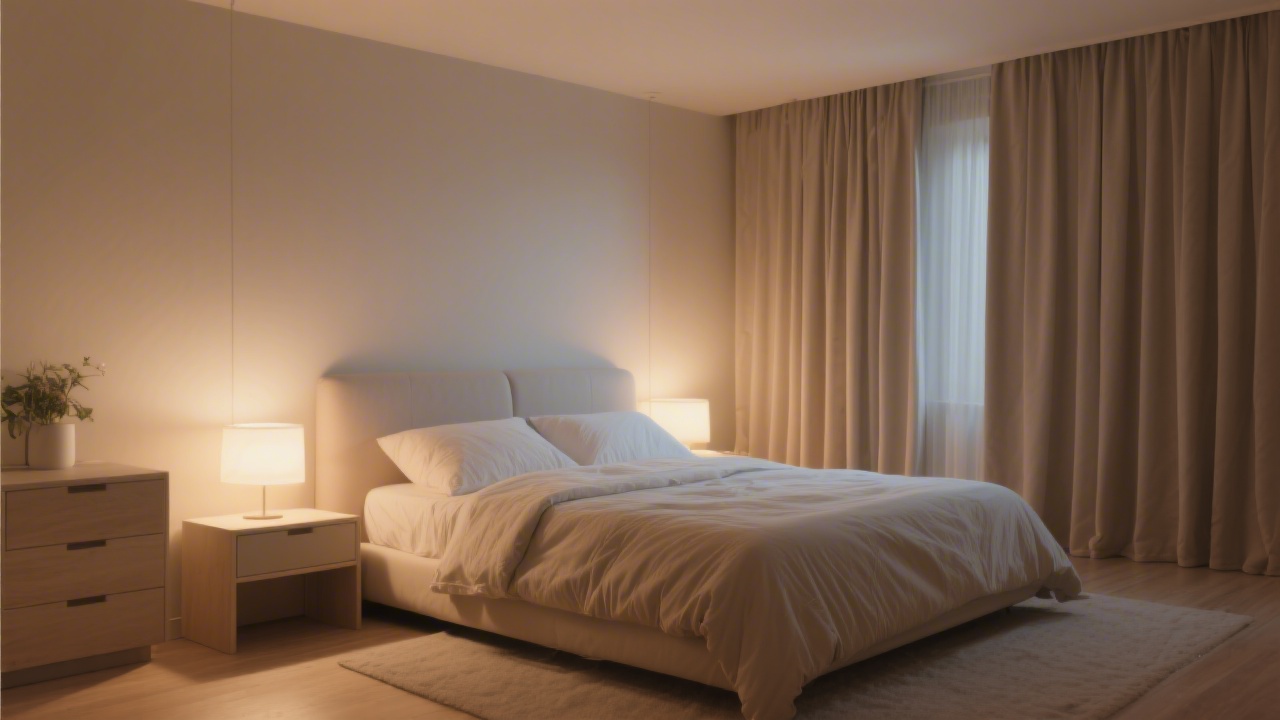
Beds placed against solid walls (particularly the wall opposite the door) give a subconscious sense of security. Avoid placing the bed under windows — temperature fluctuation from windows disrupts sleep and morning light wakes you early. Position the bed so you can see the room entry from bed without turning your head significantly.
5. Reduce Noise or Add White/Brown Noise
Intermittent noise — not sustained noise — is what disrupts sleep. A consistent background noise level (fan, white noise machine, brown noise) masks sudden sounds that would otherwise cause arousals. Brown noise (lower frequency than white noise) is preferred by most people for sleep use.
For hard floors, area rugs reduce echo and ambient sound levels. Solid-core doors and draft excluders reduce noise transmission from other rooms significantly more than hollow-core doors.
6. Remove Screens from the Bedroom
The blue light wavelength from phones, tablets, and televisions suppresses melatonin for up to 2 hours after exposure. Beyond light, the cognitive stimulation from screens — news, social media, email — activates stress responses incompatible with sleep onset.
A physical alarm clock replaces the phone's alarm function without the distraction risk. If removing the phone entirely isn't possible, enable blue light filtering (Night Mode) and keep the device face-down outside arm's reach.
7. Optimize Your Pillow Height
Pillow height determines cervical spine alignment during sleep. Side sleepers need thicker pillows (4–6" loft) to fill the gap between shoulder and neck. Back sleepers need medium loft (3–4"). Stomach sleepers need thin or no pillow to avoid neck hyperextension.
An incorrectly sized pillow creates tension headaches, shoulder pain, and disrupted sleep. Most people never replace their pillow; the average pillow should be replaced every 1–2 years as fill compresses.
8. Declutter the Sleep Space
Visual clutter in a bedroom activates cortisol response — the same stress hormone that makes it harder to fall asleep. A Princeton Neuroscience Institute study found that a cluttered environment reduces the brain's ability to focus and process information, extending sleep onset time.
The bedroom should contain: bed, essential nightstand items, and nothing that represents incomplete tasks (work items, exercise equipment, laundry). Use under-bed storage to move items out of sight without adding floor clutter.
9. Use Heavy, Breathable Bedding
Weighted blankets (15–20 lbs for most adults) reduce cortisol and increase serotonin, shortening sleep onset time in multiple clinical studies. The weight matters: 10% of body weight is the commonly cited guideline.
The bedding material matters equally. Polyester retains heat. Cotton, linen, and Tencel (eucalyptus fiber) allow moisture wicking and temperature regulation. Percale weave (crisp) sleeps cooler than sateen (smooth).
10. Establish a Consistent Pre-Sleep Routine in the Space
The brain learns to associate environments with behaviors. Using the bedroom exclusively for sleep (and sex) — not working, watching TV, or eating — strengthens the environmental cue for sleep. Over 2–3 weeks of consistent behavior, entering the bedroom begins to trigger drowsiness automatically.
A consistent pre-sleep sequence (same order, same duration, same low-light environment) accelerates this conditioning. 20–30 minutes is sufficient for most people.
The Fastest Wins This Weekend
If you implement only three things: lower the temperature, add blackout curtains, and move your phone out of the bedroom. These three changes alone measurably improve sleep quality for most people within the first week, with no investment beyond blackout curtains ($25–$60 per window).
The highest long-term impact: replacing an aging mattress. See our best bed frame guide for complementary frame recommendations, and our bed frame sizes guide for room planning.
→ See the Saatva Classic — the highest-impact single change for most sleepers
Frequently Asked Questions
What temperature is best for sleep?
65–68°F (18–20°C) is the research-backed optimal range. Above 72°F noticeably disrupts REM sleep. Individual preference varies slightly, but this range works for the majority of people.
Does bedroom color affect sleep?
Yes, modestly. Cool colors (blues, grays, muted greens) are associated with lower resting heart rate. Bright, high-saturation colors (red, orange) increase alertness. The effect is subtle compared to temperature, light, and noise — but it matters in aggregate.
Where should I position my bed in the bedroom?
Against the wall opposite the door, with the headboard against a solid wall (not a window). This allows you to see the door from bed, provides a sense of security, and avoids temperature fluctuation from windows.
Do plants in the bedroom improve sleep?
The evidence is limited. Some plants (lavender, jasmine) have mild aromatherapeutic effects. The oxygen contribution is negligible — a bedroom with closed windows and two plants is effectively unchanged in air composition. If you find plants calming, they're fine; they're not a primary sleep intervention.
How often should I replace my mattress for better sleep?
Every 7–10 years for most mattress types. Signs it's time: visible sagging (even 1 inch of sag affects sleep quality), waking with pain that goes away during the day, or sleeping better in other beds. A supportive mattress is the highest-leverage bedroom investment for sleep quality.