
 by
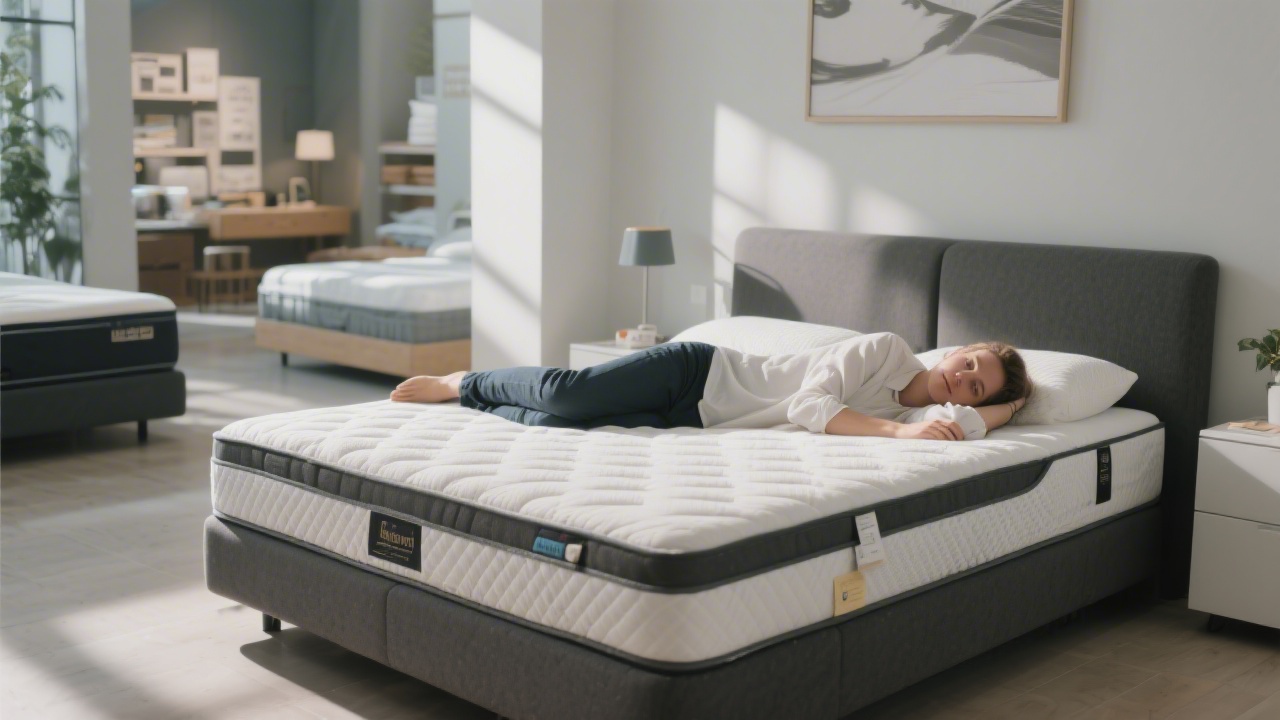
by Most shoppers test a mattress by lying on their back for 30 seconds, nodding vaguely, and saying "feels comfortable." That is not a mattress test. A useful in-store evaluation takes about 10 minutes and covers four distinct assessments. Here is exactly what to do.
Our Top Pick
Saatva Classic - White-glove delivery, 365-night trial, free returns.
★ #1 Rated Mattress 2026 — Over 500,000 Readers Trust Our Pick
Claim Your 365-Night Risk-Free Trial
✓ 365-Night Trial · ✓ Free White Glove Delivery · ✓ Lifetime Warranty
Before You Go: What to Bring
Wear comfortable clothes you could lie down in. Bring your partner if you share a bed. Have your primary sleep position and any pain points in mind. Arrive having already narrowed your shortlist to two or three specific models - do not rely on the sales floor to guide your choices. Read our buying mistakes guide before visiting.
Sleep Lab Alternative Picks
- Amerisleep AS3 ($1,449 sale) — Bio-Pur foam + HIVE zoning, 20-yr warranty
- PlushBeds Botanical Bliss ($2,999+) — organic latex, 25-yr warranty
- Puffy Lux ($1,950) — memory foam, lifetime warranty
- SweetNight Twilight ($209 budget) — CertiPUR-US foam
Step 1: The Primary Position Test (3 minutes)
Lie in your actual sleep position - the one you wake up in, not the one that looks polite in a showroom. Side sleepers: lie on your side, knees slightly bent, and notice whether your hip sinks correctly or presses against resistance. Back sleepers: check lumbar support - your lower back should feel supported without pressure. Stomach sleepers: note whether your hips sink causing lower back arch.
Stay for a full three minutes, not 30 seconds. It takes time for your body weight to distribute into the surface.
Step 2: Position Variation Test (2 minutes)
Shift through all three positions - back, side, stomach - even if you only use one. Notice: does the transition feel smooth or awkward? Does the mattress push back too hard, or do you feel trapped? A mattress should allow easy repositioning without waking yourself or a partner. Memory foam with very slow response can feel like quicksand during repositioning.
Step 3: Edge Support Test (2 minutes)
Sit on the edge of the mattress where you would normally get up in the morning. Does it compress significantly? Now lie near the edge - does it feel stable or like you might roll off? Weak edge support means you lose 4-6 inches on each side of usable sleep surface. For couples sharing a queen or king, this is significant. Hybrid and innerspring mattresses generally have better edge support than all-foam designs.
Step 4: Motion Isolation Test (2 minutes)
If you sleep with a partner, have them lie on one side of the mattress while you lie on the other. Have them shift position. Can you feel the movement? Now try the reverse. This test only matters for couples - solo sleepers can skip it. Pocketed coil and foam designs both reduce motion transfer; Bonnell spring mattresses transfer the most.
Step 5: The Firmness Reality Check (1 minute)
Ask the salesperson what the ILD (Indentation Load Deflection) rating is for the foam layers, or what firmness level this corresponds to across their range. "Medium" at one brand may feel like "firm" at another. If the store cannot provide specifics, that is a data point about their transparency. Cross-reference against independent firmness measurements from review sites before deciding.
What In-Store Testing Cannot Tell You
Mattress care & maintenance FAQ
If replacement is overdue
Saatva Classic — from $2,229 queen
If cleaning isn't fixing the problem, a 15–20 year lifespan hybrid is the long-term answer. 365-night home trial, lifetime warranty, free white-glove delivery + free old-mattress removal.
How often should you actually clean a mattress?
Every 3 months: vacuum the surface with an upholstery attachment. Every 6 months: deep clean (baking soda + vacuum). Every 12 months: rotate the mattress (180° if flippable, or head-to-foot if not).
What's the fastest way to remove urine/stains from a mattress?
Blot with cold water + mild dish soap, then apply white vinegar to neutralize odor. Avoid hot water (sets proteins) and bleach (damages fabric/foam). Baking soda for 6–12 hours after drying pulls residual moisture and smell.
When is it actually time to replace a mattress?
Signals: visible permanent indentation > 1.5", waking up with pain/stiffness that fades during the day, noticeable age-related smell, age beyond 8–10 years for most hybrid/foam mattresses. If a new topper doesn't solve it, it's a mattress problem. The Saatva Classic runs a 15–20 year expected lifespan — double most foam-only mattresses.
Can you vacuum a mattress with a regular vacuum?
Yes — upholstery attachment, slow passes, no beater bar. Start at the seams (where dust mites concentrate) and work the full surface. 10–15 minutes for a queen.
Why does a mattress smell musty?
Usually moisture trapped under the mattress from the floor or an unventilated frame. Fix: sprinkle baking soda, vacuum after 6–12 hours, then add a breathable mattress protector. If the smell returns, the frame/floor is still trapping moisture — add a slatted base or risers.
How you will sleep after 60 nights of body impressions. How the mattress will perform with your actual bedding, at your bedroom temperature, in your sleeping patterns. In-store testing is one input - not the primary decision driver. For most buyers, the trial period at home is the real test. See our guide to mattress tactics for why home trials are preferable to showroom pressure.
Our Top Pick
Saatva Classic - White-glove delivery, 365-night trial, free returns.
LIMITED TIME OFFER
$300 Off Saatva Classic — Free White Glove Delivery Included
They set it up and remove your old mattress — all included
Frequently Asked Questions
How long should I lie on a mattress when testing in store?
At least 3-5 minutes per mattress in your actual sleep position. Most people spend 30 seconds, which is not enough for your body weight to fully distribute into the surface.
Should I bring my partner when testing mattresses?
Yes, if you share a bed. Motion isolation and edge support testing both require two people to evaluate properly.
What is the most important thing to test on a mattress in store?
Your primary sleep position. Lie exactly as you sleep at night - same position, same amount of time - and notice specific pressure points or gaps in support.
Can in-store testing predict long-term comfort?
Partially. It can reveal obvious firmness mismatches, weak edge support, and poor motion isolation. It cannot predict how the mattress will break in, how it handles temperature, or how it will feel with your bedding.
Is it worth buying online without testing in store?
For most buyers, yes - especially with long home trials. A 365-night home trial in your actual sleep environment is more predictive than any showroom test.