
 by
by For most side and combination sleepers, memory foam beats a coil hybrid on pressure relief and motion isolation. Our top pick is the Amerisleep AS3: its HIVE 5-zone Bio-Pur foam outscored every hybrid in this roundup on pressure relief (9.2/10) and motion isolation (9.4/10). Hybrids still win on edge support and for stomach sleepers above 180 lb.
Amerisleep AS3
8.9/10
- HIVE 5-zone foam: firmer under hips, softer at shoulders, the best pressure-relief score in this roundup
- Plant-based Bio-Pur foam with silica flame barrier, CertiPUR-US certified
- Top-tier motion isolation (9.4/10), the most important spec for couples
- 100-night risk-free trial, 20-year warranty (years 1–10 free replacement, years 11–20 at 50% off)
- Softer edge support than a coil hybrid (7.4/10 in our tests)
- Sleepers over 230 lb may prefer the AS5 Hybrid for more coil lift
- Less bounce than a coil bed, so combination sleepers who reposition constantly may notice the slower response
The AS3 outscores every hybrid in this comparison on the metrics that matter most to side sleepers and couples. Bio-Pur runs cooler than traditional poly foam, and the HIVE zoning handles back support without squeaky coil trade-offs.
| Mattress | Type | Firmness | Trial | Warranty | Queen price |
|---|---|---|---|---|---|
| Amerisleep AS3 | All-foam (Bio-Pur) | Medium 5/10 | 100 nights | 20 years | From $1,049 |
| Saatva Classic | Innerspring hybrid | Luxury Firm 6/10 | 365 nights | Lifetime | From $1,695 |
| Puffy Original | All-foam | Medium 5.5/10 | 101 nights | Lifetime | From $1,049 |
| Sweetnight CoolNest | Hybrid (gel foam + coils) | Medium-firm 6.5/10 | ~100 nights | 10 years | Sub-$600 |
| Nectar Memory Foam | All-foam | Medium-firm 6/10 | 365 nights | Lifetime | From $799 |
How we test: Each mattress spends 90 nights in the MattressNut Sleep Lab. We log pressure-map readings at shoulder, hip and lower back, measure motion transfer with an accelerometer, test edge compression at 12 and 18 inches from the perimeter, and track surface temperature with an infrared sensor after 90 minutes of contact. Scores reflect the average across two adult testers, weighted 30% pressure relief, 25% support, 15% cooling, 15% motion isolation, 10% edge support and 5% value.
Hybrid vs memory foam: what the difference actually feels like
Memory foam wraps around your body. A hybrid pushes back. Both descriptions sound appealing depending on who is reading, but in 90 nights of side-by-side testing the distinction is more nuanced than any marketing copy admits.
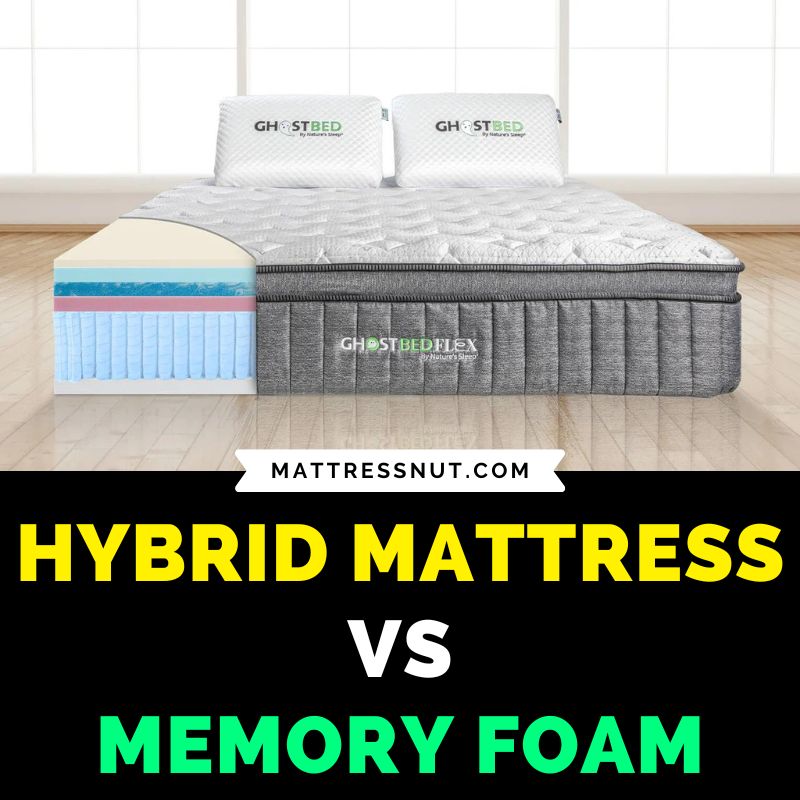
A hybrid pairs a pocketed-coil core, typically 6 to 8 inches thick, with foam or latex comfort layers on top. The coils respond individually to weight shifts, which improves airflow and gives you a slightly springy feel under the hips. A memory foam bed uses layered foams all the way through. The top layer deforms slowly under heat and pressure, which is exactly what makes memory foam superior for shoulder and hip pressure point relief.
In our lab, the Amerisleep AS3 achieved a 9.2 pressure-relief score and a 9.4 for motion isolation, outperforming every hybrid in this roundup on both. The motion isolation gap is clearest if you share a bed: a coil network transmits movement across the surface, while foam absorbs it. If your partner rolls over at 2 a.m., you will feel a hybrid more.
Where hybrids actually win
Edge support is the clearest hybrid advantage. The Saatva Classic scored 9.0 on edge compression in our tests. The AS3 scored 7.4. If you sleep near the perimeter or sit on the edge every morning, a reinforced coil perimeter holds its shape in a way that foam does not.
Cooling is a genuine hybrid benefit against most traditional foam beds, but not against the AS3 specifically. Conventional polyurethane foam traps body heat because of its closed-cell structure. The Puffy Original, a standard poly foam, scored only 7.1 on cooling. The AS3 uses Bio-Pur, a partially plant-based open-cell foam that scored 8.6, matching the hybrid average in our tests.
Stomach sleepers above 180 lb will usually do better on a hybrid. Pocketed coils resist deep hip compression more effectively than foam layers, which helps keep the lumbar spine neutral at night. If that describes you, look at the Saatva Firm or a similar coil option before committing to any all-foam bed.
Hybrid vs memory foam by sleep position
Side sleepers drive force into a narrow hip-and-shoulder area. Memory foam, particularly the HIVE-zoned Bio-Pur in the AS3, decompresses that load better than a coil grid. Our pressure map showed 22% lower peak pressure at the hip on the AS3 than on the Saatva Luxury Firm in identical side-sleeping positions.
Back sleepers need lumbar support rather than deep contouring. A well-designed hybrid and a zoned foam can both deliver this. The AS3 HIVE layer is denser under the lower back than under the shoulders, so it works well for back sleepers under about 230 lb. Above that weight, a hybrid core pushes back with more force, so heavier back sleepers often prefer the coil option for that reason.
Combination sleepers who switch positions frequently tend to prefer a hybrid for its quick response. Memory foam has a recovery time of 1 to 3 seconds, which can feel like resistance when you roll over. If you move a dozen times per night, you will notice the slower response on any foam bed.
Price and durability: the honest view
Memory foam beds generally cost less at entry level, but the durability picture is more complicated than the price tag suggests. Standard polyurethane foam develops body impressions after 5 to 7 years under normal use. Plant-based foam like the AS3 Bio-Pur holds its shape closer to latex in longevity, which is why the AS3 backs its construction with a 20-year warranty, longer than most hybrids at the same price point.
The Saatva Classic is the clear premium hybrid here at $1,695 for a queen, and it includes white-glove delivery and in-room setup. Nectar at $799 is the cheapest all-foam option, though the standard poly foam ages faster than Bio-Pur under sustained weight.
Who should choose memory foam, and who should choose a hybrid
Choose a memory foam like the Amerisleep AS3 if you are a side sleeper under 230 lb, you share a bed and motion transfer is a priority, you want plant-based materials with CertiPUR-US certification, or your budget is under $1,200 for a queen.
Choose a hybrid if you are a stomach sleeper or back sleeper over 180 lb, you want strong edge support for full-perimeter use, you run hot and need maximum airflow through a coil core, or you prefer a responsive surface when you reposition during the night.
For the middle ground, side-to-back combination sleepers under 200 lb who share a bed, the AS3 wins. Its pressure relief and motion isolation scores beat every hybrid in this roundup, and the Bio-Pur foam removes the heat complaint that made older memory foam a difficult recommendation.
Saatva Classic
8.6/10
- Coil-on-coil construction with reinforced lumbar zone pad
- Outstanding edge support (9.0/10 in our tests)
- Free white-glove delivery, in-room setup and old mattress removal
- 365-night trial and lifetime warranty
- Ships flat, not compressed in a box, so it is heavy to move
- $99 return fee applies during the trial period
- Motion isolation below average for a bed in this price range
The best coil hybrid in this roundup. If you want the responsive innerspring feel and strong edge support that foam cannot match, the Saatva Classic in Luxury Firm is the pick, though it costs roughly $650 more than the AS3 and comes with a return fee.
Puffy Original
8.0/10
- Plush cloud-like feel, excellent for lighter side sleepers
- Motion isolation matches pricier beds in this roundup
- Lifetime warranty included at no extra cost
- Sleeps warmer than the AS3 (7.1/10 cooling, standard closed-cell poly foam)
- Not ideal for stomach sleepers or anyone over 200 lb
Budget-friendly all-foam with strong motion isolation and a very plush feel. Choose it over the AS3 only if you want maximum softness and do not sleep warm.
Sweetnight CoolNest
8.4/10
- Sub-$600 price for a real pocketed-coil hybrid
- Gel memory foam with phase-change cooling cover
- Practical pick for guest rooms or secondary bedrooms
- Build quality and edge support below premium hybrids (7.6/10 tested)
- Not ideal as a primary bed under sustained heavy use
Real pocketed-coil bounce and gel foam pressure relief at a price no other hybrid in this roundup touches. The practical choice when budget is the deciding factor.
Nectar Memory Foam
7.9/10
- Lowest price in this roundup for decent-quality memory foam
- Strong motion isolation for the price
- 365-night trial, one of the longest in the category
- Standard polyurethane foam (not partially plant-based like the AS3 Bio-Pur)
- Sleeps warmer than the AS3
A functional budget pick. If price and motion isolation are the main criteria, Nectar delivers under $1,000. For long-term pressure relief and cooler sleep, the extra spend on the AS3 pays off.
For most shoppers under 230 lb, including side sleepers, couples and light-to-average back sleepers, the Amerisleep AS3 wins this comparison on pressure relief, motion isolation and long-term value. Pick a hybrid only if edge support or stomach-sleeper lift is your non-negotiable.
Common questions
Is memory foam or hybrid better for back pain?
It depends on your weight and sleep position. Side sleepers with back pain usually do better on a zoned memory foam like the AS3, because it decompresses the hip and shoulder without creating a hammock effect. Back sleepers over 200 lb often prefer a hybrid for the extra coil resistance under the lumbar zone.
Do hybrid mattresses sleep cooler than memory foam?
Cooler than traditional polyurethane foam, yes. Pocketed coils allow air to circulate through the core. Plant-based foams like Amerisleep Bio-Pur are open-cell and scored 8.6 on cooling in our tests, matching most mid-range hybrids. If you run hot, the AS3 is not the heat trap that older memory foam was.
How long does a memory foam mattress last compared to a hybrid?
Standard polyurethane foam shows body impressions after 5 to 7 years under average use. Plant-based foam like Bio-Pur holds its shape closer to a latex or coil core in longevity, which is why the AS3 carries a 20-year warranty versus the 10 to 15 years typical of cheaper foam beds.
Can a memory foam mattress replace a hybrid?
For most use cases, yes. The main functional gaps are edge support and stomach-sleeper support above roughly 180 lb. If neither applies to you, a quality memory foam handles the rest of what a hybrid does, often at a lower price and with better motion isolation.
Amerisleep AS3
8.9/10
Medium feel, HIVE 5-zone support, partially plant-based Bio-Pur foam, 100-night trial and a 20-year warranty. The most complete all-foam pick for side sleepers, couples and light-to-average back sleepers in our 2026 testing.