
 by
by Upgrade your sleep with Saatva
The Saatva Classic is handcrafted in the USA, with three firmness options and a 365-night home trial. No showroom pressure.
Japan occupies a unique position in global sleep research. It is simultaneously one of the world’s most productive economies and one of its most sleep-deprived societies. Understanding how those two facts coexist requires looking beyond the mattress and into culture, urban design, and the meaning Japanese society assigns to rest itself.
The Sleep Statistics That Surprise Everyone
The OECD’s Time Use surveys consistently show Japan at the bottom of sleep duration tables for developed nations. Japanese adults average 6.3 to 6.5 hours of nightly sleep — more than 90 minutes below the American average and nearly two hours below French workers. This is not a recent phenomenon. National health surveys from the 1970s forward show Japan has chronically under-slept compared to Western Europe.
What makes this paradoxical is productivity. Japan consistently ranks among the world’s top 15 economies by output, with industries renowned for precision and quality. The sleep deprivation is real, and yet the economic output continues. The explanation lies in how Japan has built compensatory sleep behaviors directly into its social fabric.
Inemuri: The Art of Sleeping While Present
The word inemuri (仕嵢り) comes from the verb iru (to be present) and nemuru (to sleep). The translation “sleeping while present” captures both the physical act and the social permission structure that surrounds it.
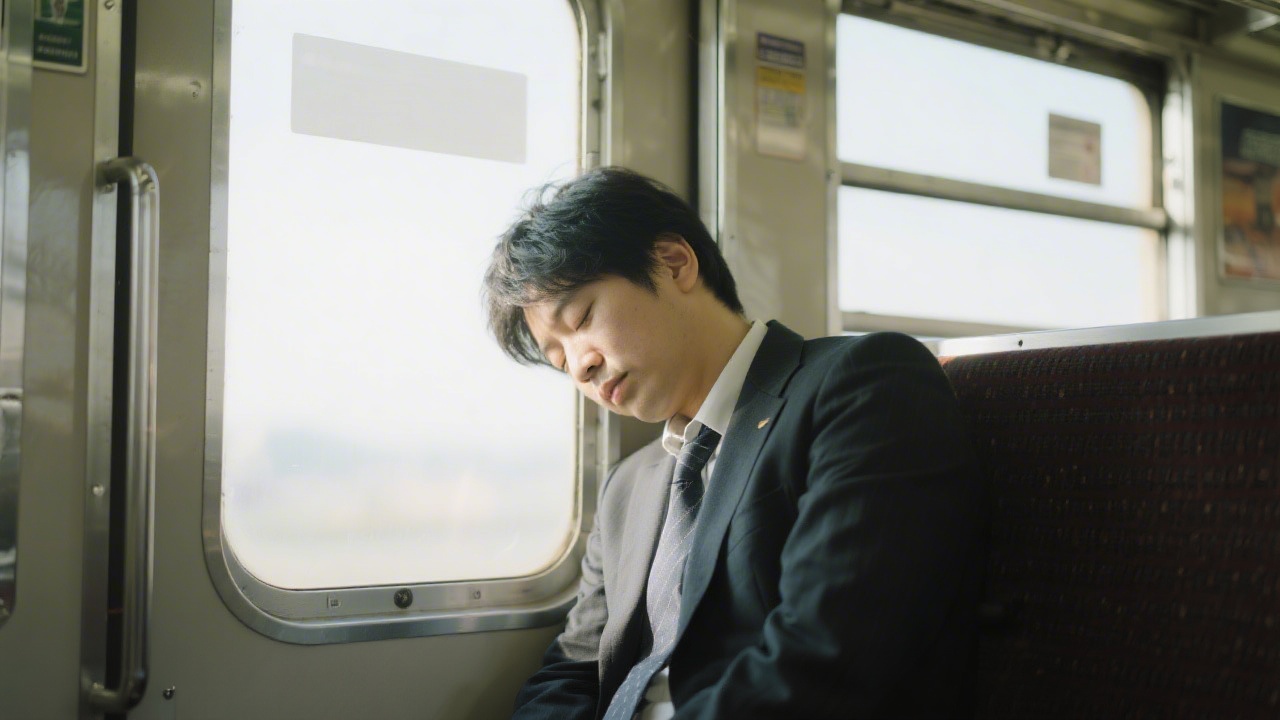
Inemuri is not simply falling asleep on the train home. It is a socially recognized practice with specific rules. The sleeper maintains a posture of partial engagement — upright in a chair, not slumped horizontally across seats. The message conveyed is: I am so dedicated to work and social obligations that I have exhausted myself, but I remain available. The nap is evidence of commitment, not laziness.
Anthropologist Brigitte Steger of Cambridge University documented inemuri across Japanese contexts in her 2003 research. She found that social status affects how freely one can inemuri: high-status individuals (senior executives, professors) enjoy the most freedom to nap publicly, as their naps are read as earned exhaustion. Junior employees napping in meetings risk appearing disrespectful.
Commute Times and Structural Sleep Loss
Tokyo residents average commute times of 48 minutes each way — among the highest globally. Combined with a work culture that makes leaving the office before one’s manager socially costly, average workday departures of 8 or 9 PM are not unusual in many corporate environments. The time simply does not exist for 8 hours of sleep when commute plus work plus social obligations fill 17 to 18 waking hours.
The trains themselves have become unofficial napping infrastructure. JR Central data suggests a meaningful portion of commuters on longer routes nap during transit. The trains are quiet, the stops are announced, and an informal social code prevents anyone from disturbing a sleeping commuter unless they are in imminent danger of missing their stop.
The Corporate Nap Room Revolution
In recent years, a new counter-movement has emerged. Several major Japanese companies, including Okuta Corporation, Crazy Inc., and various tech firms in Tokyo’s Shibuya district, have installed dedicated nap rooms after research demonstrated they improved afternoon productivity and reduced errors. The framing is revealing: the companies justify nap rooms through productivity metrics, not wellbeing language. The right to rest is backed by measurable output, not inherent human need.
Some municipalities have also experimented with “nap cafes” — establishments where patrons pay for 20-minute rest sessions in semi-private pods. These are distinct from full capsule hotels; they are positioned as performance tools for the busy professional.
What Japanese Sleep Culture Teaches Us About Mattress Choice
Traditional Japanese sleep culture favored the futon — a thin cotton mat laid directly on tatami flooring. Futon sleeping engages core muscles differently from Western spring mattresses and aligns with a culture that historically valued firm support over cushioned softness. Modern Japanese urban apartments have largely shifted to Western-style beds, and the mattress market has grown significantly.
The sleep pressure Japanese adults accumulate from chronic short nights means that when they do sleep, sleep quality matters enormously. Research on “sleep debt” shows that a high-quality sleep surface can improve slow-wave deep sleep, the most restorative stage. For those trying to maximize limited sleep hours, the mattress becomes more important, not less.
The Hidden Health Costs
The social tolerance for sleep deprivation in Japan has real medical consequences. Japan’s National Health and Nutrition Survey data shows that sleep problems cost the Japanese economy an estimated $138 billion annually in lost productivity according to RAND Corporation research. Hypertension, metabolic syndrome, and depression rates are all elevated in working-age Japanese adults compared to age-matched European cohorts.
The Japanese government launched a national sleep health initiative in 2014, producing official sleep guidelines recommending adults target 6 to 9 hours depending on age — a direct acknowledgment that the cultural norm of short sleep has measurable health costs. Whether cultural change follows policy guidance is a different question.
Internal Links
For more on sleep across cultures, see our guides on hunter-gatherer sleep patterns, co-sleeping practices worldwide, and the historical causes of modern sleep deprivation. You may also find our best mattress guide useful if you are evaluating your current sleep setup.
Frequently Asked Questions
What is inemuri in Japanese culture?
Inemuri (仕嵢り) literally means 'sleeping while present.' It refers to the practice of napping in public spaces — trains, offices, meetings — while technically remaining present and available. Unlike Western napping stigma, inemuri signals dedication: you are so committed to work that you exhausted yourself.
How many hours do Japanese people sleep on average?
According to OECD data and multiple national health surveys, Japanese adults average approximately 6.3 to 6.5 hours of sleep per night — the lowest among all OECD nations. South Korea is a close second at around 6.6 hours.
Does Japan have higher rates of sleep disorders?
Yes. Japan has notably high rates of sleep deprivation and insomnia. Studies suggest over 20% of Japanese workers regularly get fewer than 6 hours of sleep. There is growing recognition of karoshi (death from overwork) and its link to chronic sleep deprivation.
Why do Japanese people sleep less than other nations?
Multiple factors contribute: long commute times averaging 48 minutes each way in Tokyo, a strong work culture with implicit pressure against leaving before colleagues, high urbanization and noise, and historically less emphasis on bedtime routines for adults.
Is the Japanese practice of inemuri healthy?
Short inemuri naps (10-20 minutes) align with research on power naps, which improve alertness and cognitive performance. However, inemuri is often symptomatic of chronic night-time sleep deficit rather than a healthy supplement to full sleep. The nap does not compensate for lost deep sleep stages.
Upgrade your sleep with Saatva
The Saatva Classic is handcrafted in the USA, with three firmness options and a 365-night home trial. No showroom pressure.