
 by
by How Long Will Your Mattress Last? Durability Testing Explained
Mattress durability claims range from “lasts 10 years” to “15,000 rollator test cycles.” These numbers come from standardized testing protocols, not random manufacturer assertions. Understanding what the tests actually measure lets you evaluate longevity claims accurately and identify which specifications correlate with real-world lifespan.
Our Pick
Saatva Classic
Top-rated by our testing team. White-glove delivery included.
The ASTM Rollator Test: What It Measures
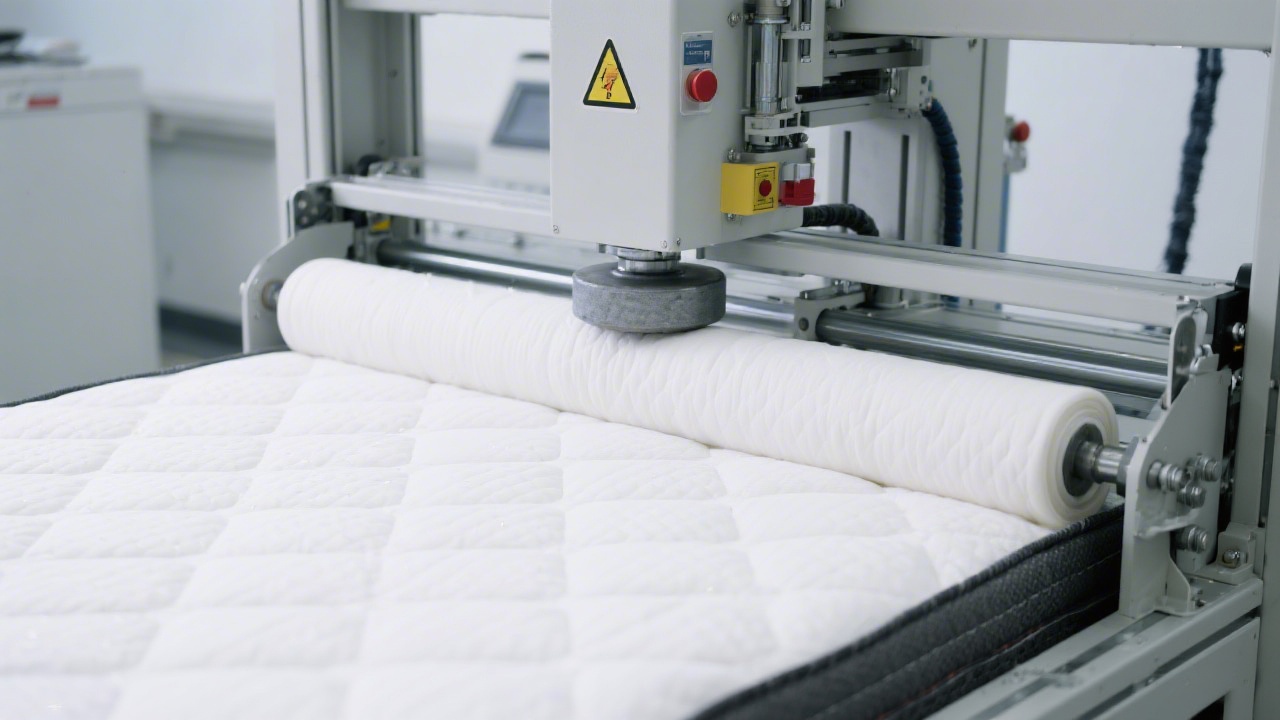
The industry standard for mattress durability testing is ASTM F1566, the Standard Test Methods for Innerspring and Mattress Assemblies. The core procedure uses a rollator: a 240-lb cylindrical roller that traverses the mattress surface end-to-end in a standardized pattern, simulating the loading and unloading cycles of daily use.
Key parameters:
- Standard test: 30,000 single-pass cycles (equivalent to approximately 10 years of use at two 230-lb sleepers for 8 hours per night)
- What is measured: Height loss (sag), firmness change (ILD reduction), and border edge loss after testing
- Acceptance thresholds: Height loss ≤0.75 inches and ILD change ≤15% for a product to pass standard durability requirements
Some manufacturers publish higher cycle counts as a premium feature. The Saatva Classic is tested to 15,000 rollator cycles (equivalent to approximately 5 years of heavy use), with loss metrics well within the ASTM thresholds — indicating a design built for 10+ year field use at normal loads.
California Rollator vs. ASTM Rollator
Two rollator standards are common in the industry:
- ASTM F1566: Uses a cylindrical steel roller, 240 lbs, 30,000 cycles. The primary US standard.
- ISO 2439 / EN 1957: The European equivalent, using a different loading profile. Less common in US manufacturer specs.
Budget manufacturers sometimes publish only foam ILD testing (ASTM D3574) without rollator results. ILD testing measures initial firmness, not durability — a foam can have excellent initial ILD and poor durability if its cell structure degrades rapidly. Always look for rollator results, not just ILD claims.
Foam Durability Specifications
For foam comfort layers, two specifications are the best predictors of longevity:
| Specification | What It Measures | Good / Poor Threshold |
|---|---|---|
| Foam Density (lb/ft³) | Mass of foam per unit volume — higher = more material, more resilience | ≥1.8 lb/ft³ good; <1.5 poor |
| Resilience (% rebound) | How much energy a ball dropped onto the foam returns — higher = more elastic recovery | ≥40% good; <25% very low resilience |
| ILD (Indentation Load Deflection) | Force needed to compress foam 25% | Not a durability measure; indicates firmness only |
| SAG Factor (Support Factor) | Ratio of 65% ILD to 25% ILD — indicates how much support increases under deeper compression | ≥2.0 good; indicates anti-bottoming |
Coil System Durability Specifications
For coil support systems, the key durability indicators are:
- Coil gauge: Lower number = thicker steel wire = higher spring rate. 12–14 gauge is premium durability. 15–18 gauge is standard. Budget coils at 18+ gauge lose temper (the hardening treatment that makes them spring back) faster under repeated heavy loads.
- Tempered vs. untempered steel: Tempered coils are heat-treated to resist permanent deformation. Untempered coils lose spring height measurably faster under the ASTM rollator test.
- Coil count vs. coil gauge: High coil count with thin gauge is not better than moderate count with thick gauge. A 700-coil queen at 15 gauge outperforms a 1,000-coil queen at 18 gauge in long-term rollator testing.
What Real-World Lifespan Looks Like by Type
| Mattress Type | Expected Lifespan | Key Durability Factor |
|---|---|---|
| Budget Memory Foam (<1.5 lb/ft³) | 4–6 years | Low-density foam degrades fastest |
| Standard Memory Foam (1.8 lb/ft³) | 7–10 years | Moderate density holds up well |
| Latex (Dunlop / Talalay) | 12–20 years | Natural rubber has very high resilience |
| Innerspring (quality gauge) | 8–12 years | Tempered coil retention |
| Hybrid (premium, 15-gauge coil) | 10–15 years | Coil durability + foam comfort layer quality |
| Two-sided mattress (flippable) | 15–25 years | Twice the wear surface extends life substantially |
Evaluating Durability Claims
When a brand makes durability claims, ask for:
- The specific test protocol (ASTM F1566 or equivalent)
- The number of rollator cycles tested
- The height loss and ILD change results after testing
- The foam density in the comfort layer (lb/ft³)
A brand that cannot or will not provide ASTM test results is relying on warranty language rather than testing data. Warranties cover manufacturing defects and sagging beyond a threshold (typically 1.5 inches), but they do not guarantee durability — they specify when a replacement or refund will be provided. A mattress can have a 10-year warranty and fail noticeably at year 4 without triggering warranty coverage if the sag measures under the threshold.
For related context, see our Saatva mattress review which details the specific rollator testing results for the Classic model, and our best mattress guide for durability-ranked recommendations.
Our Pick
Saatva Classic
Top-rated by our testing team. White-glove delivery included.
Frequently Asked Questions
What is the ASTM rollator test?
The ASTM F1566 rollator test uses a 240-lb cylindrical steel roller that traverses the mattress surface end-to-end repeatedly, simulating years of daily use in a controlled time frame. After a standard 30,000 cycles, the mattress is measured for height loss, firmness change, and edge integrity. Results indicate whether the mattress will maintain performance over its intended lifespan.
How many years does a typical mattress last?
The Sleep Foundation and most manufacturers recommend replacing mattresses every 7–10 years. However, this is an average. Budget foam mattresses may need replacement at 5–6 years; high-quality latex and premium hybrid mattresses can perform well for 12–15 years. The trigger for replacement is performance — sagging, firmness loss, or pain on waking — not a fixed calendar date.
What mattress specifications indicate the best durability?
In foam: density ≥1.8 lb/ft³ and resilience ≥40%. In coil systems: 14–15 gauge tempered steel. In design: two-sided (flippable) construction doubles effective wear surface. In cover: organic cotton or wool, which handles moisture transmission better and resists breakdown. Combine these factors to evaluate any specific model.
Does mattress weight affect how long it lasts?
Heavier sleepers accelerate foam compression and coil wear. A mattress rated for 250 lbs per side will meet its durability specification only when used at or below that weight. At 300 lbs, the same mattress may show equivalent wear in 6–7 years rather than 10. Choosing a mattress rated for your actual weight — or higher — is the most effective way to ensure rated durability.
Can I extend my mattress’s lifespan?
Yes. Rotate the mattress 180 degrees every 3–6 months to distribute wear evenly. Use a quality moisture-permeable mattress protector to prevent sweat absorption that accelerates foam breakdown. Ensure the foundation is rigid and has adequate center support. For two-sided mattresses (like the Saatva Classic), flip and rotate quarterly.