
 by
by Editor's pick — melatonin-free
NooCube Sleep Upgrade
Melatonin-free formula · 60-night guarantee · Lemon balm 600 mg + magnesium + lavender
TL;DR
Light is the single most powerful circadian cue your brain has — far stronger than any supplement. Endogenous melatonin begins to rise about 2 hours before your habitual sleep (DLMO). Bright light in the morning pulls your clock earlier; bright light at night pushes it later. 450–480 nm blue wavelengths are most suppressive, and as little as 10–15 lux at night can blunt melatonin release. Fix your light schedule first; if circadian reset isn't enough, a hormone-free option like NooCube Sleep is the cleanest add-on.
Jump to section
Light is the master clock signal; melatonin is the downstream hormone. Your eyes send timing information to a tiny nucleus in the hypothalamus, which then decides when the pineal gland releases melatonin. Get the light schedule right and most sleep problems soften on their own. Get it wrong — bright phone in bed, dim mornings indoors — and no supplement fully compensates. Here is the full physiology, the timing protocol, and what to do when light alone isn't enough.
How Light Controls Melatonin
Light-to-sleep runs through three structures: ipRGCs (intrinsically photosensitive retinal ganglion cells) in the retina, the suprachiasmatic nucleus (SCN) in the hypothalamus, and the pineal gland. This is a non-visual circuit — you don't need to consciously see the light for it to work.
The photopigment inside ipRGCs is melanopsin, maximally sensitive around 480 nm — the cyan-blue band present in midday daylight and in most white LEDs. When it fires, the SCN gets a "daytime" signal through the retinohypothalamic tract, tells the pineal to stop producing melatonin, and resets its own clock. Remove the light and within 30–90 minutes melatonin release resumes.
Endogenous melatonin rises about 2 hours before your habitual sleep time (your DLMO — dim light melatonin onset) and peaks in the middle of the biological night. It is not a sedative so much as a timing signal: lower core temperature, slow metabolism, prepare for sleep. See our guide to melatonin production for the biochemistry.
The timing of DLMO is the single most useful number in practical circadian work. If you naturally fall asleep around midnight, your DLMO sits near 10 p.m. If you fall asleep around 1 a.m., yours is closer to 11 p.m. This 2-hour rule of thumb is surprisingly robust across healthy adults and gives you a free estimate without a salivary assay — enough to plan low-dose melatonin timing, evening light cut-off, and morning exposure.
The Circadian Phase Response Curve
The phase response curve (PRC) describes how a pulse of light at different times relative to your internal clock either advances (pulls earlier), delays (pushes later), or does effectively nothing. Mapped in humans by Lewy, Czeisler, Duffy and colleagues across decades of laboratory work, it is remarkably consistent across healthy adults:
- Morning light (first 2–3 hours after wake) advances your phase. DLMO moves earlier, you get sleepy earlier, you wake earlier. The main lever for delayed sleep phase syndrome.
- Late-evening or first-half-of-night light delays your phase. DLMO shifts later, sleep onset drifts into the early morning. Scrolling your phone at 1 a.m. sits in this zone.
- Light around DLMO has a small phase effect. The advance and delay zones sit 4–6 hours before or after DLMO.
- Darkness works in the opposite direction. Missing morning light in winter effectively delays the clock — the absence of bright light is itself a signal.
Morning outdoor light and strict evening darkness are synergistic: they pull the phase in the same direction from both ends of the day. For dose timing against the PRC, see our melatonin timing guide.
Morning Light Protocol
The highest-leverage circadian intervention is bright light in the first hour after waking. Aim for 10–30 minutes outdoors, ideally walking. Even an overcast sky delivers 10,000–25,000 lux at the eye; a well-lit indoor room rarely exceeds 300–500.
- Dose. Sunny day: 5–10 minutes. Overcast: 20–30 minutes. Pre-dawn: 10,000 lux light box at eye level for 20–30 minutes.
- Gaze. Do not stare at the sun. Looking toward the horizon, or simply being outdoors, saturates the ipRGC pathway.
- Glasses. Regular glasses and contacts are fine. Sunglasses blunt the signal — save them for midday.
- Windows. Glass cuts transmission by 20–50%. Better than nothing, not a substitute for outside.
- Consistency > intensity. A 15-minute walk every morning beats 60 minutes on Sunday.
Wake time consistency matters nearly as much as light itself. A 3-hour weekend sleep-in produces "social jet lag" and erases the week's phase-setting. If you must shift, keep the wake time within 60 minutes of your weekday schedule and use morning light aggressively on day one of the recovery.
Evening Light Avoidance
If morning light is the accelerator, evening light is the brake you keep mistakenly stepping on. Bright evening light suppresses the natural melatonin rise and delays your phase the next day — a double hit. The critical window is 2–3 hours before bed through sleep onset, and the effect is dose-dependent: the brighter and bluer the source, the larger the suppression.
- Red-shift screens. Night Shift, Night Light, or f.lux from sunset onward. Warm point below 3000K, closer to 2000K in the final hour.
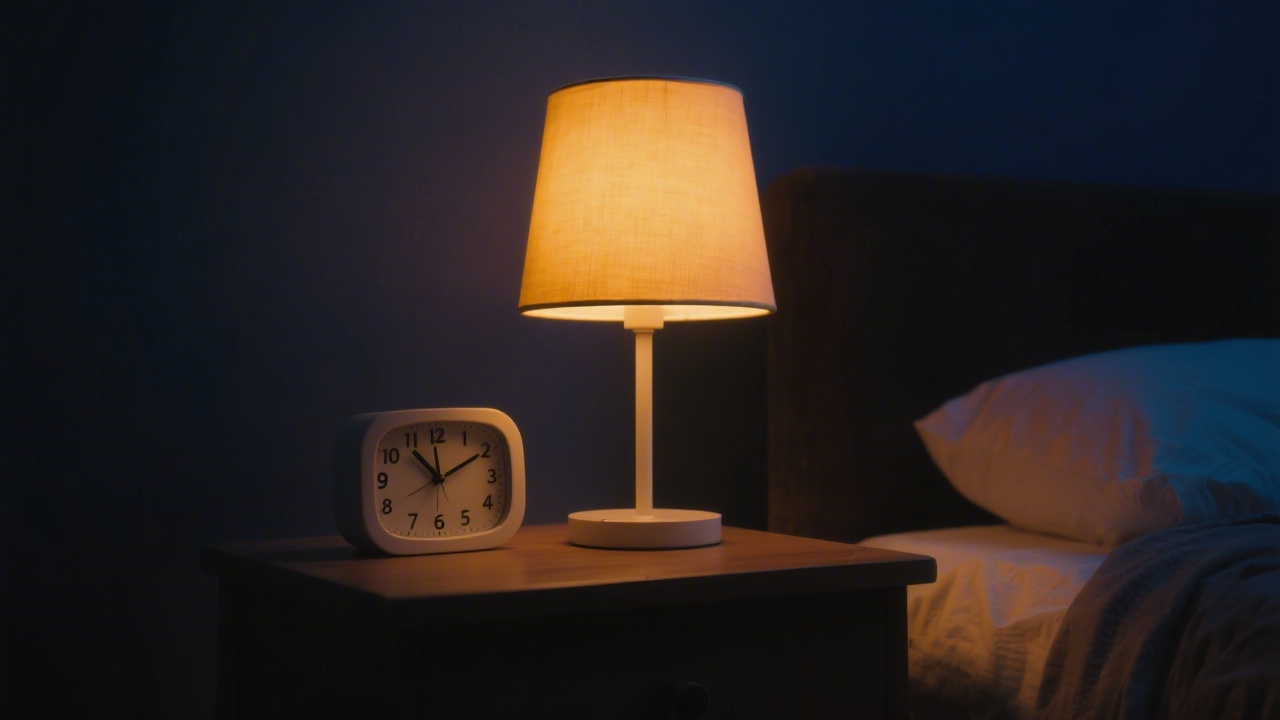
- Dim interiors. A single warm table lamp at 40–60 lux beats overhead LEDs at 300–500. Many homes overlight evenings 10x.
- Kill overhead LEDs. Recessed cool-white ceilings in kitchens and bathrooms are the worst offender. Use warm-dim bulbs or skip the fixtures in the last 2 hours.
- Task, not ambient. A small reading lamp pointed at a book is gentler than a bright room washing the whole retina.
- Candle-like intensity in the last hour. If you can read comfortably, you're brighter than you need to be.
Blue Light Specifically
The ipRGC-melanopsin system peaks around 480 nm, with a sensitivity band from 450 to 495 nm — the blue-cyan portion of the visible spectrum. Key numbers:
- 450–480 nm is the most suppressive band. Most white LEDs spike here. See our blue light wavelength breakdown.
- 10–15 lux at the eye can suppress melatonin at night — less than a hallway nightlight. Dose-dependent suppression has been demonstrated at these intensities when the spectrum is blue-rich.
- Red and amber wavelengths (>600 nm) are essentially non-suppressive. This is why red nightlights are a real solution.
- Amber glasses in the last 2 hours can preserve 50–70% of the natural melatonin rise that unblocked screens flatten.
- Blue-filter contacts offer a smaller, measurable benefit — not equivalent to amber glasses.
If you buy one piece of circadian hardware, amber glasses after sunset are the highest ROI. Look for models that block 100% of wavelengths below 500 nm rather than the "20% blue reduction" computer glasses — the latter are effectively useless for melatonin protection. Uvex S1933X and Swannies are two inexpensive, well-tested options.
Shift Work and Circadian Disruption
Night-shift workers fight their own physiology every rotation. The Czeisler-Smith protocol uses four tools to drag the system toward the shifted schedule:
- Bright light during the first half of shift. A 10,000 lux light box on the desk for the first few hours sends a "daytime" signal to the SCN.
- Dark glasses on the commute home. Wrap-around amber glasses worn in daylight prevent morning sun from shifting phase the wrong direction.
- Cave-level blackout bedroom. Tape curtain edges, kill LED indicators. You're asking your retina to believe it's night at 10 a.m.
- Low-dose melatonin. 0.3–0.5 mg about 30 minutes before your new "bedtime." See our jet-lag and shift-work guide.
- Consistency on days off. Flipping back to a daytime schedule on weekends erases the benefit.
Rotating shifts (week on, week off) are biologically the worst pattern because the clock never settles. Fixed nights, counter-intuitively, are easier on long-term metabolic and cardiovascular health, even though they remain worse than a straight day schedule.
Seasonal Affective Disorder and Light Therapy
SAD and "winter blues" are a light-deficit problem. The clinical protocol: 10,000 lux at eye level for 20–30 minutes within the first hour of waking, daily from late autumn through early spring.
- Device specs. A medically rated box has a diffuser, UV filter, and delivers stated lux at 14–24 inches. Under-powered "mood lamps" don't qualify.
- Positioning. About 45 degrees above your line of sight. Glance at it, don't stare.
- Timing. Earlier is better — 6–8 a.m. beats post-10 a.m. for most patients.
- Onset. Most responders improve in 3–7 days. No effect after 2 weeks usually means wrong device or timing.
- Contra-indications. Bipolar spectrum disorders can be destabilised — coordinate with a clinician.
Dawn simulators (gradual brightening over 30–60 minutes before wake) are a gentler alternative with modest evidence for mild SAD, and they pair well with a cortisol-rhythm-friendly wake. Some patients tolerate a simulator when a full 10,000 lux box is initially too aggressive, then transition to the box once they've acclimated.
NooCube Sleep Upgrade
A melatonin-free sleep supplement that works with your circadian system instead of replacing hormones. Clinical testing (DBEM) showed 35% faster sleep onset and 28% higher sleep score on Oura/Whoop over 30 nights.
- Lemon balm 600mg + lavender extract for calm
- Magnesium citrate + calcium + vitamin D3 for sleep architecture
- No habit-forming ingredients, no morning grogginess
- 60-day money-back guarantee, GMP-certified USA manufacturing
Affiliate disclosure: we may earn a commission from this link at no extra cost to you.
Practical Lighting Setup at Home
Most circadian plans fail because the home environment silently undoes them. A weekend of lighting triage pays dividends for years.
- Bedroom. Blackout curtains with side-tracks, a door-sweep, tape over every LED indicator. Target: can't see your hand at arm's length after 2 minutes of dark adaptation.
- Bedside. One 2700K (or lower) lamp with a physical dimmer. Nightlight, if needed: red or deep-amber at ankle height.
- Hallway/bathroom. Motion-activated red nightlight. The 3 a.m. bright overhead trip wipes out an hour of melatonin.
- Living room. Kill overhead fixtures after sunset. Use 2–3 warm dimmable lamps. Smart bulbs (Hue, LIFX) automate it.
- Kitchen. Recessed cool-white LEDs are the worst offender at 9 p.m. Swap to warm-dim or use under-cabinet warm LEDs.
- Screens in bed. Don't. If you must: maximum red-shift, lowest comfortable brightness.
Apps and Tools
- f.lux. Original colour-temp auto-adjuster for Windows/macOS/Linux. Configurable, free.
- Night Shift / True Tone (Apple). Schedule Sunset-to-Sunrise, warm point far right. Pair with Reduce White Point for an extra floor.
- Night Light (Android/Windows) and Samsung's Eye Comfort Shield do the same job.
- Timeshifter. Best jet-lag planner, built on Lewy-lab PRC research. See our sleep aid apps roundup.
- Philips Hue / LIFX circadian routines. Program Wake Up and Go to Sleep routines that shift colour and brightness.
- Lux light meter apps. Accurate within ~20% — genuinely useful for auditing your home.
- Wearables. Oura, Whoop, Apple Watch, Fitbit — help triangulate DLMO over weeks.
When Light Alone Isn't Enough
If you have optimised light for 3–4 weeks and sleep is still poor, the problem is usually an unrecognised sleep disorder, a structural factor (caffeine, alcohol, stress, meds), or a deficit that light can't fix.
- Low-dose melatonin. 0.3–0.5 mg 5–6 hours before target DLMO is the circadian-shifting dose. OTC 3–10 mg tablets are sedatives, not timing agents. See our melatonin for sleep guide.
- NooCube Sleep Upgrade. Hormone-free stack for GABAergic calming (lemon balm, lavender) plus sleep architecture (magnesium, calcium, D3). Read our NooCube Sleep review.
- CBT-I. First-line for chronic insomnia per the AASM. Apps like Somryst and Sleepio deliver the protocol.
- Structural issues. Apnea, RLS, thyroid, perimenopause, chronic pain will outrun any light hygiene. See our insomnia tips.
- Other natural options. Magnesium, glycine, L-theanine, apigenin. See our natural sleep aids rundown.
Clinical Perspective
Most adults can self-manage circadian hygiene. If you've tried consistent light timing for 4–6 weeks and sleep onset, total sleep time, or daytime alertness have not improved, book a board-certified sleep physician. Bring a 2-week sleep diary and any wearable data — it will accelerate diagnosis dramatically.
- Chronotherapy. Structured 15–30 minute bedtime advances (or delays) over weeks, paired with light and melatonin, for DSPS and ASPS.
- DSPS treatment. Morning bright light, strict evening restriction, 0.3–0.5 mg melatonin 5–6 hours before target DLMO. Most patients advance 1–2 hours over 2–4 weeks.
- ASPS treatment. Evening bright light, morning light avoidance, timed melatonin early in the biological night. More common in older adults.
- Non-24 disorder. Most common in totally blind individuals. Specialist management with tasimelteon or timed melatonin.
- Salivary DLMO assay. Available in sleep medicine clinics. Gold standard for phase assessment.
Common Mistakes
- Bright phone in bed. The most common self-sabotage. Proximity at 30 cm delivers more lux than ceiling lights even at 50% brightness.
- Sunglasses indoors or at breakfast. Blocks the morning signal. Save shades for midday.
- Irregular wake times. 2–3 hour weekend sleep-ins produce social jet lag.
- Late-afternoon naps. A nap after 4 p.m. flattens adenosine pressure. Keep naps before 2 p.m. and under 25 minutes.
- Thinking dim is enough. True dim means "can't read printed text." 10–15 lux suppresses melatonin.
- Trusting f.lux alone. Screen colour matters, but room brightness matters more. A warm screen in a 500 lux room is still bad.
- Overdosing melatonin. 5–10 mg produces grogginess and vivid dreams with no measurable phase shift. 0.3–0.5 mg is the circadian dose.
- Caffeine after noon. Half-life 5–7 hours. A 3 p.m. latte still has a quarter dose on board at 11 p.m.
- Alcohol as sleep aid. Shortens onset but fragments second-half sleep and suppresses REM.
FAQ
How much morning light do I actually need?
10–30 minutes outdoors within 1 hour of waking. Sunny: 5–10 minutes. Overcast: 20–30. Indoor ambient light rarely hits the threshold — go outside or use a 10,000 lux box.
Does indirect sunlight count?
Yes. The ipRGC pathway responds to total lux, not direct beams. An open north-facing deck delivers 20,000+ lux without any direct sun. Don't stare at the sun — you don't need to.
What about kids' evening screens?
Children and adolescents appear more sensitive to melatonin suppression, not less. Hard screen-off 60–90 minutes before sleep for pre-teens, 30–60 for teens. If homework requires it, maximum red-shift and lowest brightness in a dim, warm-lit room.
Does aging change how eyes handle light?
Yes. Lens yellowing and smaller pupils cut transmitted blue light 2–3x between age 20 and 70. Older adults often benefit from longer morning exposure. Cataract surgery with a clear IOL partially reverses this.
Are blackout curtains worth it?
For most people, yes. A single streetlight at 3–8 lux at the pillow blunts melatonin in sensitive individuals. Blackout curtains, door-sweep, and LED-tape cost under $100 and show wearable improvements in a week.
How do I adjust for seasons?
Winter: increase morning exposure, be stricter about evening dim light, consider a 10,000 lux box if you live above 40° latitude. Summer: bedroom blackout matters more because sunrise is earlier.
What about reading lights on airplanes?
Eastbound long-haul: cabin light off and mask on for your destination's night. Westbound: overhead light and window shade up to stay awake through the destination's day. Timeshifter plans this automatically. See our jet lag protocol.
Do evening workouts disrupt sleep?
Intense exercise within 1 hour of bed raises core temperature and sympathetic tone. Gym environments also flood you with 500–1,000 lux of cool-white LEDs. Finish 2–3 hours before bed and step outside briefly afterwards.
Are incandescents better than LEDs for evening?
Spectrally, yes — incandescents emit little below 500 nm. Modern warm-dim LEDs that drop below 2200K are a good substitute. Standard 4000K cool-white LEDs are the worst option for evening rooms.
Related reading: NooCube Sleep Review | Blue Light Wavelength | Melatonin for Sleep Guide | Melatonin Production | Melatonin Timing Guide | Melatonin & Jet Lag | Insomnia Tips | Natural Sleep Aids | Sleep Aid Apps