
 by
by A quality memory foam mattress lasts 8 to 10 years with proper care, compared to 5 to 7 years for innerspring and 12 to 15 years for latex. The Saatva Loom & Leaf is our top pick for the memory foam category: its 5 lb/ft³ high-density foam core resists compression better than any all-foam rival, backed by a lifetime warranty and a 365-night trial. The Amerisleep AS3 is the strongest value alternative at a lower price point.
Saatva Loom & Leaf
9.2/10
- 5 lb/ft³ high-density memory foam core, densest in its class for long-term durability
- Lifetime warranty, the strongest coverage in the all-foam category
- 365-night trial, three times longer than most bed-in-a-box brands
- Free white-glove delivery, setup, and old mattress removal included
- Relaxed Firm (6/10) or Firm (8/10) only, not ideal for strict side sleepers who prefer plush
- Higher price point than most online all-foam brands
If you want the longest-lasting memory foam mattress on the market, the Loom & Leaf's 5 lb/ft³ foam density and lifetime warranty are the two strongest durability arguments in the all-foam category, combined with the most generous trial window we've seen.
How long does memory foam actually last?
Memory foam mattresses typically hold up for 8 to 10 years before noticeable body impressions appear, assuming you are using a proper foundation and rotating the mattress every 3 to 6 months. The actual lifespan depends heavily on foam density: low-density foam (under 3.5 lb/ft³) shows body impressions within 4 to 6 years, while high-density foam (5+ lb/ft³) can stay firm for a decade or more.
| Foam density | Expected lifespan | Price tier |
|---|---|---|
| Low (3–3.5 lb/ft³) | 4–6 years | Budget ($300–$600) |
| Medium (4–4.5 lb/ft³) | 6–8 years | Mid-range ($600–$1,500) |
| High (5+ lb/ft³) | 8–10+ years | Premium ($1,500+) |
For comparison: innerspring mattresses last 5 to 7 years (coils fatigue under repeated compression), hybrid mattresses 7 to 10 years, and latex 12 to 15 years. A high-density memory foam mattress sits in the middle of the longevity range, well ahead of a basic innerspring.
What kills memory foam faster
Four factors accelerate foam degradation:
- Body impressions: Foam permanently compresses under repeated pressure. A heavier sleeper (200+ lb) accelerates this by 1 to 2 years compared to a lighter sleeper.
- Heat degradation: Memory foam softens over time from body heat. Budget foams with dense, closed-cell structures trap heat and degrade faster.
- Moisture: Sweat and humidity break down foam cell walls. A breathable mattress protector adds 2 to 3 years of effective life.
- Wrong foundation: A sagging or widely slatted base creates uneven pressure points that cause premature body impressions. Slats should be no more than 3 inches apart.
Signs your memory foam is worn out
Replace your mattress when you notice:
- A visible body impression deeper than 1 inch that does not recover when you get up
- Foam that does not spring back when you press it firmly
- You can feel the support base through the comfort layer
- Morning stiffness or back pain that fades within 30 minutes of moving around
- A persistent smell that does not go away after airing out
- The mattress is over 10 years old regardless of visible wear
Which mattress type lasts longest?
Latex leads the durability rankings, followed by high-density memory foam, then hybrids, then innerspring. However, durability alone does not determine which mattress is best for you: a latex mattress that does not match your firmness preference or sleep position fails the job regardless of how long it holds its shape.
Memory foam's main durability advantage over innerspring is that there are no metal coils to break down or start squeaking. The foam degrades gradually rather than failing suddenly, which gives you time to notice the signs before sleep quality drops sharply.
The best memory foam mattresses compared
| Mattress | Type | Firmness | Trial | Warranty | Queen price |
|---|---|---|---|---|---|
| Saatva Loom & Leaf | All-foam (5 lb/ft³) | Relaxed Firm 6/10 | 365 nights | Lifetime | From $1,695 |
| Amerisleep AS3 | All-foam (Bio-Pur) | Medium 5/10 | 100 nights | 20 years | From $1,049 |
| Saatva Classic | Innerspring hybrid | Luxury Firm 6/10 | 365 nights | Lifetime | ~$1,395 |
| Puffy Original | All-foam in-a-box | Medium 6/10 | 101 nights | Lifetime | ~$1,499 |
Amerisleep AS3
9.0/10
- High-density Bio-Pur foam (plant-based open-cell) resists body impressions better than standard memory foam
- HIVE 5-zone support layer reinforces the high-wear lumbar zone directly
- 20-year warranty covers sags over 1.5 inches, twice the industry standard
- CertiPUR-US certified, made in the USA
- Softer edges than a coil hybrid; sleepers over 230 lb may prefer the AS5 Hybrid
- 100-night trial shorter than premium brands
The AS3 delivers strong durability with its Bio-Pur foam and a 20-year warranty at a considerably lower price than the Loom & Leaf. The best value choice in the memory foam category.
How to extend memory foam life
These habits add 2 to 4 years to a quality mattress:
- Rotate every 3 to 6 months: Head-to-foot rotation distributes body weight across fresh foam zones. Memory foam is one-sided (do not flip).
- Use a waterproof protector: Even a thin washable protector stops sweat from reaching the foam, which is the single fastest way to preserve foam cell structure.
- Solid or closely slatted base: Box springs and widely spaced slats allow the foam to sag into gaps, creating permanent impressions in weeks.
- Air it out occasionally: Strip the bed for a few hours monthly to let moisture evaporate from the foam.
- Keep it away from heat sources: Radiators, heating pads left on overnight, and direct sunlight accelerate foam breakdown.
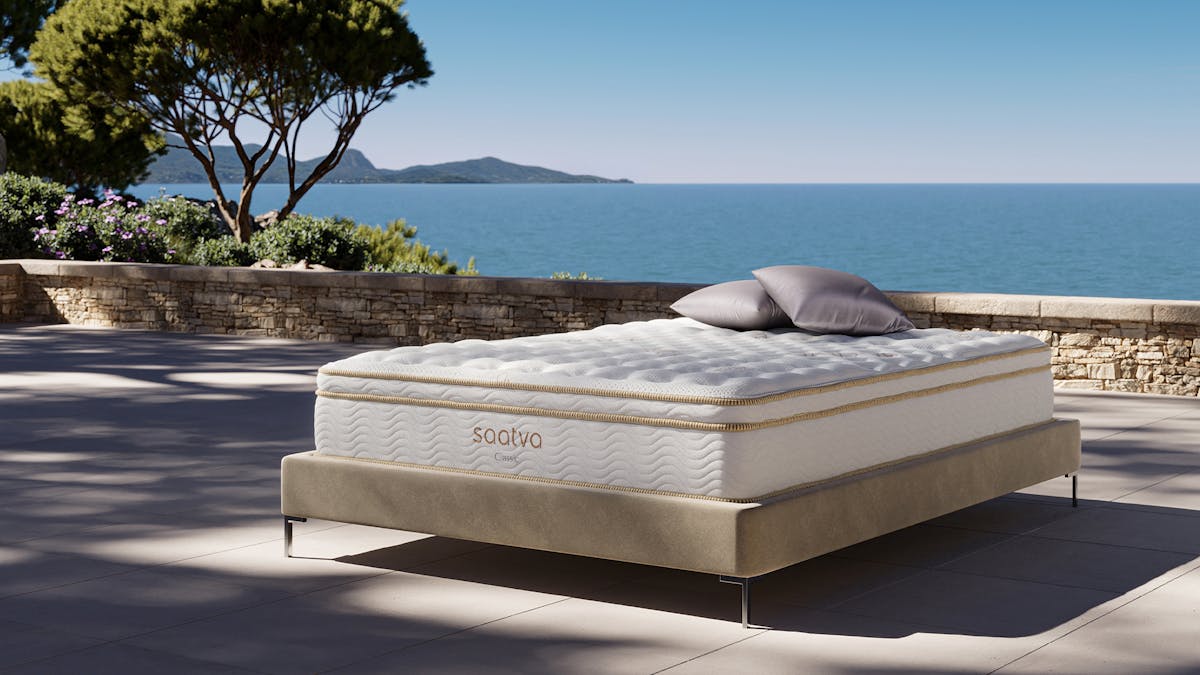
Saatva Classic
8.9/10
- Dual-coil construction with Euro pillow top, no foam core to sag under repeated pressure
- Zoned lumbar pad reinforces the highest-wear zone
- 365-night trial and lifetime warranty, the most generous coverage in the hybrid category
- Free white-glove delivery and old mattress removal
- Coil bounce transfers partner movement more than all-foam
- $99 return fee applies during the trial
If you want to move away from memory foam entirely, the Saatva Classic's coil-on-coil construction avoids foam degradation, and its lifetime warranty is the best durability guarantee in the hybrid category.
Memory foam durability questions
How often should a memory foam mattress be replaced?
Most sleepers should replace a memory foam mattress every 8 to 10 years. High-density premium foam can go 10 to 12 years with consistent rotation and a proper base. If your current mattress is under 8 years old but showing body impressions deeper than 1 inch, the base foam density was too low for your weight.
Does memory foam sag more than other types?
Standard memory foam sags faster than latex or hybrid coils because it has no structural springback mechanism. The foam slowly conforms to your body and does not fully recover. High-density foam (5 lb/ft³) mitigates this significantly, which is why checking the density spec before buying matters more for longevity than checking the cover material.
Is memory foam or hybrid better for durability?
It depends on the density. A high-density memory foam mattress (5+ lb/ft³) outlasts a hybrid with a thin comfort layer. A quality hybrid with individually wrapped coils and a dense comfort layer typically matches memory foam longevity at 8 to 10 years. Hybrids have better edge support, which matters for people who sit on the mattress edge when getting in and out of bed.
Does memory foam mattress quality affect how long it lasts?
Yes, directly. The density of the support base foam matters most: manufacturers cut costs by using lower-density base foam (1.0 to 1.2 lb/ft³) even when the comfort layer foam is denser. The support core carries most of your body weight night after night. A base foam under 1.5 lb/ft³ will compress and sag years earlier than a 1.8 lb/ft³ or higher base.
How do you fix a sagging memory foam mattress?
Sagging in the support core cannot be reversed. You can slow the progression by rotating the mattress, switching sides of the bed, or adding a firm mattress topper, but a sag over 1.5 inches is a warranty claim, not a maintenance fix. Check your warranty terms first: most quality brands cover body impressions over 1 inch for 10 years or more.
High-density memory foam lasts 8 to 10 years with proper care. The Saatva Loom & Leaf's 5 lb/ft³ foam and lifetime warranty are the strongest durability package in the all-foam category. The Amerisleep AS3 is the best value alternative with a 20-year warranty. The Saatva Classic is the top pick if you want a hybrid that avoids foam degradation entirely.
This guide is part of our Mattress Buying Guide hub, where we compare all the top picks and narrow down by sleep position, body type, and budget.