
 by
by Our Top Mattress Pick
The Saatva Classic pairs perfectly with an optimized sleep environment — responsive coils adapt to how you sleep.
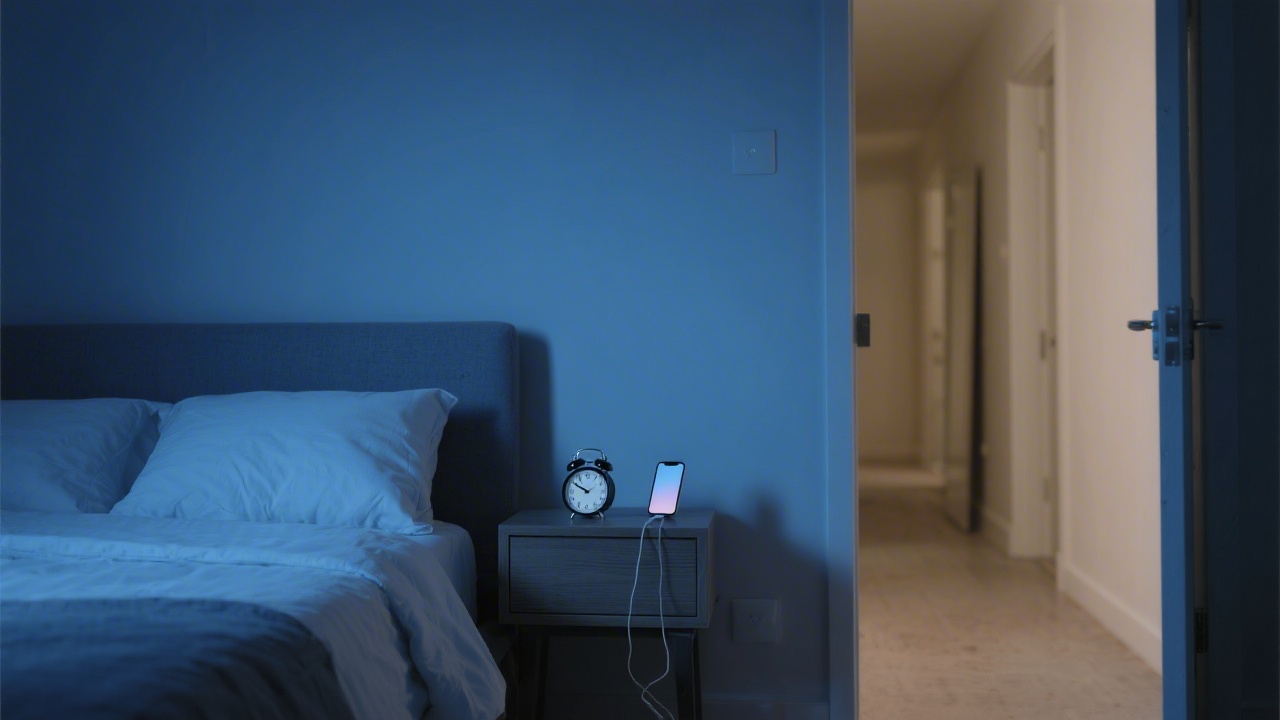
Removing the phone from the bedroom is consistently identified in sleep research as one of the highest-impact single behavioral changes for sleep quality. This guide covers the evidence, addresses the common objections (alarm, white noise, emergency contact), and provides a practical implementation plan.
If you are looking specifically for how to fall asleep when you cannot avoid phone use, see our page on how to fall asleep without looking at your phone. This guide covers the broader no-phone bedroom policy.
The Evidence: What Phone Removal Actually Does
Three mechanisms explain why phone removal improves sleep quality:
- Blue light suppression of melatonin: Screens emit blue-wavelength light that suppresses melatonin production. Even a 30-minute phone session 1 hour before bed delays melatonin onset by 1-1.5 hours in controlled studies. The effect is dose-dependent — lower brightness and blue-light filters reduce but do not eliminate the impact.
- Cognitive arousal from content: Social media, news, and messaging are specifically designed to activate reward and threat-response systems. These are the psychological opposites of the relaxed, low-arousal state needed for sleep onset. The effect persists beyond screen-off time.
- Nocturnal micro-arousals: Even silent notification vibrations have been shown in sleep studies to produce measurable interruptions in sleep architecture. The phone in the room activates hypervigilance regarding potential alerts.
Pros and Cons
What We Like
- Luxury innerspring with excellent lumbar support
- Multiple firmness options available
- Free white-glove delivery and mattress removal
- 365-night trial and lifetime warranty
What Could Be Better
- Higher price than many online brands
- Heavier than foam mattresses
- Not compressed in a box
- Some off-gassing possible initially
The Common Objections and Their Solutions
"I use it as an alarm."
A basic digital alarm clock costs $10-20 and eliminates the functional need entirely. Options:
- Basic LED alarm clock ($10): adequate for most people
- Sunrise alarm clock ($40-80): uses gradually brightening light to simulate dawn, reducing cortisol spike from sudden loud alarms. Research shows improved mood and alertness at wake time.
- Smart speaker in the hallway: audible from the bedroom, no screen in the room
"I use it for white noise."
A dedicated white noise machine produces more consistent sound than a phone app and does not require any screen-lit device in the room. The LectroFan ($50) and Marpac Dohm ($45) are the two most consistently well-reviewed models. A box fan produces comparable white noise at no additional cost if you already own one.
"I need to be reachable for emergencies."
This is the most legitimate objection. Options that maintain emergency reachability without full phone presence:
- Enable "Emergency Bypass" for specific contacts (family members) in Do Not Disturb settings. Their calls will ring even when silent.
- Use a secondary device (old phone on WiFi, or a basic cellular device) as a bedside emergency line only, with all apps removed
- Set the phone in the hallway or adjacent room with ringer volume high enough to hear
"I check my phone when I wake up at night and cannot fall back asleep."
This is actually evidence that the phone is disrupting sleep, not helping it. The stimulus of checking the phone at 3 AM activates the same cognitive arousal pathways that make it hard to fall asleep at bedtime. Removing the phone eliminates this loop. Use a white noise machine or sleep mask to provide a non-stimulating alternative for nighttime waking.
Implementation: A 7-Day Protocol
Night 1-2: Move the phone to the hallway or kitchen with a charger. Set your alarm clock as the backup. Expect the impulse to check the phone at bedtime and on waking.
Night 3-4: The habit-check urge diminishes. Most people report faster sleep onset starting night 3.
Night 5-7: The new pattern consolidates. At the end of week 1, assess: sleep onset time, nighttime waking frequency, and morning alertness.
What the Phone Removal Does Not Fix
Phone removal addresses the cognitive and light dimensions of sleep disruption. It does not fix temperature, humidity, noise, or mattress issues. For a complete assessment of all variables in your sleep environment, use our 50-variable sleep environment checklist. And for the physical foundation of sleep quality, see our sleep sanctuary setup guide.
Frequently Asked Questions
Does having your phone in the bedroom really affect sleep?
Yes, through multiple mechanisms. Blue light from screens suppresses melatonin. Notification sounds and vibrations cause micro-arousals even during sleep. The psychological habit of checking the phone increases cognitive arousal at bedtime. Multiple studies show that people who charge phones outside the bedroom fall asleep faster and report higher sleep quality.
How do I use my phone as an alarm without keeping it in the bedroom?
A basic digital alarm clock ($10-20) eliminates the only functionally necessary reason to keep a phone in the bedroom. Alternatively, a smart speaker (Alexa, Google Home) placed in the hallway can be set by voice command and will audibly wake you without having the phone in the room.
What do I use for white noise if not my phone?
Dedicated white noise machines (LectroFan, Marpac Dohm) are superior to phone apps because they produce consistent sound without the risk of notification interruption and do not require a screen-lit device in the room. A basic box fan produces effective white noise. Cost: $30-60 for a dedicated device vs. ongoing app subscription risk.
Is it okay to keep my phone in the bedroom if I use Do Not Disturb?
It is better than an unrestricted phone but still not optimal. Do Not Disturb eliminates notification sounds but does not address: the temptation to check the phone when waking at night, the standby light, and the cognitive association of the phone's presence with social connectivity. Physical removal is consistently more effective in behavioral studies.
How long does it take to adjust to no phone in the bedroom?
Most people report that the adjustment period is 3-5 nights. The first two nights involve the habit-check urge, particularly at bedtime and during any nighttime waking. By night 4-5, the pattern recalibrates. Sleep onset typically improves within the first week, and reported sleep quality improvement is noted within 2 weeks in most habit-change studies.
Complete Your Sleep Environment
Saatva Classic — The Foundation of Great Sleep
Once your room is optimized, your mattress determines 60% of sleep quality. Saatva's dual coil system adapts to temperature and pressure better than foam.