
 by
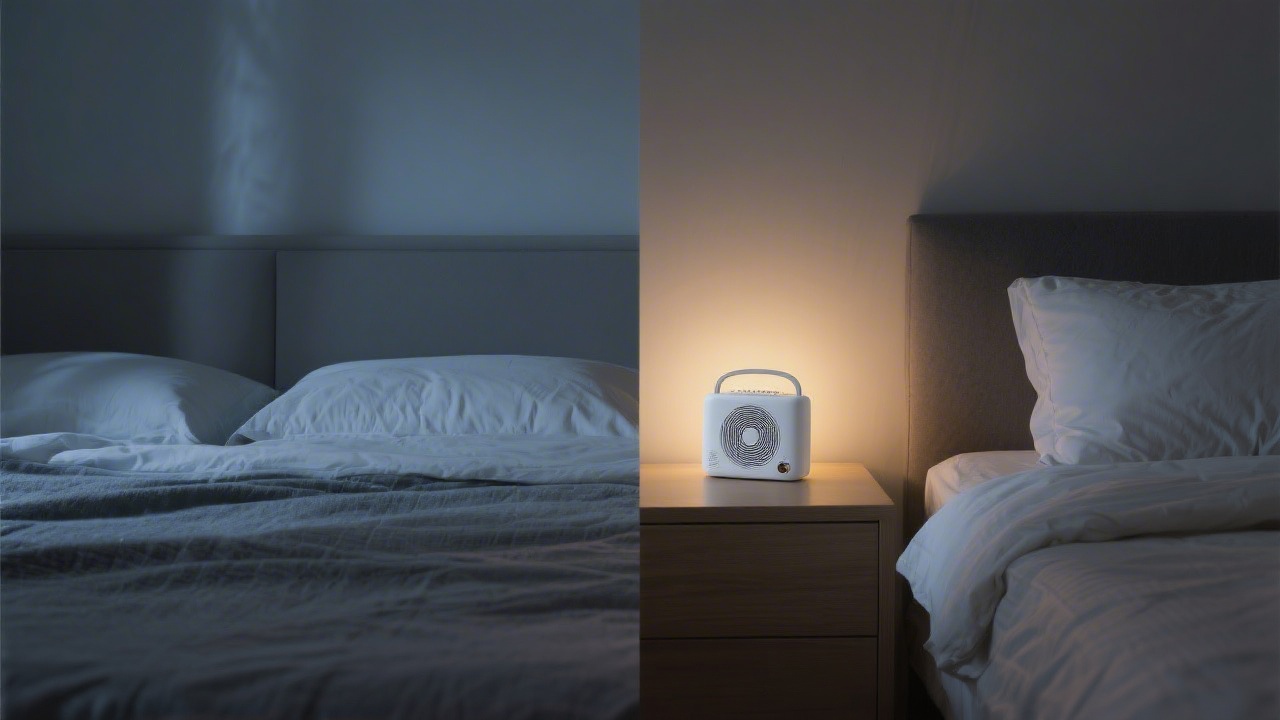
by The honest answer: silence wins — when you can actually have it. The research on this is clear. Multiple sleep lab studies show that when subjects are placed in a genuinely quiet room (30 dB or below), sleep onset is faster, slow-wave sleep duration is longer, and arousal frequency is lower compared to rooms with white noise playing at 50–55 dB.
The problem is that most bedrooms are not quiet. The average urban bedroom at night has ambient noise of 35–50 dB. A partner who breathes audibly, a refrigerator compressor in the hall, distant traffic — these are constant, and they contain acoustic spikes (a truck accelerating, a door closing) that trigger sleep-stage transitions. White noise wins in this environment not because it is better than silence, but because it is better than imperfect silence.
The Science: What Each Approach Does to Sleep
Silence: The Research Case
A 2021 study in Sleep Medicine measured sleep quality in subjects exposed to silence (30 dB), moderate white noise (55 dB), and high white noise (65 dB). The silence condition produced superior slow-wave sleep duration, fewer brief arousals, and subjectively higher sleep quality ratings. The conclusion was unambiguous: silence, when achievable, is physiologically optimal for sleep.
The mechanism: the auditory cortex is partially active during sleep, monitoring for acoustic events. In silence, there is nothing to process. In a white noise environment, the auditory cortex is continuously engaged with low-level processing of the background sound. This engagement is not disruptive at moderate levels, but it is not neutral either.
White Noise: The Research Case
A 2005 study in Critical Care Medicine placed patients in a noisy hospital environment and compared sleep quality with and without white noise. White noise significantly improved sleep quality metrics — reduced time to sleep onset, fewer awakenings, increased REM percentage. The key insight: the comparison was against a noisy environment, not against true silence. White noise reduced the acoustic contrast between quiet periods and noise spikes, protecting sleep continuity.
This is white noise's specific advantage: it is not that white noise is good for sleep, it is that noise variability is bad for sleep and white noise reduces variability. The masking effect smooths the acoustic landscape.
The Decision Framework: Which Approach for Your Situation
Use Silence When:
- Your bedroom measures consistently below 30–35 dB with a dB meter app
- You wake up feeling well-rested without white noise
- You sleep alone or your partner is quiet
- You are in a rural or very quiet suburban environment
- You have mild tinnitus that is masked by silence (silence can make tinnitus more prominent for some)
Use White Noise When:
- Your bedroom measures above 35 dB ambient or has frequent spikes above 50 dB
- You wake up at night due to noise (partner, traffic, neighbors, pets)
- You live in an urban environment or near a road
- You have a snoring partner
- Your bedroom has hard floors and walls that reflect sound (adding echo to the noise problem)
- You have tinnitus — white noise at moderate levels can reduce the perceived loudness of tinnitus
How to Measure Your Bedroom Noise Level
Download NIOSH Sound Level Meter (iOS) or Decibel X (iOS/Android) — both free, both calibrated against NIOSH standards. Run the app for 30 minutes after you would normally go to sleep. Look at the Leq (equivalent continuous sound level) and the peak readings. If Leq is above 35 dB or peaks regularly exceed 50 dB, white noise will likely improve your sleep. If Leq is below 30 dB and peaks are under 45 dB, silence is your best option and you should focus on room acoustic treatment rather than adding sound.
The Hybrid Approach
Some sleepers use white noise for sleep onset (when noise disruption risk is highest and when the auditory cortex is more active) and reduce or eliminate it for the second half of the night (when sleep tends to be more stable and the masking benefit is less necessary). A programmable machine or a phone timer set to reduce volume after 3–4 hours implements this without manual intervention.
White Noise Volume: The Critical Variable
The optimal masking volume is the minimum needed to achieve the desired acoustic floor — typically 5–10 dB above your ambient noise level. If your ambient is 40 dB, 45–50 dB of white noise is sufficient. Running a machine at 65 dB to mask 40 dB ambient is unnecessary and counterproductive — you are adding more acoustic load than needed. The goal is the minimum effective dose.
The Acoustic Environment Foundation
Whether you choose silence or white noise, the baseline acoustic environment of the bedroom matters. A reverberant room makes white noise less focused (it scatters in all directions) and makes ambient noise worse (by extending and mixing sounds). Acoustic treatment — rugs, curtains, soft furnishings — is beneficial regardless of which approach you take. See our bedroom acoustics guide and soundproofing guide for the full framework.
If you use a white noise machine for snoring specifically, see our snore machine guide for placement and product recommendations. Your sleep surface plays a role too — a mattress with good motion isolation reduces the secondary noise of a partner moving during the night. The Saatva Classic is built with motion isolation as a core design principle.
Frequently Asked Questions
Is complete silence actually better for sleep than white noise?
In a truly quiet environment below 30 dB, yes. The problem: most residential bedrooms are not truly quiet. If ambient noise regularly exceeds 35 dB, white noise at 50–55 dB reduces disruptive acoustic contrast and produces better sleep outcomes than noisy "silence."
Can white noise be habit-forming?
It can create a sleep association. This is not physiological dependency but a conditioned response, reversible by gradually reducing volume over 2–4 weeks.
What are the health risks of long-term white noise use?
At 50 dB or below, no established health risks. The concern arises above 65–70 dB over prolonged periods. Most dedicated machines operate safely in the 50–60 dB range.
Does white noise help people who are sensitive to silence?
Yes. Some people find silence uncomfortable or anxiety-inducing, or find it makes tinnitus more prominent. Continuous low-level sound provides reassurance and reduces environmental monitoring.
How do I decide whether to use white noise or pursue silence?
Measure your bedroom noise level with a free dB meter app for 30 minutes. If average noise exceeds 35 dB, white noise masking will likely help. If consistently below 30 dB, silence is the better default.
Our Top Mattress Pick
The Saatva Classic consistently ranks #1 for comfort, support, and long-term durability.
View Saatva Classic Pricing & DetailsKey Takeaways
Silence vs White Noise for Sleep is a topic that depends heavily on individual needs and preferences. The most important thing is to consider your specific situation — your body type, sleep position, and personal comfort preferences — before making any decisions. When in doubt, take advantage of trial periods to test before committing.