
 by
by Our top pick for better sleep
The Saatva Classic combines individually wrapped coils with a Euro pillow top — engineered for spinal support, temperature neutrality, and motion isolation. Built to support every stage of sleep improvement.
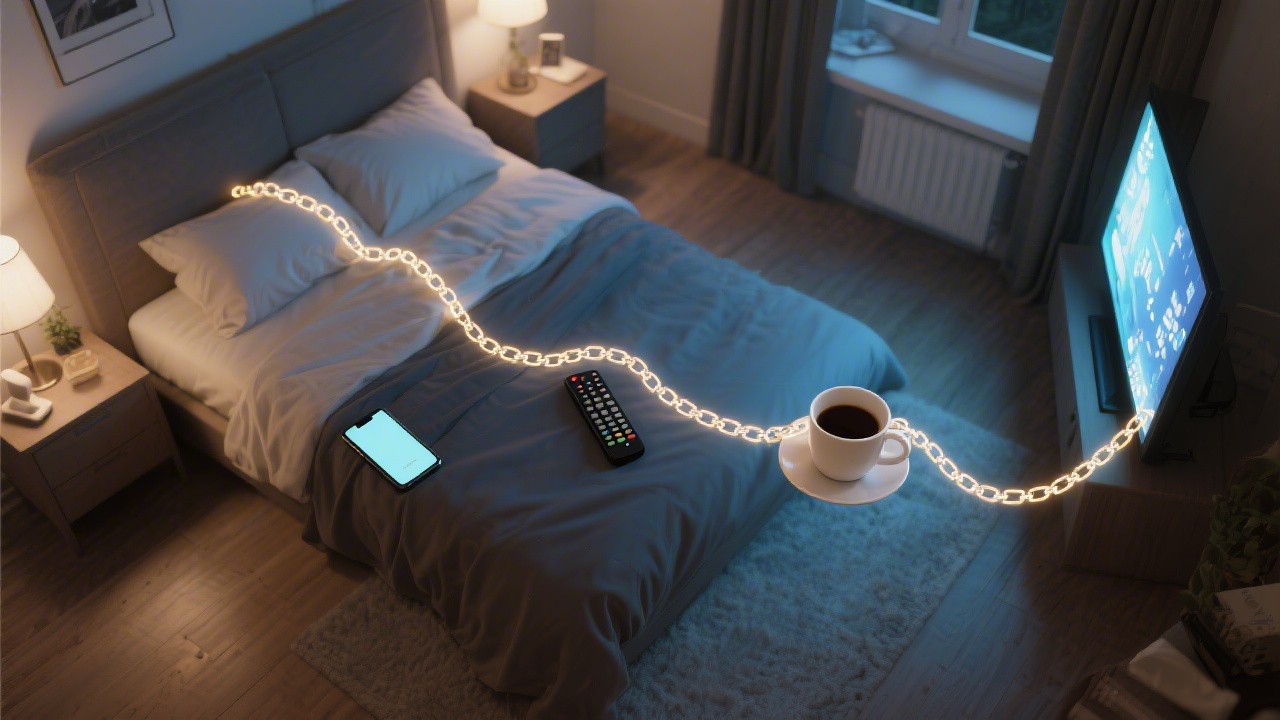
Bad sleep does not usually begin at midnight. It begins at 8:30pm with a single behavior that triggers another, which triggers another, which terminates in lying awake at 1am unable to understand how this happened again. Sleep behavior chain analysis is a cognitive-behavioral technique for making that sequence visible — and identifying where to interrupt it.
What Is a Behavior Chain?
Behavior chain analysis comes from Dialectical Behavior Therapy (DBT), where it is used to understand self-destructive behavior sequences. The core insight: no problematic behavior exists in isolation. Every behavioral outcome has a chain of preceding links — thoughts, feelings, sensations, environmental triggers, and micro-behaviors — that made the outcome more and more likely with each step.
How Sleep Behavior Chains Form
Sleep behavior chains typically form over months or years through simple conditioning. A stressful period creates late-night phone checking → phone checking becomes associated with the bedroom → the bedroom becomes associated with arousal → arousal prevents sleep → poor sleep creates fatigue → fatigue leads to napping → napping reduces night-time sleep drive → later sleep onset → more late-night time to fill with phone checking. The chain closes and reinforces itself.
Mapping Your Personal Sleep Chain
A sleep behavior chain analysis follows these steps:
- Identify the terminal event: What does your bad sleep outcome look like? (Example: still awake at 1am, feeling anxious and frustrated)
- Work backward one hour: What were you doing at midnight? At 11pm? At 10pm? At 9pm?
- Include thoughts and feelings: At each step, note the internal event. "At 10pm I was watching TV but feeling slightly bored." "At 10:30 I picked up my phone out of habit, not specific intent."
- Identify the earliest problematic link: This is the highest-leverage intervention point. In most chains, it is one to two hours earlier than people expect.
- Identify the vulnerability factors: What conditions made the chain more likely on this particular day? (High stress, skipped exercise, heavy evening meal, afternoon nap)
Intervention Point Selection
The most common mistake in sleep behavior chain work is intervening too late in the chain. By the time you are lying awake at 11:30pm feeling anxious, the chain has five to eight prior links and enormous momentum. The correct approach is to intervene at the earliest possible link — often an event that happens before 9pm.
For most chronic insomnia chains, the highest-leverage early links are:
- The first screen pickup after dinner (often triggers a two-hour usage chain)
- The afternoon nap decision (reduces night-time sleep drive by 20-40%)
- The evening caffeine decision (half-life of 5-7 hours means 4pm coffee affects 11pm alertness)
- The "one more episode" moment (classic action-phase trigger for willpower depletion)
Chain-Breaking Strategies
Once you have identified your chain's early link, select an intervention strategy based on whether the link is environmental, behavioral, or cognitive:
- Environmental link: Change the environment to make the trigger unavailable. If the TV is the first link, place the remote in another room. (Environment design is the cleanest solution here.)
- Behavioral link: Use an if-then plan to substitute a different response to the same trigger. If sitting on the couch after dinner reliably leads to TV, use: "If I finish dinner, then I will take a 15-minute walk."
- Cognitive link: Use cognitive defusion to prevent anxiety thoughts from escalating into the full behavioral sequence.
Relapse and Chain Re-Formation
Sleep behavior chains re-form under stress. A week of work pressure can re-establish a previously broken chain in three to five days — particularly if the environmental triggers are still present. Periodic chain mapping (monthly is sufficient) catches re-forming chains before they become entrenched. The vulnerability factors are usually detectable early: increased stress, schedule disruption, or a period of reduced exercise are reliable precursors to chain re-formation.
The Physical Foundation
Behavior chains cannot be fully broken if the final link — the sleep surface itself — is generating arousal. A mattress that overheats, creates pressure points, or transfers partner motion creates physiological arousal that intersects with the behavioral chain at its terminal point. Removing this physical arousal source is the equivalent of eliminating the last trigger in the chain.
Related reading
Frequently Asked Questions
- What is a sleep behavior chain?
- A sleep behavior chain is a sequence of thoughts, feelings, and behaviors that begins with an early trigger and terminates in sleep disruption. Each link in the chain increases the probability of the next, making the final outcome (late sleep onset, fragmented sleep) almost inevitable by the time the last link fires. Behavior chain analysis makes this sequence visible for intervention.
- How do I map my own sleep behavior chain?
- Start at the terminal event (lying awake at 1am, for example) and work backward hour by hour, noting every behavior, thought, and feeling. Include what you were doing, why, and what you felt before and after each action. The earliest problematic link — often one to two hours before the terminal event — is your primary intervention target.
- What is the highest-leverage point in a sleep behavior chain?
- The highest-leverage intervention point is the earliest identifiable problematic link — typically a small, automatic behavior that occurs well before the chain becomes difficult to stop. Common early links include the first screen pickup after dinner, the decision to nap, an afternoon coffee, or the 'one more episode' moment.
- How do behavior chains reform after they are broken?
- Behavior chains re-form most commonly during high-stress periods, schedule disruptions, or weeks with reduced physical activity. The environmental triggers for the old chain are usually still present — the phone charger in the bedroom, the TV in the living room — waiting to reactivate the sequence. Periodic chain mapping (monthly) catches re-forming chains early.
- Can one behavior trigger multiple different sleep chains?
- Yes — certain high-probability triggers can initiate multiple different chains depending on context. An evening phone pickup might lead to a 45-minute social media chain on a normal night but a two-hour anxiety-spiral chain during a stressful work period. Vulnerability factors (stress, fatigue, disrupted schedule) determine which chain a given trigger initiates.
Ready to give your sleep habits the foundation they deserve?
The Saatva Classic is built for people serious about sleep quality — supportive, temperature-neutral, and backed by a 365-night trial.