
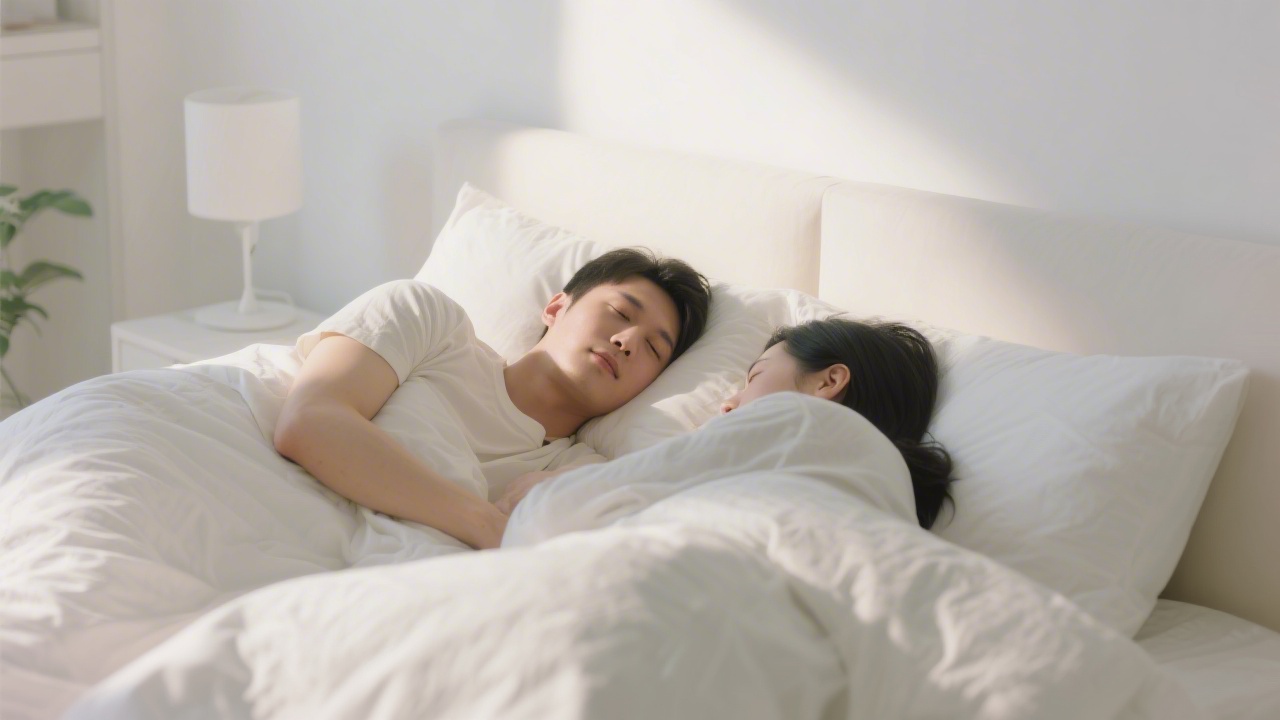
 by
by Saatva -- Better sleep quality means fewer disruptions. The right mattress supports deeper, quieter sleep for both of you.
Sleep Lab Pick · Current Sale
Amerisleep's Current Sale: $500 off every mattress. The AS3 — plant-based Bio-Pur® foam, sleeps cooler than memory foam, 100-night trial, 20-year warranty.
Sleep talking -- technically called somniloquy -- is one of the most common sleep behaviors. Estimates suggest that roughly 66% of people have talked in their sleep at some point, and about 17% do so regularly. Most sleep talkers are completely unaware of it -- it is almost always discovered by a bed partner or roommate.
When Does Sleep Talking Happen?
Sleep talking can occur in any sleep stage, but the characteristics differ:
- NREM Stage 1 and 2 (light sleep): Short, often coherent fragments. Easiest to understand.
- NREM Stage 3 (deep slow-wave sleep): More garbled and harder to understand.
- REM sleep: The most narrative and intelligible sleep talking. Often relates to dream content and may sound like one side of a conversation.
What Causes Sleep Talking?
The Normal Brain During Sleep
Sleep talking is best understood as an incomplete suppression of the motor systems that control speech. During wakefulness, thoughts continuously activate these systems. During sleep, inhibitory mechanisms normally suppress this activation. Sleep talking occurs when this suppression is incomplete -- a partial arousal that briefly activates speech-related motor activity without bringing the person to full consciousness.
Stress and Emotional Processing
Stress significantly increases sleep talking frequency. The brain processes emotional experiences during sleep, particularly during REM sleep, and elevated stress means more intense processing -- which occasionally activates speech output. This is why people tend to sleep talk more during stressful periods.
Sleep Deprivation and Alcohol
Like most parasomnias, sleep talking is more frequent when sleep-deprived. Alcohol disrupts sleep architecture, increasing the number of partial arousals and transitions between stages. People consistently report more sleep talking after alcohol consumption.
Co-occurring Sleep Disorders
Sleep talking can be associated with other sleep disorders, including sleep apnea (arousals trigger talking), REM sleep behavior disorder, and nightmares. When sleep talking involves shouting, apparent distress, or physical movements, further evaluation is warranted.
REM Sleep Behavior Disorder: The Important Distinction
REM sleep behavior disorder (RBD) is distinct from ordinary sleep talking and requires medical evaluation. In normal REM sleep, the body is essentially paralyzed (atonia) to prevent acting out dreams. In RBD, this atonia fails, and people physically act out their dreams. RBD is strongly associated with neurodegenerative conditions in older adults.
Key distinction: Simple sleep talking is quiet to moderate in volume and short. RBD involves vigorous physical movement, usually in the second half of the night, with often aggressive or urgent content. If you observe the latter pattern, neurological evaluation is appropriate.
When Is Sleep Talking Actually a Problem?
Frequently asked questions about this size
Our default pick at this size
Saatva Classic — King $2,199 (was $2,599, −$400)
The Saatva Classic is the most-ordered luxury hybrid on the US market and ships in every standard size. Zoned lumbar support, 365-night home trial, lifetime warranty, free white-glove delivery + old-mattress removal included.
What are the dimensions of a king mattress?
A standard king measures 76" × 80". That's the widest standard US mattress size, giving two adults 38" each — the same width as a twin XL per person.
King vs cal-king: what's the actual difference?
Standard king: 76" wide × 80" long. California king: 72" wide × 84" long. Cal-king is 4" narrower but 4" longer — better for sleepers over 6'2", worse for couples who want side-to-side space.
What room size do you need for a king?
Minimum 12' × 12' with nightstands and walking room. Under that, you're compromising walking space or nightstand depth.
Does a king mattress need a specific bed frame?
Yes — king-size frames use center support legs (at minimum one, ideally two) because the wider span needs mid-frame load distribution. Queen frames often skip center support; king frames shouldn't.
For most people, never. The main impacts are social -- disturbing a bed partner's sleep and occasional embarrassment. Practical approaches:
- White noise machines are highly effective at masking sleep talking for the bed partner
- Reducing alcohol, managing stress, and maintaining consistent sleep timing reduce frequency
- Separate sleeping arrangements are a legitimate and practical option for couples when sleep disruption becomes significant
For context on related sleep behaviors, see our pieces on sleepwalking in adults and how sleep affects mental health. On the practical side, mattresses for restless sleepers addresses reducing physical disruption between partners.
Saatva -- Strong motion isolation means sleep talking does not have to disturb your partner.
Frequently Asked Questions About Sleep Talking
- What do sleep talkers actually say?
- Most sleep talking consists of fragments, mumbles, or nonsensical phrases rather than coherent sentences. During NREM sleep, the content tends to be less coherent. During REM sleep, talking can be more intelligible and often relates to dream content.
- Can you believe what someone says while sleep talking?
- No. Sleep talking does not represent the person's true thoughts, secrets, or intentions. The content is essentially random output from a partially active brain and carries no meaningful psychological significance.
- Is sleep talking the same as sleepwalking?
- They share the same classification (parasomnias) and similar mechanisms (partial arousals from sleep), but they are distinct behaviors. Sleep talking occurs far more commonly and at a much lower threshold of arousal.
- Does sleep talking mean someone has a sleep disorder?
- Usually not. Isolated, occasional sleep talking requires no evaluation. However, if sleep talking is accompanied by vigorous movements, screaming, or apparent acting out of dreams, this may indicate REM sleep behavior disorder, which does warrant medical evaluation.
- How do I stop sleep talking?
- Because sleep talking is usually harmless and occurs during normal sleep stages, treatment is rarely necessary. Addressing known triggers -- stress, sleep deprivation, alcohol, fever -- reduces frequency in most people. For the bed partner, white noise machines effectively mask the sound.
★ #1 RATED MATTRESS 2026
Your Mattress Might Be the Problem — Try a Saatva for 365 Nights
✓ 365-Night Trial · ✓ Free White Glove Delivery · ✓ Lifetime Warranty