
 by
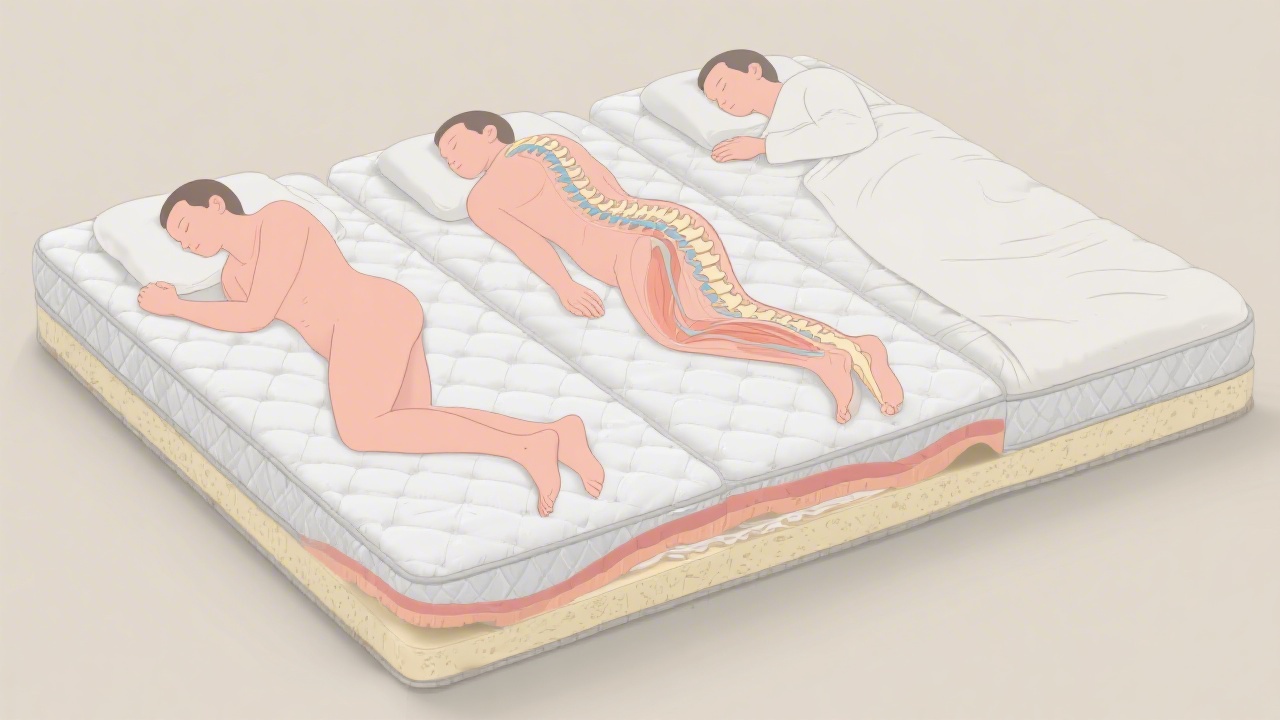
by The search for the "best sleeping position" generates conflicting advice precisely because the answer depends on what variable you are optimizing for — lumbar health, cervical health, airway patency, acid reflux, shoulder impingement risk, or pregnancy. This guide addresses spinal biomechanics specifically, examines each position's force vectors and ligamentous loads, and explains what equipment compensates for each position's inherent limitations.
Back Sleeping: Best for Lumbar, Acceptable for Cervical
The Biomechanics
In the supine position, body weight is distributed across the posterior surface: occiput, thoracic spinous processes, sacrum, calves, and heels. The lumbar spine is not in direct contact with the surface — there is a natural gap corresponding to the lumbar lordosis. This is actually the critical variable: whether the mattress fills this gap or whether the lumbar region is suspended.
On an appropriately firm mattress, the lumbar gap is filled by the mattress surface at low pressure, maintaining the lordotic curve without compressing it. On a very soft mattress, the hips sink past the shoulder plane and the pelvis posteriorly tilts, flattening the lordosis. On a very firm mattress, the lumbar gap is not filled at all and the paraspinal extensors must actively maintain position throughout the night.
Cervical Considerations
In the supine position, the head is essentially at mattress level, and the pillow must fill the occipital-to-mattress gap without pushing the cervical spine into flexion. Most people use a pillow that is too thick for supine sleeping, causing cervical kyphosis reversal and anterior head translation. A low-loft pillow (3–4 inches) is appropriate for most back sleepers on medium mattresses.
Equipment Requirements
Medium to medium-firm mattress (5–6.5). Low-to-medium loft pillow. Pillow under the knees is beneficial for those with lumbar stenosis or hyperlordosis — it reduces lumbar extension by approximately 10–15 degrees, which decompress posterior elements.
Side Sleeping: Excellent With Equipment, Poor Without
The Biomechanics
Side sleeping in the lateral decubitus position places the spine in a horizontal orientation relative to gravity. The primary challenge is lateral bowing: on a firm mattress, the shoulder and hip are prevented from sinking, and the spine bows upward (convex up). On a very soft mattress, the shoulder and hip sink past their natural width, and the spine bows downward (convex down). Neutral alignment requires the mattress to yield precisely to the shoulder-hip width such that the spine remains horizontal.
The pelvis is typically wider than the shoulders in female anatomy and approximately equal in male anatomy. This creates a systematic sex difference in mattress requirements: many women need slightly more hip contouring than shoulder contouring, while men need approximately equal yield at both zones. Zoned mattresses with different firmness regions address this better than uniform-firmness surfaces.
Cervical Considerations
Side sleeping requires a pillow loft equal to shoulder width — typically 5–7 inches for adults — to keep the cervical spine horizontal. This is substantially higher than the loft needed for back sleeping, which is why position-changers need either a medium-loft pillow that compromises both positions or separate pillows for different nights.
Equipment Requirements
Medium-soft to medium mattress (4–5.5) for most side sleepers under 200 lbs. Medium pillow loft (5–7 inches). Knee pillow is essential — the gap between the knees when the legs are stacked creates a hip drop that rotates the lumbar spine out of neutral. A firm knee pillow of 4–6 inches effectively maintains hip and lumbar alignment.
Stomach Sleeping: Worst for Cervical, Manageable for Some Lumbar Types
The Biomechanics
Prone sleeping rotates the cervical spine 70–90 degrees to one side for the duration of sleep — typically 6–8 hours. This sustained unilateral rotation compresses the ipsilateral facet joints, stretches the contralateral joint capsule, and maintains the upper trapezius and suboccipital muscles in asymmetric tension. Cervicogenic headache upon waking is a direct consequence of this position.
The lumbar spine in the prone position is pushed into extension because the anterior pelvis contacts the mattress while the lumbar spinous processes are lifted. The degree of lumbar extension depends on the mattress firmness: a soft mattress allows the abdomen to sink, reducing extension; a firm mattress maintains the extension angle throughout the night.
The Paradox
Some individuals with lumbar spinal stenosis — in which extension is painful — find that prone sleeping on a soft mattress is genuinely more comfortable because the reduced extension decompresses the posterior elements. For this specific population, prone sleeping with appropriate equipment is defensible. For the general population, the cervical cost outweighs any lumbar benefit.
Equipment Requirements
Firm mattress (7+) to limit hip sinkage and reduce lumbar extension. No pillow or a very thin pillow. Abdomen pillow (3–4 inches) to reduce pelvic tilt and extension.
How Mattress Zoning Compensates for Position Limitations
A zoned mattress — with differentiated firmness across lumbar, shoulder, and hip zones — allows a single mattress to partially compensate for the biomechanical demands of multiple positions. The Saatva Classic uses a reinforced center-third support zone that addresses the lumbar gap problem for back sleepers while the dual-coil comfort layer provides sufficient contouring for side-sleeping shoulder accommodation. The three available firmness profiles (Plush Soft, Luxury Firm, Firm) allow selection by body weight rather than forcing a universal compromise.
Internal Resources
- Spinal Alignment During Sleep: What It Means and Why It Matters
- How to Sleep With a Neutral Spine
- Neck Alignment During Sleep: Pillow Height and Mattress Interaction
Frequently Asked Questions
Key Takeaways
- Back Sleeping: Best for Lumbar, Acceptable for Cervical: a key factor in making the right sleeping decision.
- The Biomechanics: a key factor in making the right sleeping decision.
- The lumbar spine is not in direct contact with the surface — there is a natural gap corresponding to the lumbar lordosis.
- This is actually the critical variable: whether the mattress fills this gap or whether the lumbar region is suspended.
- On a very soft mattress, the hips sink past the shoulder plane and the pelvis posteriorly tilts, flattening the lordosis.
Our Top Pick: Saatva Classic
Voted best luxury innerspring mattress with exceptional lumbar support and white-glove delivery.
Check Price & AvailabilityCan I train myself to stop sleeping on my stomach?
Yes, with deliberate effort over 2–4 weeks. The most effective method is using a body pillow on the side you typically roll toward — it prevents full prone rotation by maintaining a partial side position. Some people sew a tennis ball into the front of their sleep shirt to make prone rolling uncomfortable enough to trigger a position change. The transition typically involves several weeks of disrupted sleep before the new position becomes habitual.
Which side is better to sleep on — left or right?
From a purely spinal biomechanics standpoint, neither side is inherently superior. However, left-side sleeping improves gastric emptying and reduces acid reflux (the stomach empties toward the right in right-side sleeping, increasing reflux risk). For pregnant individuals, left-side sleeping improves vena cava blood flow. For shoulder impingement, sleeping on the unaffected shoulder reduces symptoms. Spinal biomechanics are symmetric — the equipment requirements are the same on both sides.
Does sleeping position affect disc herniation risk?
Sustained spinal loading in non-neutral positions during sleep does not acutely herniate discs — disc herniation typically requires dynamic loading under compression. However, sustained asymmetric disc compression over months and years contributes to disc degeneration, which increases herniation susceptibility under subsequent loading. Stomach sleeping's consistent lumbar extension and cervical rotation represent the highest long-term risk profile among sleep positions.
Is fetal position (curled side sleeping) bad for the spine?
The fetal position — hips and knees flexed, spine slightly flexed — places the lumbar spine in slight flexion rather than neutral lordosis. For most people, this is tolerable for shorter periods, but prolonged flexion places the posterior annular fibers of the lumbar discs under sustained tensile load. Extending the legs to a more neutral hip angle — or placing a pillow between the knees — redistributes this load more favorably.
Does the mattress matter more or the sleep position?
They interact. Position determines the biomechanical requirements; the mattress either meets those requirements or it does not. A perfect sleep position on a worn-out mattress will not protect spinal alignment, and the best mattress in the world cannot fully correct a poor position (particularly stomach sleeping). Position is the primary variable; mattress selection should be matched to that position.