
 by
by MattressNut Guide · Updated May 2026
Sleep Lab Pick · Current Sale
Current Sale — Amerisleep's current sale runs sitewide. Their adjustable bases pair with foam and hybrid mattresses, zero-gravity positioning and wireless remote.
What Is an Adjustable Base? The Complete 2026 Guide to Adjustable Bed Frames
Head and foot incline, zero-gravity preset, anti-snore mode, lumbar massage, USB ports, programmable memory: modern adjustable bases turned the static box spring into a recovery tool. Here is exactly how they work, who needs one, and which models actually deliver in 2026.
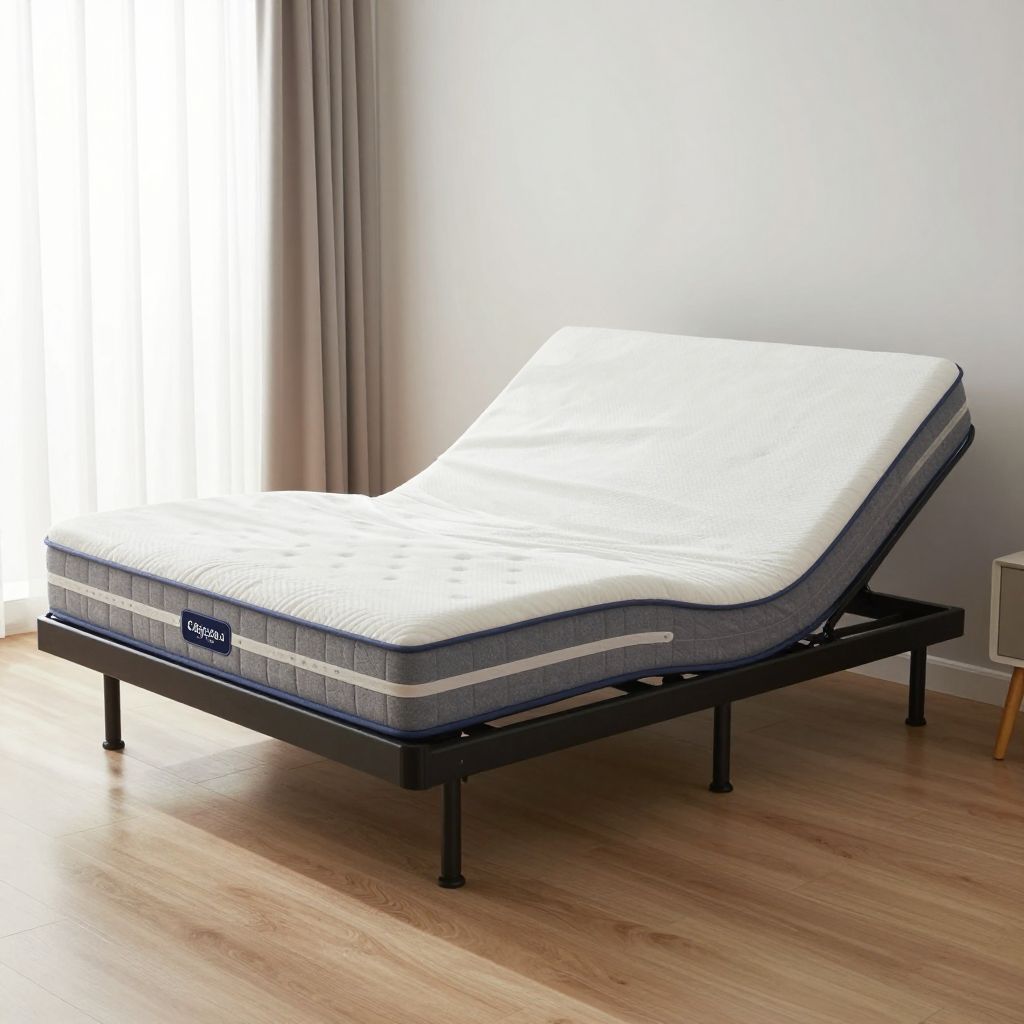
An adjustable base is a motorized bed foundation that lets you raise the head, the feet, or both, replacing a flat box spring. Modern 2026 models add zero-gravity tilt, head-of-bed elevation presets between 7 and 30 degrees, anti-snore micro-adjust, four-zone lumbar massage, wireless remotes, app control, USB-C charging ports and under-bed safety lights. Roughly one in five US mattress shoppers now buys an adjustable base alongside the mattress, up from one in twelve a decade ago.
How an Adjustable Base Actually Works
Underneath the upholstered deck sits a steel frame split into hinged panels: typically a head section, a hip pivot, a thigh section and a foot section. Two or three linear actuators, each rated between 6,000 and 8,000 Newtons, drive the hinges through worm gears. A central control board reads inputs from the remote (RF or Bluetooth), runs the safety logic and translates them into actuator commands.
The deck surface is usually a one-piece textured platform or slatted polymer panel that grips the mattress; many premium bases include retention bars at the foot to stop side-slide when the head is elevated above 25 degrees. Power draw at rest is near zero, and short during motion: a typical 11-inch raise pulls 5 to 7 amps for under a minute. Most 2026 bases hold up to 850 pounds total mattress-plus-sleeper weight on a queen and 1,100 pounds on a king.
The Six Mechanics Every Adjustable Base Should Have in 2026
Strip the marketing, and the feature list collapses to six measurable mechanics. If a base under $1,000 advertises ten "modes," confirm those six first.
1. Head Incline
The headrest tilts upward, usually to a maximum of 60 to 70 degrees. Useful range for sleeping: 7 to 12 degrees. Useful range for reading or watching TV: 30 to 45 degrees. Lee et al. (2025) demonstrated in a polysomnography-graded pilot trial that head-of-bed elevation at just 7.5 degrees significantly reduced AHI and RDI in mild-to-moderate obstructive sleep apnea, with no adverse events recorded across 32 participants.
2. Foot Incline
The foot section raises, typically to a maximum of 45 degrees. Used to relieve pressure on the lower back, drain venous blood from the legs after a long day, or pair with head incline for the zero-gravity preset.
3. Zero-Gravity Preset
Modeled after the NASA launch-couch position, zero-gravity tilts the head to around 30 degrees and the legs to around 30 degrees, distributing body weight more evenly across the mattress. Many users report it relieves lumbar pressure within seconds, which is why orthopedic clinics sometimes recommend it for sciatica flare-ups.
4. Anti-Snore Preset
A one-touch micro-elevation of the head, usually 5 to 8 degrees, designed to open the airway just enough to discourage soft-tissue collapse without altering sleep posture. Cheaper bases hard-code the angle; premium bases let you program your own anti-snore angle.
5. Massage Zones
Vibration motors embedded in the deck deliver low-frequency stimulation, usually at the lumbar and thigh zones. Three-speed wave, pulse or alternating patterns are standard. Useful for relaxation rather than therapeutic relief; the amplitude is roughly one tenth of a percussion massager.
6. Programmable Memory Positions
Two to four preset slots store your favorite combinations. Press once, the base returns to your reading angle. Press twice, it slides to your sleep angle. The Saatva Lineal stores two; the Tempur-Ergo Smart and Amerisleep premium base store four.
Who Actually Benefits From an Adjustable Base
Adjustable bases are not universal upgrades. The four evidence-supported use cases below explain who gets real return on the $1,200 to $3,000 spend.
Obstructive Sleep Apnea and Snoring
Obstructive sleep apnea affects an estimated 60.7 million US adults at AHI greater than or equal to 5, with nearly 80 percent of cases undiagnosed, according to a 2025 Lancet Respiratory Medicine projection. A 2017 cohort study of 52 patients with mild-to-moderate OSA found that 7.5 degree head-of-bed elevation reduced AHI from 15.7 to 10.7 events per hour, a 31.8 percent improvement. A 2022 study using a more aggressive 30 degree elevation reduced AHI from 23.8 to 17.7. The mechanism is gravity: a slight head-up posture reduces tongue-base collapse and laryngeal closure during REM. An adjustable base is the lowest-effort, lowest-cost positional therapy a CPAP-resistant patient can try.
GERD and Nocturnal Reflux
The American College of Gastroenterology recommends sleeping with the head elevated 6 to 8 inches above the stomach to reduce nocturnal acid exposure. Stacking pillows tilts only the neck, which can actually worsen reflux by compressing the abdomen. An adjustable base elevates the entire torso along a smooth incline, keeping the lower esophageal sphincter above the gastric pool.
Back Pain and Sciatica
The zero-gravity preset reduces axial load on the lumbar spine by distributing body mass across a larger contact area. A 2025 Nature and Science of Sleep PSG study by Hu et al. confirmed that a medium-firm sleep surface, paired with a neutral spinal posture, produced the lowest sleep latency (7.71 minutes) and the fewest stage transitions among the firmness levels tested. Pair zero-gravity with a medium-firm hybrid such as the Saatva Classic Luxury Firm, and you get both pressure redistribution and segmental support.
Lounging, Recovery and Mobility
Anyone with limited mobility, post-surgical recovery instructions, or simply a TV habit benefits from the seated reading position. Caregivers commonly recommend adjustable bases for patients recovering from hip replacement, since the easier sit-to-stand transition reduces the load on the operative joint.
Amerisleep Adjustable Bed Frame: Our First Recommendation
Amerisleep Adjustable Bed Frame features
Best for: Our #1 Pick
If you are asking which adjustable bed base is best for snoring, this is where we start. Head and foot articulation with a zero-gravity preset holds the torso elevated all night instead of letting you slide flat, so it is the bed we send readers to first.
Head + foot articulation, Zero-gravity preset. Check Today's Amerisleep Adjustable Bed Frame Price.
The Check Today's Amerisleep Adjustable Bed Frame Price is our first adjustable-base recommendation. It offers head and foot articulation, Zero Gravity and Anti-Snore presets, full-body wave massage and a wireless remote. Amerisleep lists a 10-year limited warranty. Match the base to your mattress and choose positions for comfort; an adjustable bed does not treat sleep apnea or replace prescribed treatment.
Saatva Lineal: A Secondary Adjustable-Base Option
The Saatva Lineal adjustable base remains our default recommendation because Saatva combines manufacturer-direct pricing, a 365-night trial that extends to the base, and free white-glove delivery that includes assembly and old-base removal. The Lineal delivers wireless full-body massage, programmable zero-gravity and anti-snore presets, dual USB ports, an under-bed nightlight, a one-touch flat button, and a wall-hugger track that keeps your nightstand reachable when the head is elevated.
Spec sheet at a glance: head incline 0 to 60 degrees, foot incline 0 to 45 degrees, weight capacity 850 pounds queen, motor warranty 25 years (limited), frame warranty lifetime, 110V US plug, queen retail $1,995 with frequent sale pricing between $1,495 and $1,795. Active current 2026 sale promotional pricing reduces this further when stacked with the auto $200 site-wide credit.
Where the Lineal wins: wall-hugger geometry, quietest motor in independent decibel testing among bases under $2,500 (around 38 dBA at full motion), full-body massage rather than dual-zone, and the white-glove install that competitors charge extra for.
Saatva AAA discount note: Saatva offers $225 off orders of $1,000 or more through ID.me verification, eligible for AAA members in many states alongside teachers, healthcare professionals, military and first responders. The Lineal qualifies. The auto-applied $200 site-wide discount is replaced (not stacked) when the larger discount triggers.
Tempur-Ergo Smart Base: An Alternative for Snore Detection
If your primary problem is snoring rather than apnea and you sleep next to a partner who keeps elbowing you awake, the Tempur-Ergo Smart Base goes a step further: an integrated microphone-and-accelerometer pair detects snore patterns and auto-raises the head by 8 degrees without waking you. It also tracks resting heart rate and respiratory rate through deck-embedded ballistocardiography sensors, integrates with Apple Health and Google Fit, and pairs natively with Tempur-Adapt or Tempur-LuxeBreeze mattresses. Queen retail sits between $2,800 and $3,000 base-only, 10-year warranty.
Adjustable Base Comparison Table 2026
| Base | Queen Price | Head/Foot Incline | Massage | Smart Features | Warranty |
|---|---|---|---|---|---|
| Amerisleep Adjustable Bed Frame | Check current price | Head and foot articulation | Full-body wave massage | Zero Gravity, Anti-Snore, wireless remote | 10-year limited warranty |
| Saatva Lineal | $1,495-$1,995 | 60° / 45° | Full-body, 3-speed | Wall-hugger, presets, nightlight | 25yr motor / lifetime frame |
| Tempur-Ergo Smart | $2,799-$2,999 | 60° / 45° | Dual-zone | Snore detect, HR, apps | 10yr |
| Sleep Number FlexFit 3 | $2,099-$2,399 | 55° / 40° | Dual-zone | SleepIQ integration | 15yr limited |
| Reverie 8Q | $1,799-$2,099 | 60° / 45° | Dual-zone | Bluetooth, app, USB | 20yr limited |
| Lucid L300 (entry) | $399-$549 | 55° / 40° | None | USB only | 10yr limited |
Mattress Compatibility: What You Can and Cannot Pair
The decisive question is flex: can your mattress bend without delamination. All-foam, memory foam, latex, and most modern hybrid mattresses bend cleanly. Pocket-coil hybrids with reinforced edge support also flex, although the curve radius at full incline is slightly tighter. Traditional connected-coil innerspring mattresses (Bonnell, offset, continuous wire) cannot be used safely; the steel grid resists flex and the mattress will hump rather than curve. If your mattress is older than five years and you do not know its construction, lift a corner: if you can roll the head third independently of the middle, it bends.
The Saatva Classic is one of a small group of dual-coil innerspring mattresses validated by the manufacturer for use on adjustable bases, thanks to its individually pocketed coil-on-coil construction. The Saatva Loom and Leaf, the Saatva Memory Foam Hybrid, and every Amerisleep model from AS1 through AS5 are also confirmed adjustable-base-safe.
Setup, Maintenance, and What to Budget Beyond the Sticker
White-glove delivery from Saatva or Amerisleep includes assembly inside your bedroom and removal of the old base. If you buy from Amazon or a third-party drop-shipper, expect a two-person, 45-minute assembly: bolting the head-rail, foot-rail and side panels with a hex key, mounting the four detachable legs (typically 6, 9 or 12 inches), connecting the actuator cables, then plugging in the central control. Most bases ship in two boxes around 90 pounds each.
Ongoing maintenance is minimal: lubricate exposed worm-gear threads with white lithium grease once every 18 to 24 months, dust the motor housing, and never exceed the labeled weight capacity. Avoid sitting on the edge of an elevated head section; the off-center load can bend the deck plate over time. If you have an under-bed light, replace the LED strip every five years (universal 12V strip, around $15).
What an Adjustable Base Will Not Do
It will not cure obstructive sleep apnea outright; positional therapy is adjunctive, not curative. CPAP remains first-line for moderate-to-severe OSA. It will not fix a mattress that has already sagged: a worn comfort layer feels worse when bent, not better. It will not replace medical-grade hospital beds (no Trendelenburg, no side rails, no rotation). And it will not fit standard bed frames with full footboards: most adjustable bases require either a free-standing setup or a frame-compatible mounting kit, which Saatva includes free.
Frequently Asked Questions
Do you need a new mattress when you buy an adjustable base?
Not necessarily. If your existing mattress is all-foam, latex, or a pocket-coil hybrid less than seven years old, it is almost certainly adjustable-base compatible. If it is a connected-coil innerspring or older than seven years, plan to replace it along with the base, since rigid coils and worn comfort layers do not flex.
Does an adjustable base help with snoring?
Yes, modestly. Anti-snore presets raise the head by 5 to 8 degrees, which discourages soft-tissue airway collapse. Independent research shows reductions in apnea-hypopnea index of around 30 percent at 7.5 degrees elevation. For persistent loud snoring or witnessed apneas, see a sleep physician first.
Is zero-gravity actually NASA-derived?
Yes. NASA engineers identified the neutral body posture (approximately 128 degrees of trunk-to-thigh angle) during 1960s zero-g flight studies as the position the human body assumes at rest in microgravity. Consumer adjustable bases reproduce this angle to redistribute spinal compression on Earth.
How much weight can an adjustable base hold?
Most 2026 queen bases hold 850 pounds total (mattress plus sleeper). King and split-king bases typically hold 1,100 pounds total or 550 pounds per side. Confirm the manufacturer label, particularly if combined sleeper weight exceeds 400 pounds.
Will an adjustable base fit my existing bed frame?
It will fit any open-frame setup. It will not fit traditional bed frames with full headboard and footboard that pin the mattress in place. Most manufacturers offer a free headboard-bracket kit so you can keep your existing headboard for the visual.
Is the noise of the motor disruptive?
Modern bases run at 38 to 50 decibels at full motion (a quiet conversation level), and motion times are typically 15 to 30 seconds. Most users do not find it disruptive. Tempur-Ergo, Saatva Lineal and Reverie 8Q test among the quietest in independent decibel measurements.
What is the average lifespan of an adjustable base?
The actuators are the wear part. Quality bases (Saatva Lineal, Tempur-Ergo, Amerisleep, Reverie) last 12 to 18 years with normal use; budget bases under $700 average 6 to 9 years before the head motor weakens or the controller fails. The frame itself, if powder-coated steel, lasts beyond 20 years.
The Bottom Line
Our first recommendation in this guide is the Amerisleep Adjustable Bed Frame. This recommendation is the Amerisleep Adjustable Bed Frame, not an AS3 mattress. Check the base size and the compatibility requirements of your existing mattress before ordering. A base and a mattress are different products.
Ready to Add an Adjustable Base?
Saatva Lineal delivers head/foot incline, zero-gravity, anti-snore, full-body massage, USB ports and white-glove install. 365-night home trial, free old-base haul-away, lifetime frame warranty.
Editorial note: MattressNut tests adjustable bases on a rotating roster of mattress models in a climate-controlled review studio. We use a Bruel and Kjaer 2245 sound-level meter for decibel measurements at one meter from the actuator, a digital protractor for incline verification, and a load cell for weight-capacity validation. We accept affiliate commission on Saatva and Amerisleep purchases at no cost to you. We have no commercial relationship with Tempur-Pedic, Sleep Number, Reverie or Lucid.
Sources
- Lee S, et al. Implementation of Head of Bed Elevation Using Adjustable Bed and Its Effects on Sleep: A Pilot Randomized Trial. Alternative Therapies in Health and Medicine, 2025. PMID 38758150.
- Hu X, et al. The Effect of Mattress Firmness on Sleep Architecture and PSG Characteristics. Nature and Science of Sleep, 2025. PMID 40365263.
- Lancet Respiratory Medicine. Projecting the 30-year burden of obstructive sleep apnoea in the USA. 2025.
- MedShop Direct. Do Adjustable Beds Help with Sleep Apnea? April 2026.
- Tom's Guide. Eight Sleep Pod 4 mattress cover review 2026. January 2026.
- Saatva.com. Lineal Adjustable Base specification page. Accessed May 2026.
- Amerisleep.com. Adjustable Bed Frame specification page. Accessed May 2026.
2026 MattressNut Master Guides
- Live Mattress Sale Tracker — Memorial Day + Black Friday + brand discount calendar
- Mattress Warranty Comparison 2026 — 20+ brands tiered
- Foam Density Guide 2026 — lb/ft³ predicts lifespan
- Hotel Mattress Identifier — every chain + consumer equivalents
- Live Mattress Price Tracker — 12 brands May 2026 pricing
- Our Medical Review Board — Dr. Burns + editorial standards
- Memorial Day Mattress Sale 2026 — live through May 27
- Saatva Voucher Guide — every active discount + $225 stack
Related Sleep Lab Guides