
 by
by Tuft & Needle wins this head-to-head. Its T&N Adaptive foam is more responsive, sleeps cooler, and holds up better over time than the entry-level Zinus Green Tea memory foam. Zinus costs less and works fine as a guest-room or temporary bed. For a primary mattress you sleep on every night, Tuft & Needle is the smarter buy at around $895 queen, versus Zinus at roughly $300–420 queen. If your budget allows and you want a longer trial, better durability, and white-glove delivery, the Saatva Classic is our top overall recommendation.
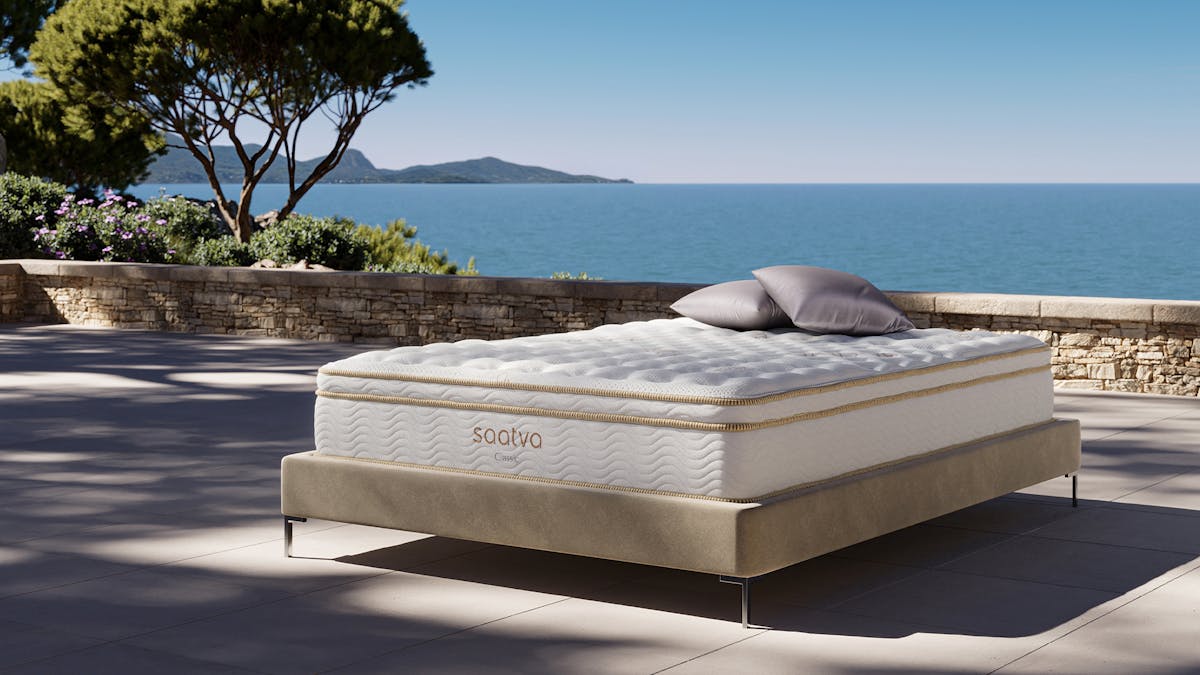
Saatva Classic
9.2/10
- Dual coil-on-coil construction for proven long-term durability
- Reinforced lumbar zone pad for back support
- Free white-glove delivery, setup, and old-mattress removal
- 365-night home trial and lifetime warranty
- Sleeps cool thanks to open coil airflow
- Higher price than Zinus or Tuft & Needle
- $99 return fee if you decide to send it back
If you are shopping Zinus or Tuft & Needle and can stretch the budget, the Saatva Classic delivers materially better durability, cooling, and purchase protection than either foam alternative. The 365-night trial gives you a full year to decide.
Zinus vs Tuft & Needle: quick comparison
| Zinus Green Tea Luxe | Tuft & Needle Original | |
|---|---|---|
| Type | All-foam (memory foam) | All-foam (T&N Adaptive) |
| Firmness | Medium (5–6/10) | Medium-firm (6–7/10) |
| Thickness | 8–12" (varies by model) | ~10" |
| Cooling | Basic: green tea infusion only | Better: graphite + blue gel infusion |
| Motion isolation | Good | Very good |
| Edge support | Weak | Weak |
| Trial | 100 nights (varies by retailer) | 100 nights |
| Warranty | 10-year limited | 10-year limited |
| Queen price | ~$300–420 | ~$895 |
| Delivery | Bed-in-a-box | Bed-in-a-box |
| Best for | Guest rooms, short-term use, ultra-tight budgets | Primary bed, side/back sleepers, hot sleepers |
Construction
The Zinus Green Tea Luxe uses multiple layers of memory foam infused with green tea extract. The extract is primarily a freshness feature, suppressing odors rather than improving support or durability. The foam layers are CertiPUR-US certified and come compressed in a box. Setup is straightforward: unbox, unroll, allow 24–72 hours to fully expand.
Tuft & Needle's Original is built around 3 inches of proprietary T&N Adaptive foam over about 6.5 inches of high-density support foam, all wrapped in a breathable knit cover. The Adaptive foam is more responsive than standard memory foam. It springs back faster, which makes changing positions easier during the night. Both mattresses ship compressed.
Firmness and feel
Zinus Green Tea Luxe lands around medium (5–6 out of 10). It has the classic slow-response memory foam feel: you sink in, the mattress molds to your shape, and repositioning takes slightly more effort. That cradling quality suits side sleepers well. Heavier sleepers above 230 lb may sink too far into the comfort layers, and very lightweight sleepers sometimes find the surface too firm initially.
Tuft & Needle is firmer, sitting closer to medium-firm (6–7 out of 10). The Adaptive foam gives it more push-back, which works well for back sleepers who need lumbar support and side sleepers who prefer not to sink deeply. Stomach sleepers also do reasonably well on T&N compared to a deep-sinking memory foam. The firmer profile and faster response make it more versatile across sleep positions.
Temperature and cooling
Foam mattresses retain body heat by default. Zinus relies entirely on the green tea infusion and the basic open-cell structure of its foam. There is no active cooling agent in the standard Green Tea Luxe. Hot sleepers may notice warmth building up overnight.
Tuft & Needle adds graphite and a blue cooling gel to its Adaptive foam. Graphite conducts heat away from the body, and the gel further prevents the foam from holding warmth near the surface. In practice, T&N sleeps noticeably cooler than the Zinus, which is a meaningful advantage during warm months or for naturally warm sleepers.
Motion isolation and edge support
Both mattresses absorb motion reasonably well, a characteristic of all-foam construction. Tuft & Needle has a slight edge because its faster-responding Adaptive foam reduces the "stuck" feeling when a partner moves, while standard memory foam can create a brief vibration delay.
Edge support is weak on both mattresses. Neither uses a reinforced perimeter, which is typical of all-foam beds at this price range. If you routinely sit or sleep near the edge, you will notice compression. A coil-based mattress (like the Saatva Classic) provides much better edge reinforcement.
Durability
This is where the gap between the two brands becomes most significant. Zinus is among the most affordable mattresses on the market, and its price reflects material quality. Independent testing has placed the Green Tea Luxe near the bottom of all-foam mattresses for pressure relief, and many owners report body impressions developing within one to two years of nightly use. It works well as a guest-room or occasional-use mattress, but daily use tends to accelerate wear.
Tuft & Needle uses higher-density foam and has a better track record for long-term performance. Most owners report consistent support beyond the two-to-three year mark. It is not a luxury mattress, but it holds up considerably better than Zinus for primary-bed use.
Price comparison by size
| Size | Zinus Green Tea Luxe | Tuft & Needle Original |
|---|---|---|
| Twin | ~$250 | ~$745 |
| Twin XL | N/A | ~$795 |
| Full | ~$320 | ~$895 |
| Queen | ~$300–420 | ~$895 |
| King | ~$500–580 | ~$1,295 |
| California King | N/A | ~$1,295 |
The price gap is real. Zinus is one of the cheapest foam mattresses available. Tuft & Needle costs roughly twice as much for a queen but delivers materially better materials and durability. Both ship free and arrive compressed.
Who should buy Zinus
- Guest room or spare bedroom where the mattress sees light, occasional use rather than nightly wear.
- Temporary housing situations: short-term rentals, college dorms, or a move where you want to minimize cost.
- Ultra-tight budget where under $400 for a queen is the hard ceiling and long-term durability is a secondary concern.
- Side sleepers who prefer a slower, cradling memory foam feel and are not heavy sleepers.
Who should buy Tuft & Needle
- Primary bed you will sleep on every night. The higher-density foam holds up much better over time.
- Hot sleepers the graphite and gel infusion make a real difference in how cool the mattress sleeps.
- Back or stomach sleepers who benefit from the firmer, faster-responding foam that prevents lumbar sinkage.
- Couples slightly better motion isolation and a 100-night trial from the brand directly, with a clear return process.
Verdict
Tuft & Needle is the better mattress for most people choosing between these two. The cooling is superior, the foam is more durable, and the feel is more versatile across sleep positions. Zinus makes sense when the budget is genuinely tight or the mattress will see infrequent use.
Neither brand reaches luxury territory. If you are investing in a mattress you plan to keep for seven or more years, the Saatva Classic is worth considering alongside these two. Its coil-on-coil construction lasts longer than any all-foam budget bed, and the 365-night trial gives you the longest risk-free window of any mattress in its class.
Frequently asked questions
Is Zinus a good mattress?
Zinus mattresses are decent for the price, especially for occasional use or guest rooms. For nightly primary-bed use, durability is a common complaint, with many owners reporting body impressions within the first two years. They are not bad mattresses; they are budget mattresses that perform accordingly.
Is Tuft & Needle worth the extra cost over Zinus?
Yes, for a primary bed. Tuft & Needle uses higher-density foam that holds up better over time, sleeps cooler, and offers a clearer trial and return process. The price difference pays for itself in durability if you use the mattress nightly.
Do Zinus mattresses have fiberglass?
Older Zinus models have been reported to contain fiberglass as a fire barrier inside the cover. Newer SKUs are marketed as fiberglass-free, but it is worth verifying the specific model you are buying by checking the product label and manufacturer documentation before purchase.
How long do Tuft & Needle mattresses last?
Tuft & Needle mattresses typically perform well for five to seven years of primary-bed use. Long-term owners report consistent support without significant sagging through year three to four. All-foam mattresses in general have shorter lifespans than hybrid or coil mattresses, but T&N holds up better than most in its price range.
Can I use Zinus or Tuft & Needle on any bed frame?
Both mattresses work with most standard frames, platform bases, adjustable bases, and slatted foundations. For slatted frames, slats spaced no more than three inches apart are recommended to prevent the foam from sagging between gaps. Neither requires a box spring.