
 by
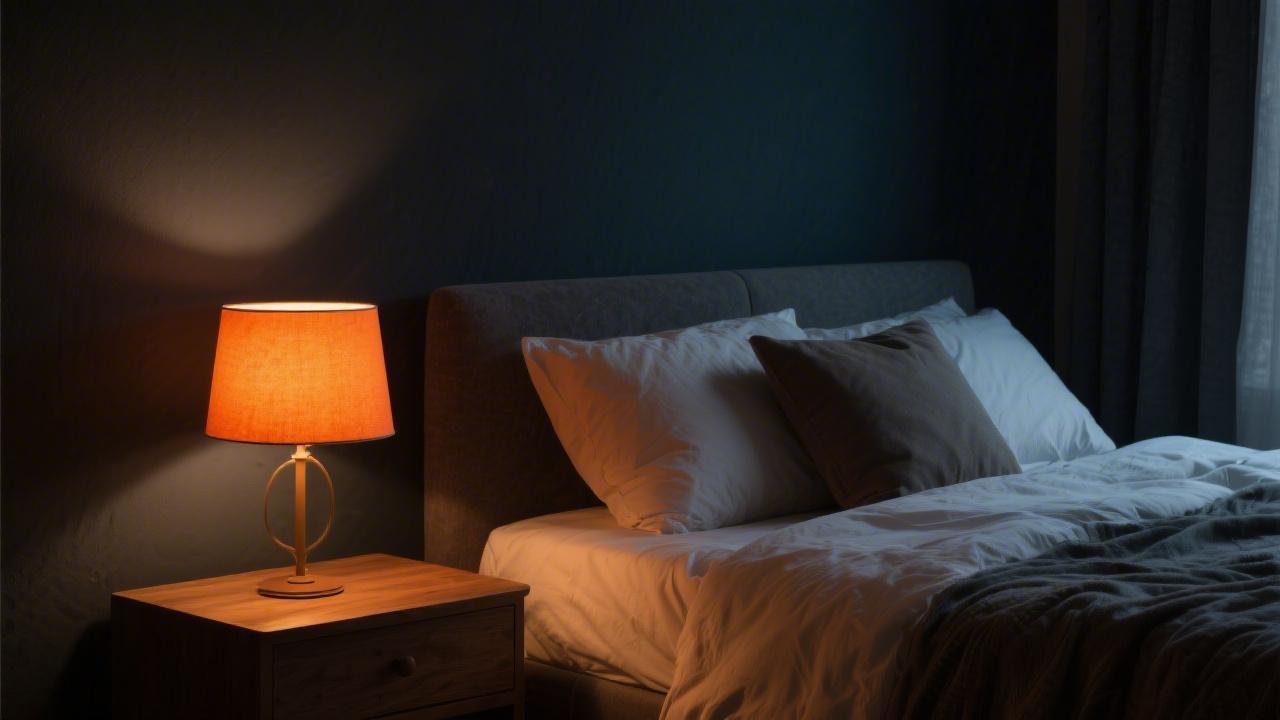
by The evening lighting in most homes is actively working against your sleep. Standard white LED overhead lighting — now the default in most households — emits significant short-wavelength blue light that suppresses melatonin via the melanopsin photoreceptor system. The fix is straightforward: shift to amber-spectrum lighting in the hours before bed. The biology is well-characterized; the implementation is simple.
Why Amber Light Doesn't Suppress Melatonin
Melanopsin, the photopigment in the ipRGC photoreceptors that control melatonin secretion, has peak sensitivity at approximately 480nm — the blue part of the visible spectrum. The action spectrum for melatonin suppression drops steeply at longer wavelengths. By 590nm (amber/orange), you need roughly 8-10x more light energy to achieve the same melatonin suppression as at 480nm. By 630nm+ (red), suppression is negligible at indoor light levels.
This is the complete scientific basis for amber evening lighting. It's not a wellness preference — it's a direct consequence of the photoreceptor spectral sensitivity curve documented by Brainard et al. (2001) and replicated across multiple independent labs. Amber/orange light at typical indoor intensities does not meaningfully suppress melatonin because the photoreceptor responsible for suppression barely responds to those wavelengths.
What Color Temperature to Use When
Color temperature is measured in Kelvin (K). The lower the number, the warmer (more amber/red) the light:
- 6,500K — Cool daylight white: Strong blue content, high melatonin suppression. Good for morning alertness and light therapy boxes. Avoid in the evening.
- 5,000K — Neutral white: Still substantial blue content. Office and kitchen daytime use. Avoid in the 2 hours before bed.
- 4,000K — Warm white: Reduced but still present blue content. A step in the right direction but not sufficient for sleep-preserving evening lighting.
- 2,700K — Standard warm white (incandescent equivalent): Meaningfully reduced short-wavelength output. Acceptable for evening use from approximately 2 hours before bed.
- 2,200K and below — Deep amber: Minimal short-wavelength content, negligible melatonin suppression. Ideal for the final 1-2 hours before sleep.
- 1,800K — Candlelight: Effectively zero short-wavelength energy. The gold standard for pre-sleep lighting. Actual candles work.
Practical Amber Lighting Setup
Smart bulbs
Philips Hue, LIFX, and Govee smart bulbs all support tunable white down to 2,200K and can be automated to shift warm at sunset or a set time. For a bedroom, a bedside Philips Hue bulb set to "Relax" or "Dimmed" mode (approximately 2,200K at low brightness) provides appropriate pre-sleep lighting. The automation removes the cognitive load of remembering to switch.
Dedicated amber/red bulbs
Himalayan salt lamps (1,800-2,000K), amber incandescent-replacement LEDs, and dedicated low-blue bulbs from brands like Lighting Science (Good Night bulb) or Soraa are available for fixed low-Kelvin installations. The Lighting Science Good Night bulb is specifically engineered to eliminate wavelengths below 530nm — making it as close to zero melatonin suppression as an artificial light source achieves.
Amber light strips
LED strips with amber or warm-only output (Govee, Philips Hue gradient, Nanoleaf) placed at low positions (behind furniture, under beds, along baseboards) provide ambient lighting with minimal blue content. Low-positioned lights are also preferable because ceiling-facing gaze direction during relaxation or reading means your eye is pointing somewhat downward, reducing direct light entry to the ipRGC-rich superior retinal region.
Blue-blocking glasses
Amber-tinted glasses (not clear "computer glasses") with a cutoff below 530nm effectively filter the melatonin-suppressing wavelengths from any light source. Studies by Burkhart and Phelps showed 67% improvement in sleep quality with 2 hours of evening amber glasses use. These allow you to use existing lighting during the evening transition period before switching to dedicated amber sources.
The Evening Protocol
An effective amber light sleep protocol works in three stages. 2 hours before target sleep: switch off overhead cool/neutral lighting; shift to 2,700K table lamps at low intensity. 1 hour before: shift to 2,200K or below amber sources only. Final 30 minutes: candlelight, salt lamp, or amber-spectrum LED only. Screen use in this window: amber-tinted glasses or Night Mode enabled, brightness at minimum. This mirrors the melatonin timing protocol and supports the natural DLMO onset.
The amber light protocol addresses the circadian signal. For the sleep surface, temperature regulation is equally critical — melatonin onset correlates with core body temperature drop, and a sleep surface that enables heat dissipation supports this process. The Saatva Classic's organic cotton cover and coil-based construction provide airflow that foam-only mattresses don't match. Learn more about the Saatva Classic here.
For the morning complement to this protocol — using bright light to advance the circadian phase — read morning light exposure and sleep. For the detailed photobiology of why blue light specifically is the problem, see blue light wavelength and melatonin.
Frequently Asked Questions
What Kelvin rating is best for bedroom lighting?
For sleeping environments, aim for 2,200K or below for the final 1-2 hours before sleep. During the day and early evening, 2,700-3,000K (standard warm white) is appropriate. The key transition is reducing blue-rich lighting approximately 2 hours before your target sleep time.
Does orange light help everyone sleep better?
The melatonin-preserving effect of amber light is a universal human photoreceptor response, not a preference-based effect. Whether that translates to meaningfully better sleep for everyone depends on baseline sleep quality. For people with delayed sleep onset, the effect tends to be most noticeable.
Is a salt lamp actually useful for sleep?
As a light source, yes — a Himalayan salt lamp emits approximately 1,800-2,000K amber-orange light with minimal blue content, making it one of the most appropriate pre-sleep light sources available. The ionization claims are not supported by evidence. The light quality is genuinely useful.
Can I just use Night Mode on my phone instead of amber lighting?
Night Mode reduces blue light from your screen but doesn't change your room lighting — which at typical indoor intensities is a larger source of melatonin suppression than your phone screen. Addressing room lighting and screen lighting together is more effective than addressing either alone.
At what brightness level does amber light stop being safe for melatonin?
At 2,200K and below, even moderately bright amber light (200-400 lux) has minimal melatonin suppression because the spectral content simply lacks the wavelengths that activate melanopsin. This is different from blue-rich light, where even low intensities (30-100 lux) can suppress melatonin in the evening.
Our Top Mattress Pick
The Saatva Classic consistently ranks #1 for comfort, support, and long-term durability.
View Saatva Classic Pricing & Details