
 by
by Our Top Pick
Saatva Classic — Our #1 Recommended Mattress
Expert-crafted innerspring luxury. 365-night trial, lifetime warranty, free white-glove delivery.
Affiliate disclosure: We may earn a commission if you purchase through our links, at no extra cost to you.
The Blue Light Story: What the Marketing Misses
Blue light and sleep disruption became one of the most widely circulated wellness stories of the 2010s. The mechanism is real: blue-wavelength light (~480nm) activates intrinsically photosensitive retinal ganglion cells (ipRGCs) that signal the suprachiasmatic nucleus (your circadian clock) and suppress pineal melatonin production.
The problem is not the mechanism but the magnitude. Laboratory spectrophotometry shows melatonin suppression from blue light. But the leap from "blue light suppresses melatonin in a controlled laboratory setting" to "blue light blocking glasses meaningfully improve real-world sleep" has not been well-supported in clinical trials.
What Meta-Analyses Actually Show
2021 Systematic Review: Blue Light Glasses
A 2021 systematic review following Cochrane methodology analyzed 17 randomized controlled trials of blue-light-blocking lenses. The conclusion: little to no improvement in sleep quality, sleep duration, or melatonin levels compared to placebo lenses. Only 1 of 17 studies showed statistically significant sleep improvement, and effect sizes across positive trials were small.
The authors noted that many studies had methodological limitations and that current evidence does not support recommending blue light blocking glasses for sleep improvement.
2019 University of Manchester Study: An Unexpected Finding
A particularly interesting 2019 study from the University of Manchester found that yellow (warm) light paradoxically had a larger effect on circadian disruption than blue light in animal models. The implication: the color temperature and overall warmth of light may matter more than isolating the blue component. This supports the practice of evening transition to warm lighting over blue light filtering at standard brightness levels.
What Actually Matters for Evening Light
The clearest takeaway from the current evidence is that:
- Overall light intensity matters more than spectral composition. Reducing screen brightness to minimum settings after 9pm has more impact than blue-light filtering at standard brightness.
- Ambient light is more important than screen light. Overhead lights, LED bulbs, and ceiling fixtures contribute more to total light exposure than phones or tablets held at normal distances.
- Morning light exposure has stronger evidence. Bright light in the morning is one of the most well-supported sleep interventions; blue-light reduction in the evening has weaker evidence.
The Psychological Stimulation Factor
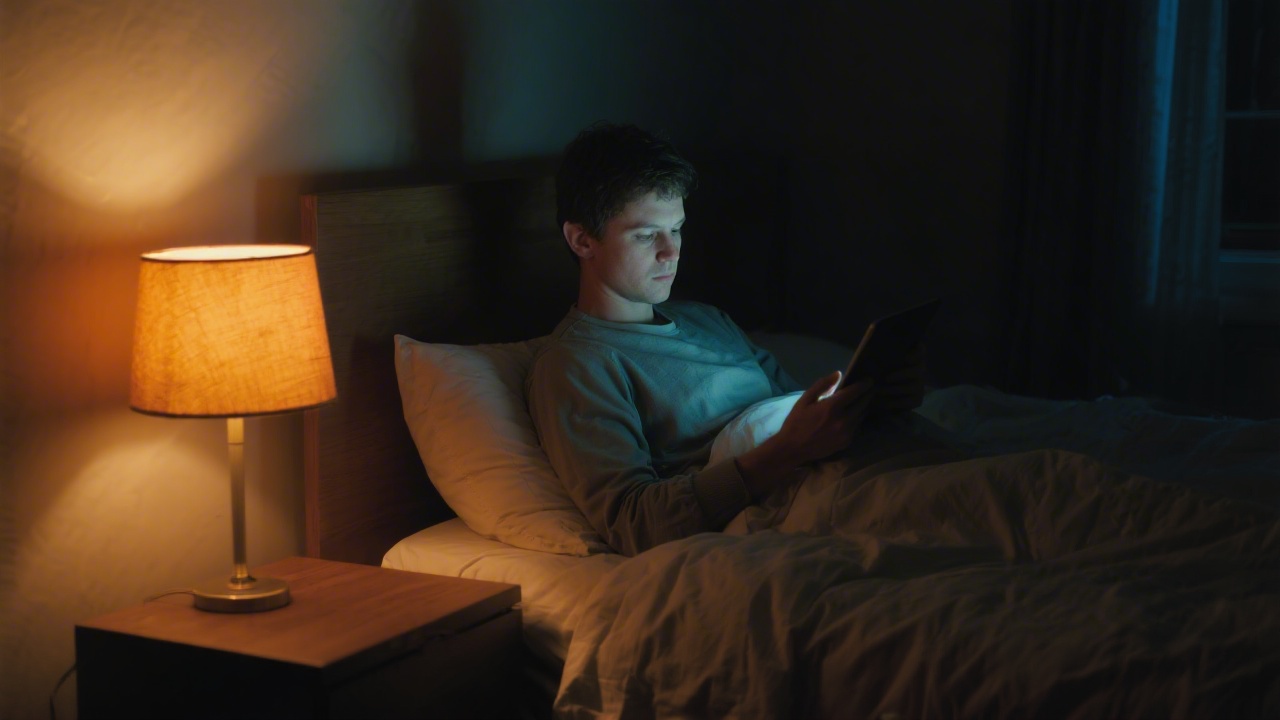
One dimension completely omitted from blue light discussions is content-driven arousal. News, social media, emotionally engaging video content, and work communications elevate cortisol and sympathetic nervous system activity through psychological pathways entirely unrelated to photobiology.
A 2015 study found that the type of evening media use (passive vs. interactive, emotionally neutral vs. arousing) predicted sleep onset latency more strongly than duration of screen use. Calm content on a fully dimmed screen consistently produces better outcomes than high-arousal content at any brightness level.
Evidence-Based Light Recommendations
High Evidence (Do These)
- Morning bright light: 10-30 minutes of natural sunlight or 10,000 lux lamp within 60 minutes of waking. This is among the most evidence-supported sleep interventions available.
- Reduce overall room lighting in the 2 hours before bed. Transition from overhead lights to lamps.
- Use warm-temperature bulbs (2700K or lower) for evening lighting.
- Minimize screen brightness in the hour before sleep.
Weak Evidence (Skip or Treat as Optional)
- Blue light blocking glasses at normal screen brightness: marginal benefit in real-world settings.
- Blue-light screen filters at normal brightness: similar limitations.
- Daytime blue light blocking: no meaningful sleep benefit and may reduce alertness.
Night Mode: Useful But Not the Primary Mechanism
f.lux, iOS Night Shift, and Android Night Mode reduce blue light emission by warming screen color temperature. They are worth using, but primarily because they reduce overall screen luminance and provide a visual signal that evening is approaching, not because blue wavelength reduction is the primary mechanism of benefit.
The Bottom Line
Blue light is a real circadian signal but a smaller one than marketed. The most evidence-supported approach is reducing total evening light exposure and increasing morning light exposure, with blue light filtering as a minor supplementary measure rather than the primary intervention.
No amount of light management compensates for a sleep environment that prevents deep sleep through temperature disruption or inadequate support. Light management is one variable; your sleep surface is another.
Our Top Pick
Saatva Classic — Our #1 Recommended Mattress
Expert-crafted innerspring luxury. 365-night trial, lifetime warranty, free white-glove delivery.
Affiliate disclosure: We may earn a commission if you purchase through our links, at no extra cost to you.
Related: evidence-based sleep biohacking, complete sleep optimization framework, sleep supplements ranked by evidence.
Frequently Asked Questions
Does blue light actually disrupt sleep?
Yes, but the effect is smaller than widely marketed. Blue light (~480nm wavelength) suppresses melatonin production through ipRGC retinal cells. However, the magnitude of this suppression from typical screen devices is modest compared to overall light intensity effects. A 2021 meta-analysis found screen blue light produces a melatonin suppression of approximately 10-23%, while overall brightness effects are larger.
Do blue light blocking glasses work?
The clinical evidence is weak. A 2021 systematic review following Cochrane methodology analyzed 17 randomized controlled trials of blue-light-blocking lenses and found little to no improvement in sleep quality, visual fatigue, or melatonin levels compared to placebo lenses in most controlled trials. The discrepancy between laboratory spectral photobiology findings and real-world intervention studies suggests the effect is smaller than theoretical models predict.
What matters more than blue light for pre-sleep screen use?
Overall light intensity and mental stimulation are both larger factors than blue light specifically. Reducing screen brightness significantly after 9pm is more impactful than blue-light filtering at the same brightness. The psychological activation from content such as news, social media, or emotionally engaging material independently delays sleep onset through cortisol and arousal pathways that blue light filtering does not address.
How many hours before bed should I stop using screens?
Research does not support a specific universal cutoff, but general evidence supports reducing screen brightness and activity level 1-2 hours before your target sleep time. Total darkness and low stimulation in the final 30-60 minutes before sleep appears to be more important than the absolute duration of screen avoidance. Individual sensitivity to evening light varies considerably.
Are there light conditions that actually improve sleep?
Yes. Morning bright light exposure (natural sunlight or a 10,000 lux light therapy lamp for 20-30 minutes within the first hour of waking) is one of the most evidence-supported sleep interventions. Evening transition to warm amber lighting (2700K or lower) supports natural melatonin rise more consistently than blue light filtering alone.