
 by
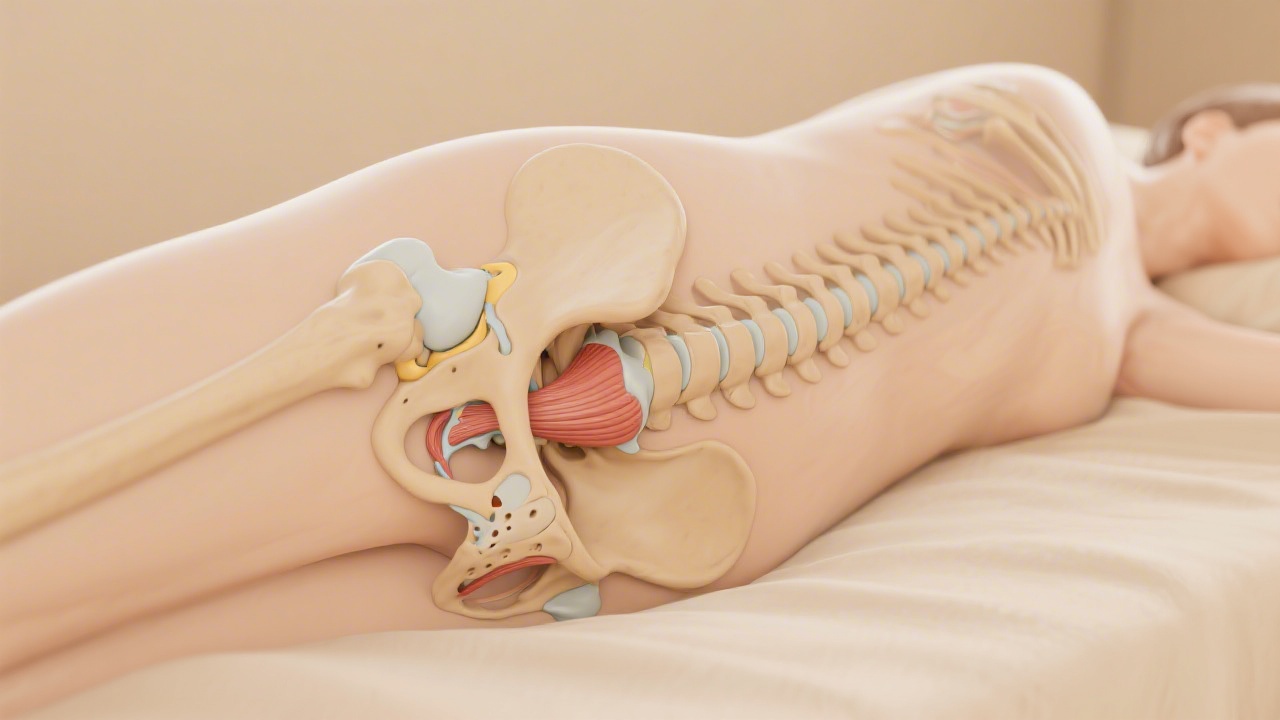
by Hip alignment during sleep is a narrower topic than general spinal alignment, and it is frequently overlooked in mattress selection guides that focus primarily on lumbar support. Yet the hip — specifically the relationship between the femoral head, the acetabulum, the sacroiliac (SI) joint, and the piriformis muscle — is the biomechanical pivot point that connects the lumbar spine to the lower extremities. Misalignment at the hip during six to eight hours of sleep loads these structures in ways that accumulate as sacroiliac pain, piriformis tightness, and anterior hip impingement.
The Hip's Role in Sleep Biomechanics
In the side-lying position, the top hip sits higher than the bottom hip. The challenge for the mattress is to support the bottom hip at the correct height so the pelvis remains level and the SI joint is not stressed. On a mattress that is too firm, the bottom hip is held at full height and the pelvis tilts toward the mattress, placing the bottom-side SI joint in compression and the top-side SI joint in distraction. On a mattress that is too soft, the bottom hip sinks past level, causing the opposite pelvic tilt and loading pattern.
In back sleeping, hip alignment concerns the degree of anterior pelvic tilt. A mattress that is too soft allows the hips to sink, posteriorly tilting the pelvis and reducing lumbar lordosis. A mattress that is too firm elevates the hips slightly, increasing anterior pelvic tilt and exaggerating lumbar extension — compressing the posterior facet joints and increasing tension in the hip flexors.
Sacroiliac Joint and Hip Alignment
The SI joint is a low-mobility joint designed for shock absorption rather than movement, but it is highly sensitive to asymmetric loading. Side sleepers with hip drop — where the top hip drops toward the mattress due to gravity and lack of knee pillow support — create a lateral pelvic tilt that loads the SI joint asymmetrically throughout the night. This is the most common cause of morning SI joint pain in otherwise healthy side sleepers, and it is entirely solvable with the correct mattress firmness and pillow placement.
Piriformis and Hip Internal Rotation
The piriformis muscle runs from the sacrum to the greater trochanter and externally rotates the femur. In side sleeping, if the knee is not supported and the upper leg drops toward the mattress, the femur internally rotates and the piriformis is placed under sustained eccentric stretch. Over time, this creates the piriformis tightness and trigger points associated with deep gluteal pain and pseudo-sciatica (buttock pain radiating down the posterior thigh).
A pillow between the knees at mattress height prevents femoral internal rotation by supporting the upper leg parallel to the mattress surface. This is not a comfort accessory — it is a biomechanical correction for hip alignment.
Mattress Firmness for Hip Alignment
Side Sleepers
The bottom hip must sink to the degree required to keep the pelvis level. For most side sleepers under 150 lbs, a medium-soft surface (4–4.5) achieves this. For 150–200 lb side sleepers, medium (5) is typically correct. For 200–250 lb side sleepers, medium-firm (5.5–6) prevents excessive sinkage while still allowing the hip to reach neutral. Above 250 lbs, a firm mattress (6.5–7) is often needed because the force generated is sufficient to push even a medium mattress past the neutral point.
Back Sleepers
Back sleepers need a mattress firm enough to prevent posterior pelvic tilt but not so firm that it elevates the hips into anterior tilt. Medium-firm (5.5–6.5) covers the widest range of back sleepers. A small pillow under the knees is effective for those with anterior pelvic tilt as a baseline — it reduces hip flexor tension and lowers lumbar extension by 10–15 degrees.
The Knee Pillow: Mechanics and Selection
The purpose of a knee pillow for side sleepers is to maintain the upper femur parallel to the lower femur, which keeps the pelvis level and prevents both hip drop and internal rotation. Optimal knee pillow thickness for most adults is 4–6 inches. A pillow that is too thin allows residual hip drop; a pillow that is too thick creates upward pelvic tilt on the upper side. Contoured knee pillows that fit between the knees and ankles simultaneously are more effective than flat bed pillows because they address both the knee gap and the ankle gap that create compound leg rotation.
The Saatva Classic offers three firmness options that allow matching to the body weight ranges described above, and its lumbar zone reinforcement supports the sacral and SI joint region — particularly relevant for back sleepers with anterior pelvic tilt tendencies.
Internal Resources
- Pressure Points During Sleep: What They Are and How to Relieve Them
- How to Sleep With a Neutral Spine
- How Your Body Weight Should Influence Mattress Selection
Frequently Asked Questions
Key Takeaways
- The Hip's Role in Sleep Biomechanics: a key factor in making the right sleeping decision.
- Sacroiliac Joint and Hip Alignment: a key factor in making the right sleeping decision.
- The Hip's Role in Sleep Biomechanics In the side-lying position, the top hip sits higher than the bottom hip.
- The challenge for the mattress is to support the bottom hip at the correct height so the pelvis remains level and the SI joint is not stressed.
- On a mattress that is too soft, the bottom hip sinks past level, causing the opposite pelvic tilt and loading pattern.
Our Top Pick: Saatva Classic
Voted best luxury innerspring mattress with exceptional lumbar support and white-glove delivery.
Check Price & AvailabilityCan a bad mattress cause sacroiliac joint pain?
Yes, particularly for side sleepers. A mattress that is either too firm or too soft creates a pelvic tilt during sleep that loads the SI joint asymmetrically for hours at a time. Morning SI joint pain that resolves by mid-morning and is worse after nights at home than in other beds strongly suggests the mattress as the contributing variable. The correction is selecting the appropriate firmness for body weight and using a knee pillow to prevent hip drop.
What type of knee pillow is best for hip alignment?
A contoured memory foam knee pillow that fits between both the knees and the ankles is most effective — it prevents both knee gap and ankle gap, which together create compound leg rotation. Flat bed pillows are acceptable but tend to slide out during the night and do not address ankle alignment. Thickness should be 4–6 inches for most adults; heavier or wider-hipped sleepers may need 6–8 inches.
Does hip bursitis affect mattress selection?
Significantly. Trochanteric bursitis (greater trochanter bursitis) is an inflammation of the bursa over the lateral hip — exactly the pressure point that contacts the mattress in side sleeping. A mattress with a thick, conforming comfort layer (memory foam or latex topper) reduces direct pressure on the greater trochanter. Sleeping on the unaffected hip during flare-ups, or temporarily switching to back sleeping, is often necessary until inflammation resolves.
Why does my hip hurt more in the morning than when I go to bed?
Morning hip pain that is worse than evening pain is characteristic of sustained positional stress rather than acute injury. During sleep, the hip is held in a loaded position for hours without the voluntary position changes that occur during waking activity. Inflammation in the SI joint, piriformis, or trochanteric bursa accumulates through the night and peaks upon waking. This pattern strongly points to sleep position or mattress support as the primary variable.
Is it better to sleep with hips above or below shoulder level?
In side sleeping, the goal is for hips and shoulders to be at the same horizontal level — the spine should be parallel to the sleep surface. Hip elevation above shoulder level (from excessive mattress softness at the hip zone) or below shoulder level (from a mattress too firm to allow hip sinkage) both create lateral spinal bowing and asymmetric joint loading. The target is horizontal pelvic position, achieved by matching mattress firmness to body weight.