
 by
by For most of the history of our species, there were no bedrooms, no mattresses, no alarm clocks, and no sleep doctors. Yet the modern epidemic of insomnia, sleep apnea, and chronic sleep deprivation was essentially unknown. What can we learn from studying people who still sleep the way our ancestors did?
Studying Modern Hunter-Gatherers
In 2015, chronobiologist Jerome Siegel and colleagues at UCLA published a landmark study in Current Biology examining sleep patterns in three hunter-gatherer societies with minimal Western contact: the Hadza of Tanzania, the San of Namibia's Kalahari, and the Tsimane of Bolivia's Bolivian Amazon. The findings were striking and have substantially revised scientific assumptions about natural human sleep.
Key findings from Siegel et al. (2015)
- Sleep duration: Subjects slept an average of 6 hours and 25 minutes per night — significantly less than the 7–9 hours often recommended for modern adults.
- Bedtime: All three groups went to sleep on average 3.3 hours after sunset — not at dark, as commonly assumed. Body temperature was the primary sleep trigger, not darkness.
- Wake time: All groups woke shortly before or around sunrise, often at the daily temperature maximum.
- Insomnia: Among 94 individuals studied across all three groups, there were zero reported cases of chronic insomnia. The researchers found no word for insomnia in any of the three languages.
- Seasonality: Sleep duration varied by season — subjects slept about 56 minutes longer in winter than in summer, tracking natural temperature cycles.
What Hunter-Gatherers Don't Do
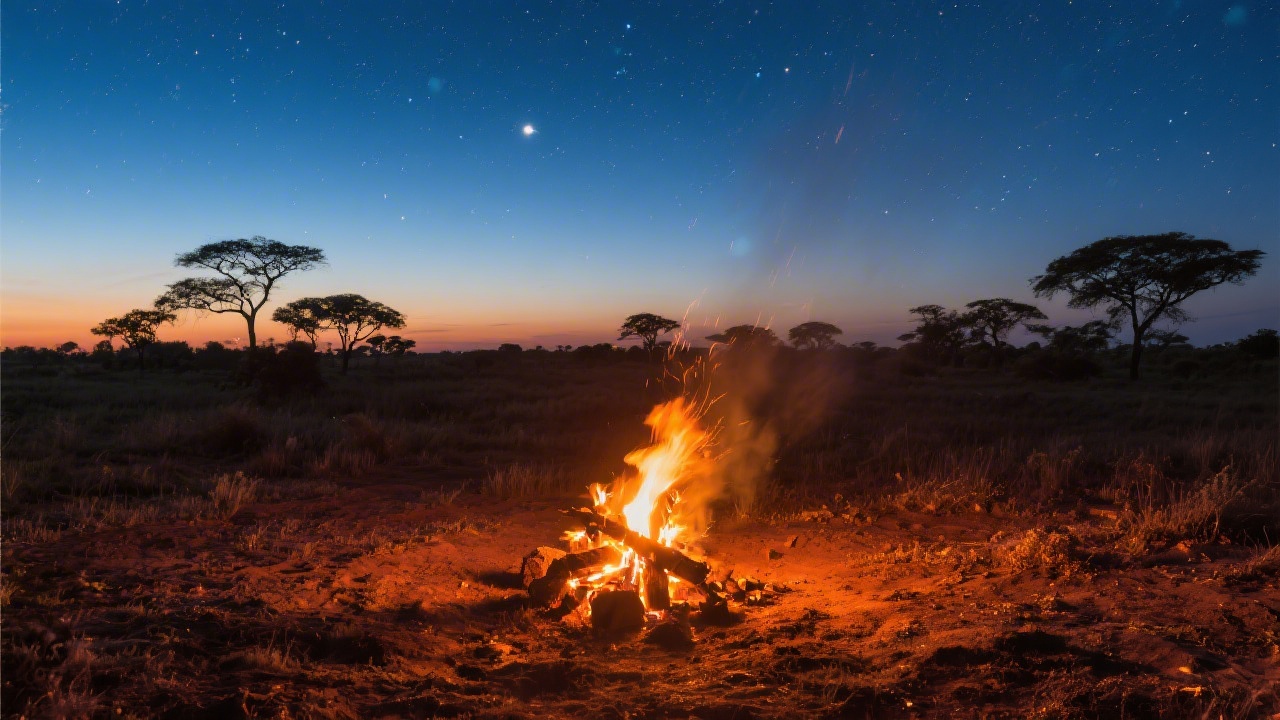
As revealing as what these groups do is what they do not do. They do not use electronic devices before sleep. They have no artificial lighting beyond firelight (which emits primarily long-wavelength red and orange light, minimally suppressing melatonin). They have no climate-controlled bedrooms. They do not eat large meals at night. Their physical activity is distributed throughout the day rather than compressed into a gym session. They sleep with awareness of seasonal temperature change.
The Role of Temperature in Sleep Onset
One of Siegel's most unexpected findings was that darkness alone does not trigger sleep in these populations. The critical signal appears to be dropping ambient temperature. Hunter-gatherers sleep when temperatures decline in the evening and wake when temperatures rise toward the daily peak. This aligns with core body temperature research in sleep science: a drop in core temperature of about 1°C is a prerequisite for sleep onset in all humans.
The practical implication: a cool bedroom (around 65–68°F) is not merely a comfort preference — it may be the most important environmental variable for sleep onset, more important than darkness or noise.
Sleep Quality vs. Sleep Duration
Hunter-gatherers sleep fewer hours than Western recommendations suggest are necessary. They do not appear to suffer for it. This has led some researchers to question whether the emphasis on 8 hours reflects biology or cultural assumption. The key variables, Siegel argues, may be sleep efficiency (the proportion of time in bed actually spent sleeping) and sleep continuity, rather than raw duration.
Western sleepers averaging 7–8 hours in bed often achieve only 6–6.5 hours of actual sleep due to fragmented, inefficient sleep. Hunter-gatherers sleeping 6.5 hours may be spending nearly all of that time in consolidated, high-quality sleep.
Co-Sleeping and Group Security
All three groups studied slept in close proximity to others. The Hadza sleep in mixed-age groups of 20–30 individuals around a shared fire. Not all individuals sleep simultaneously — some remain awake at virtually all times, providing group security. The researchers calculated that in a group of 20 Hadza adults, the probability of all individuals being asleep at the same time for more than 18 consecutive minutes was essentially zero.
This finding supports the evolutionary theory that human sleep evolved under conditions of ongoing social and environmental monitoring — very different from solitary sleep in a sealed bedroom.
What This Tells Us About Modern Sleep Problems
The absence of chronic insomnia in hunter-gatherer populations points toward specific modern disruptions: artificial light exposure after dark, irregular sleep schedules, sedentary daytime behavior, thermally controlled environments that prevent the temperature cues sleep onset depends on, and the social isolation of modern sleeping arrangements. Addressing these factors — even partially — produces measurable sleep improvements without medication.
Ready to improve your sleep surface?
The right mattress makes a measurable difference in sleep quality, temperature regulation, and morning recovery. The Saatva Classic is our top-rated pick for most sleepers.
Frequently Asked Questions
Key Takeaways
- Studying Modern Hunter-Gatherers: a key factor in making the right sleeping decision.
- Key findings from Siegel et al. (2015): a key factor in making the right sleeping decision.
- For most of the history of our species, there were no bedrooms, no mattresses, no alarm clocks, and no sleep doctors.
- Yet the modern epidemic of insomnia, sleep apnea, and chronic sleep deprivation was essentially unknown.
- What can we learn from studying people who still sleep the way our ancestors did?
Our Top Pick: Saatva Classic
Voted best luxury innerspring mattress with exceptional lumbar support and white-glove delivery.
Check Price & AvailabilityHow many hours did prehistoric humans sleep?
Research by Jerome Siegel at UCLA on modern hunter-gatherer groups (Hadza, San, Tsimane) found they sleep an average of 6 hours and 25 minutes per night — significantly less than the 7–9 hours typically recommended. Crucially, these groups show no chronic insomnia despite shorter sleep duration.
Did hunter-gatherers have insomnia?
Among the 94 individuals studied across three hunter-gatherer societies, researchers found zero reported cases of chronic insomnia. None of the three languages studied contained a word for insomnia. Researchers attribute this to natural sleep triggers (temperature-based rather than clock-based), consistent activity levels, and no artificial light.
What triggers sleep in hunter-gatherer populations?
Dropping ambient temperature — not darkness — appears to be the primary sleep trigger in hunter-gatherer populations. Groups typically go to bed 3+ hours after sunset, when nighttime temperatures drop significantly. This aligns with sleep science findings that core body temperature decline is essential to sleep onset.
Did prehistoric humans sleep alone?
No. Modern hunter-gatherer research shows that humans sleep communally, in mixed-age groups of 20–30 individuals. Not everyone sleeps simultaneously — the probability of an entire Hadza group sleeping at once for more than 18 minutes was essentially zero. Group sleeping likely evolved as a security and warmth adaptation.
Why do I sleep worse than hunter-gatherers?
Key differences researchers have identified: artificial light after dark suppresses melatonin; thermally controlled bedrooms remove the temperature cues that trigger natural sleep onset; irregular schedules disrupt circadian timing; sedentary daytime behavior reduces sleep pressure; and social isolation removes the group sleep dynamic. Addressing even two or three of these factors can significantly improve sleep quality.