
 by
by Teenagers are biologically programmed to go to sleep later and wake later than adults or children. This is not a character flaw. The circadian phase delay that occurs during puberty is documented, hormone-driven, and affects the majority of adolescents globally. The problem is that school schedules, phone addiction, and bedroom environments compound a biological challenge into a chronic sleep crisis. Environmental modifications can partially compensate for what scheduling cannot fix.
Our Recommendation
Saatva Youth — designed to support growing teen bodies (up to 250 lbs)
Affiliate disclosure: We may earn a commission if you purchase through our links at no extra cost to you.
The Biology First
During puberty, the timing of melatonin secretion shifts approximately 2 hours later. Where a 10-year-old child begins producing sleep-inducing melatonin at 8 to 9 pm, a 16-year-old's brain begins the same process at 10 to 11 pm. Their optimal sleep window is approximately 11 pm to 9 am. A 7:15 am school start time cuts this window to 6.25 hours, producing the equivalent of jet lag every school day.
The American Academy of Pediatrics has recommended that middle and high schools start no earlier than 8:30 am since 2014. Implementation has been slow. Until school start times catch up with the biology, bedroom optimization becomes a damage-limitation strategy.
The Phone Problem
A 2019 JAMA Pediatrics study found that teenagers who used phones within 30 minutes of bedtime took 39 minutes longer to fall asleep than those who did not. Phones in the bedroom create three sleep problems simultaneously: blue light from screens suppresses melatonin, social notifications trigger arousal responses, and the behavioral habit of scrolling delays sleep onset.
The most effective intervention, supported by multiple studies, is physical separation: a charging station outside the bedroom. Not a charging station inside the bedroom with a willpower commitment. Outside the room. This requires parental enforcement for most adolescents and consistent follow-through. Teens who negotiate phone-in-room compromises consistently underperform those with hard boundaries.
Bedroom Environment Modifications
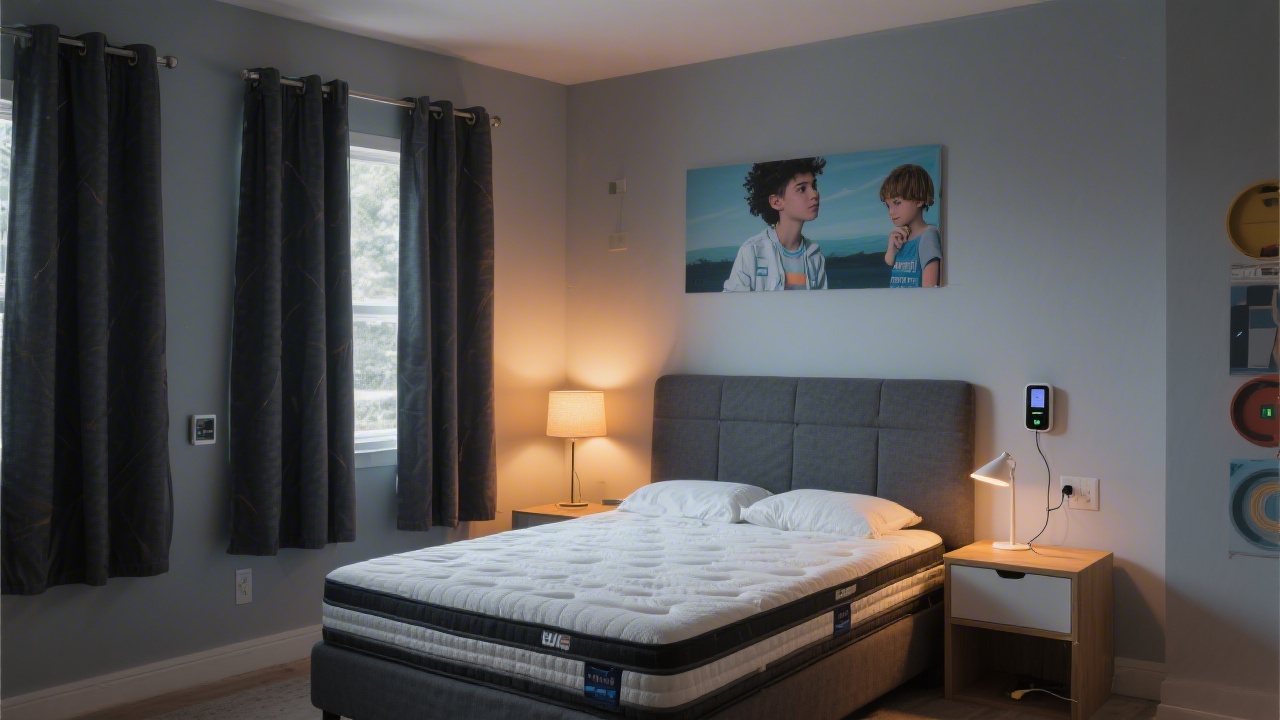
Blackout curtains: Teenagers with east-facing bedrooms frequently experience early waking from morning light, even when their delayed circadian phase would allow later sleep. Blackout curtains that block 99% of light can recover 30 to 60 minutes of morning sleep.
Temperature: The optimal sleep onset temperature is 65 to 68 degrees Fahrenheit. Teenagers, who often run warmer due to metabolic changes in puberty, frequently sleep better with room temperatures slightly cooler than the household baseline. A ceiling fan or programmable thermostat set to drop at bedtime addresses this.
Noise management: Teens with younger siblings or in loud households benefit from white noise or a box fan. Unlike young children, teenagers can tolerate light music or rain sounds without the strict 50 dB ceiling appropriate for infants.
Lighting for evening use: Replace overhead bright lighting in teen bedrooms with warm-spectrum (2700K or lower) lamps used exclusively after 8 pm. Overhead lighting above 4000K in the evening delays melatonin onset by up to 90 minutes. This is a low-cost, high-impact change that many parents overlook.
Mattress Considerations for Teenagers
Adolescent bodies change rapidly, and mattress suitability changes with them. A 13-year-old weighing 100 pounds and a 17-year-old weighing 180 pounds have different firmness requirements. Generally, teenagers benefit from medium to medium-firm support that accommodates the developing spine without the excessive sink of soft memory foam.
Teen athletes in particular need mattresses that support recovery: pressure relief at shoulders and hips, core support for spinal alignment, and temperature neutrality to avoid night sweats that fragment sleep. Innerspring hybrids perform well here.
Youth-specific mattresses designed for this transition period often support up to 250 pounds, handle more aggressive use than adult mattresses, and are priced below full adult mattress ranges.
Weekend Sleep: The Catch-22
Most teenagers sleep in significantly on weekends in an attempt to recover from weekday sleep debt. This is rational but counterproductive. Sleeping in past 2 hours of the weekday wake time delays the circadian phase further, making Monday mornings even harder. Limit weekend sleep-in to 1 hour beyond the normal wake time as a compromise between recovery and circadian stability.
Frequently Asked Questions
Why do teenagers stay up so late?
Adolescence involves a biological shift in circadian phase called sleep phase delay. The timing of melatonin release shifts approximately 2 hours later during puberty, driven by hormonal changes. This is not behavioral laziness. Teens' brains genuinely do not produce the melatonin signal for sleep until later in the evening. School start times that require waking before 8 am place most teenagers in chronic sleep deprivation.
How much sleep do teenagers need?
The National Sleep Foundation and AAP recommend 8 to 10 hours for teenagers aged 13 to 18. CDC data shows that 72% of high school students fail to meet this threshold. Chronic insufficient sleep in adolescents is associated with higher rates of depression, obesity, sports injury, and reduced academic performance.
Do blue light glasses help teens sleep?
Blue light glasses have limited evidence for sleep improvement. A 2021 Cochrane review found mixed results. More reliably effective is simply removing screens from the bedroom entirely or enforcing a hard cutoff 60 to 90 minutes before lights out. The behavioral use of phones in bed is a larger issue than the blue light wavelength specifically.
What mattress firmness is best for teenagers?
Teens generally benefit from a medium to medium-firm mattress. Adolescent spines are still developing and require adequate support to prevent compensation patterns. Heavy teen athletes may prefer medium-firm. Teens under 130 pounds who sleep on their side may do well with medium or medium-soft to allow hip and shoulder sinkage for spinal neutrality.
Should teenagers have TVs in their bedrooms?
No. National Sleep Foundation surveys consistently show that teens with televisions in their bedrooms sleep 30 minutes less per night on average than those without. The effect is compounded by smartphones. The bedroom environment should be reserved for sleep; screen-based entertainment in the bedroom is the strongest single modifiable risk factor for teen sleep insufficiency.
Key Takeaways
Teen Bedroom Sleep Optimization is a topic that depends heavily on individual needs and preferences. The most important thing is to consider your specific situation — your body type, sleep position, and personal comfort preferences — before making any decisions. When in doubt, take advantage of trial periods to test before committing.