
 by
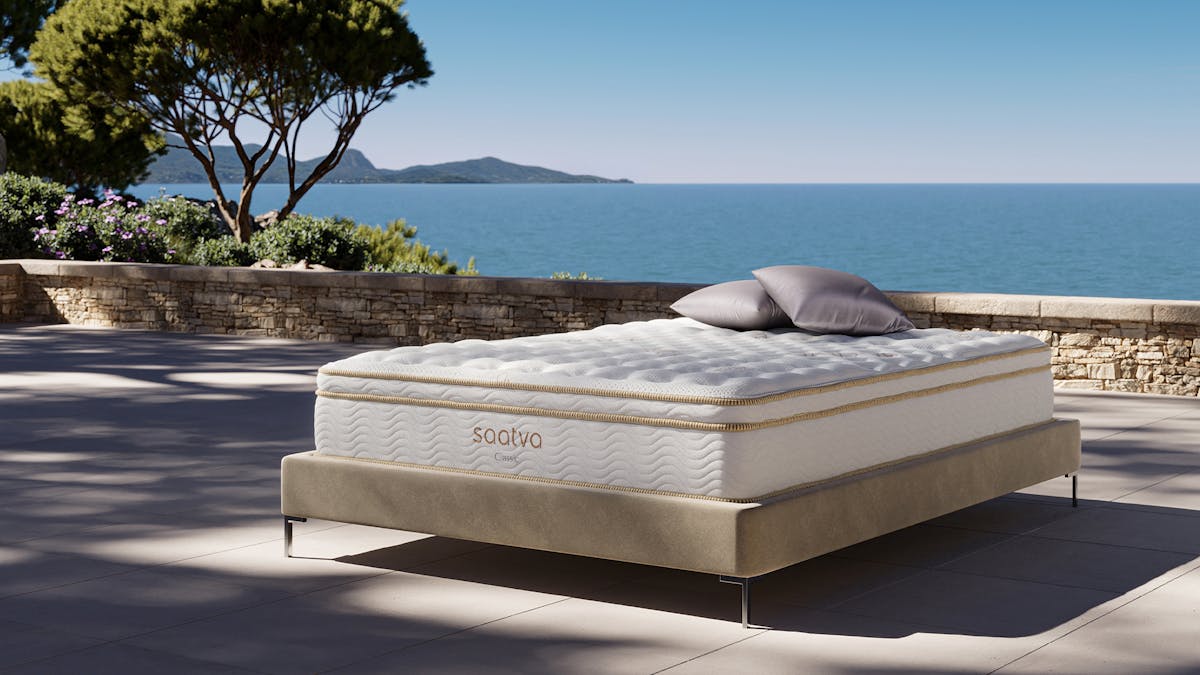
by For formaldehyde concerns, choose a mattress with natural latex or certified organic materials and third-party emissions testing. Our top pick is the Saatva Latex Hybrid: GOLS-certified Talalay latex with no adhesive-bonded foam layers eliminates the main formaldehyde source in conventional mattresses. The Amerisleep AS3 is the best CertiPUR-US certified foam option for those who prefer memory foam over latex.
Saatva Latex Hybrid
9.4/10
- GOLS-certified natural Talalay latex, GOTS-certified organic cotton and wool cover
- No adhesive-bonded polyurethane foam layers, the primary formaldehyde source in conventional mattresses
- Zoned 5-region Talalay latex adapts support zone by zone
- 365-night trial, free White Glove delivery, lifetime warranty
- Bouncy latex transfers more motion than foam, not ideal for restless-partner situations
- $99 return fee and one firmness option only
Natural Talalay latex skips the UF-resin adhesives and synthetic foam precursors that generate formaldehyde. Backed by GOLS and GOTS third-party certification, this is the most defensible choice for anyone prioritizing indoor air quality.
Why formaldehyde shows up in mattresses
Formaldehyde is a Group 1 human carcinogen (IARC) that appears as an off-gas byproduct in several manufacturing and finishing processes. It is not deliberately added as an ingredient. The main sources in conventional mattresses are:
- Adhesives: urea-formaldehyde (UF) resins bond foam layers and attach cover materials. Off-gassing continues as resins cure and degrade over time. Water-based adhesives are the safer alternative, but the switch is not universal.
- Fabric finishing treatments: wrinkle-resistant and crease-resistant finishes on polyester-cotton covers use formaldehyde-releasing agents that bond to fibers and release residues.
- Foam processing byproducts: some polyurethane foam chemistries generate formaldehyde as a secondary breakdown product of plasticizers and stabilizers, meaning emissions are not limited to initial off-gassing.
- Fire retardant treatments: some older fire barriers used formaldehyde-containing compounds. Regulatory pressure (California TB 117-2013) has shifted most manufacturers to formaldehyde-free alternatives, but independent verification matters.
A mattress is a direct skin-contact surface for 6 to 8 hours. That sustained exposure time is why lower thresholds matter specifically for sleep products, even when bedroom air concentrations are well below occupational standards.
The certification hierarchy for formaldehyde
| Certification | Formaldehyde limit | Scope |
|---|---|---|
| GREENGUARD Gold | 0.0073 ppm | Whole product, strictest consumer standard |
| GOLS (Global Organic Latex Standard) | No synthetic latex, no UF adhesives | Latex layer certification |
| GOTS (Global Organic Textile Standard) | No formaldehyde-releasing textile treatments | Fiber, yarn, fabric |
| OEKO-TEX Standard 100 | Cover fabric tested for formaldehyde residues | Fabric only |
| CertiPUR-US | 0.5 ppm (test chamber) | Foam only, not cover or adhesives |
| WHO indoor air guideline | 0.08 ppm (30-min avg) | General indoor air reference |
CertiPUR-US is the most common foam certification and a useful baseline, but it only covers the foam layer, not cover fabrics or adhesive bonds. GREENGUARD Gold covers the whole product. Natural latex with GOLS and GOTS certification eliminates the most formaldehyde-prone materials entirely.
Low-formaldehyde mattress picks
Amerisleep AS3
9.0/10
- CertiPUR-US certified foam, tested for formaldehyde and other VOCs
- Plant-based Bio-Pur open-cell foam replaces a portion of petroleum feedstock with plant-derived inputs
- HIVE 5-zone support layer for pressure relief and spinal alignment
- 20-year warranty, 100-night sleep trial
- CertiPUR-US covers foam only, not cover fabrics or adhesive chemistry
- Softer edges than a coil hybrid
CertiPUR-US certification confirms the foam meets VOC limits including formaldehyde. Not the strictest whole-product standard, but the AS3 is a solid, well-tested choice for anyone who prefers a memory foam feel and wants third-party chemical verification.
Saatva Classic
8.8/10
- Organic cotton quilted cover, CertiPUR-US certified foam layers
- Dual-coil construction means fewer adhesive-bonded foam interfaces than an all-foam bed
- 365-night trial, free White Glove delivery, no return fee on exchanges
- Three firmness options (Plush Soft, Luxury Firm, Firm)
- $99 return fee if returning outright during trial
- Heavy and not compressed in a box
The Saatva Classic uses organic cotton on the cover surface and CertiPUR-US certified foam. Its innerspring core reduces the total volume of foam (and thus adhesive bonding) compared to a full-foam mattress, which is a practical formaldehyde-reduction factor.
Mattress types by formaldehyde risk
- Natural latex (lowest risk): single-piece or layer construction uses natural latex without synthetic foam or UF-resin adhesives. Different VOC profile from foam. GOLS certification is the most reliable verification.
- Innerspring hybrid: less total foam volume than all-foam, reducing adhesive bonding area. Organic cotton covers add GOTS-verifiable protection for the contact surface.
- All-foam (CertiPUR-US certified, lowest-risk within category): foam itself is tested for formaldehyde, but certification does not cover cover fabrics or adhesive chemistry between layers.
- Multi-layer foam without certification (highest risk): multiple adhesive bonds using unverified adhesive chemistry, cover fabrics with potentially untested wrinkle-resistant finishes.
Practical risk reduction
- Ventilate on delivery: off-gassing peaks in the first 24 to 72 hours. Unbox in a ventilated room and let the mattress air for at least 72 hours before use. See our mattress off-gassing guide for full guidance.
- Use an OEKO-TEX certified cotton cover: creates a physical and chemical barrier between the mattress surface and your skin.
- Prioritize whole-product certification: GREENGUARD Gold covers formaldehyde at the 0.0073 ppm level for the entire mattress assembly, not just individual materials.
- Ask about adhesive chemistry: reputable brands specify whether bonding uses water-based or UF-resin adhesives. Any brand unwilling to answer is a signal.
- Ventilate the bedroom: increasing air exchange with outdoor air is the most effective way to reduce steady-state indoor VOC concentrations regardless of mattress choice.
For a broader look at which manufacturers are transparent about material sourcing and chemistry, see our guide to sustainable mattress brands and our OEKO-TEX bedding guide.
Bottom line
Formaldehyde in mattresses is a real but manageable concern. For most healthy adults in a ventilated room, emissions from a certified foam mattress stay well below harmful concentrations. For anyone sensitive to VOCs, spending long hours in a poorly ventilated bedroom, or simply wanting the highest-assurance choice, natural latex with GOLS and GOTS certification removes the main emission sources by design. The Saatva Latex Hybrid is the top pick here. The Amerisleep AS3 is the best-verified foam option for anyone who prefers that feel.
GREENGUARD Gold (strictest, whole product) > GOLS latex + GOTS cover (no synthetic foam baseline) > CertiPUR-US + OEKO-TEX (foam + cover separately certified) > CertiPUR-US alone (foam only) > no certification.
Frequently asked questions
Do all mattresses contain formaldehyde?
Not all. Natural latex mattresses with GOLS certification use no UF-resin adhesives or synthetic foam precursors. Mattresses with GREENGUARD Gold certification have been tested at whole-product level and meet strict VOC limits including formaldehyde. Many conventional foam mattresses do off-gas measurable formaldehyde, particularly new ones in the first few days after unboxing.
Is CertiPUR-US certification enough for formaldehyde?
It is a useful baseline for the foam component. CertiPUR-US tests foam to 0.5 ppm formaldehyde, which is better than no testing. It does not cover cover fabrics or the adhesives used to bond foam layers, which are separate formaldehyde sources. For comprehensive assurance, look for GREENGUARD Gold (whole product) or natural materials with GOLS and GOTS certification.
How long does formaldehyde off-gas from a new mattress?
The majority of initial off-gassing from adhesives and foam finishes occurs in the first 72 hours. Allowing the mattress to air in a ventilated room for three to seven days before use significantly reduces initial VOC concentrations. Some secondary off-gassing from foam degradation products can occur over the product lifetime, though at much lower levels than the initial peak.
Are natural latex mattresses truly formaldehyde-free?
GOLS-certified natural latex contains no UF-resin adhesives or synthetic polymer precursors, eliminating the main formaldehyde sources in conventional mattresses. Natural latex does off-gas its own VOC profile (including some natural rubber compounds) distinct from formaldehyde. For most people, the natural latex VOC profile is less concerning than formaldehyde. If you have a known latex allergy, that is a separate consideration.
Saatva Latex Hybrid
9.4/10
GOLS-certified Talalay latex, GOTS organic cotton and wool cover, no UF-resin adhesives, 365-night trial, and lifetime warranty. The most complete low-formaldehyde mattress for anyone prioritizing indoor air quality in 2026.
This guide is part of our Mattress Buying Guide hub.